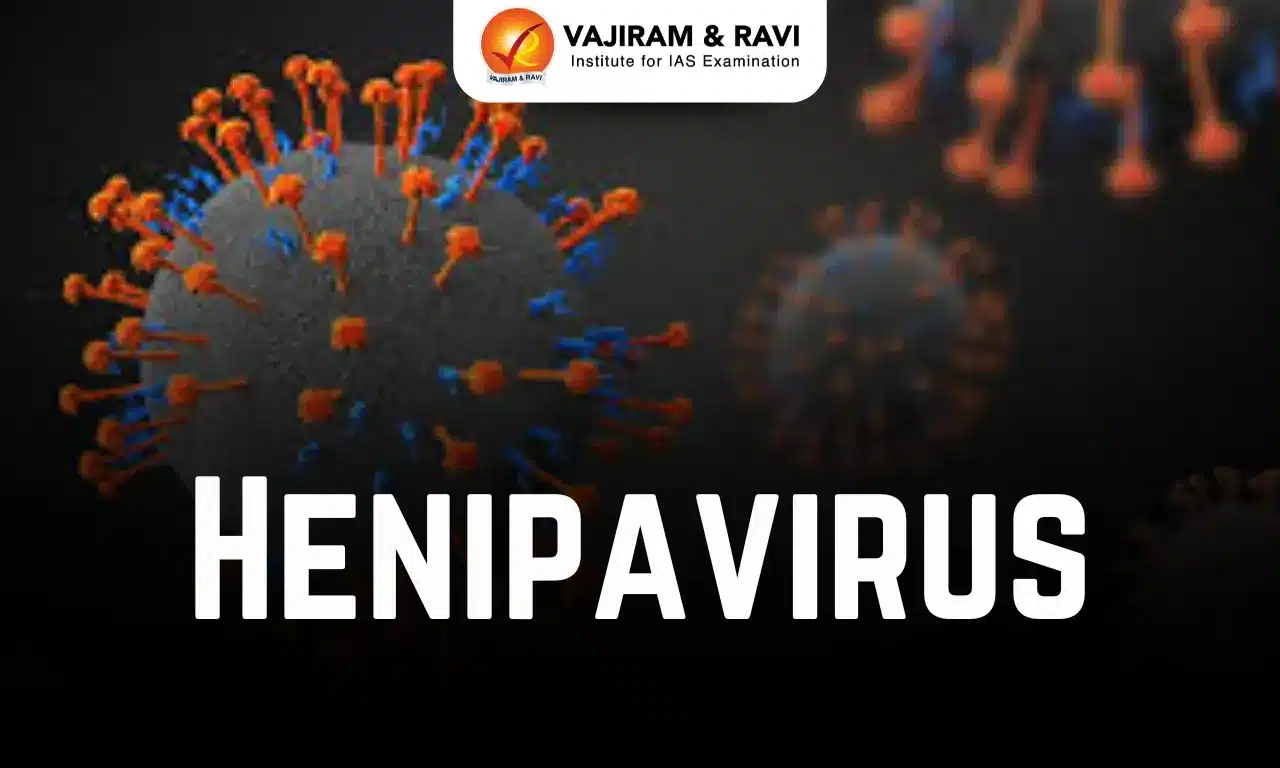
Henipavirus Latest News
Camp Hill virus, a henipavirus related to Nipah, has been recently detected in North America, raising concerns of a potential outbreak.
About Henipavirus
- Henipaviruses (family Paramyxoviridae) are zoonotic, negative-sense RNA viruses.
- Fruit bats (Pteropus species, also called ‘flying foxes’) are the natural hosts of Henipaviruses.
- Henipaviruses can cross species barriers, infecting various mammals, including humans.
- They often cause severe respiratory illness and encephalitis and are associated with high case fatality rates.
- The two most notable henipaviruses are Hendra virus and Nipah virus.
- Hendra virus, first identified in Australia, has caused outbreaks with mortality rates up to 70%.
- The Nipah virus has been linked with numerous outbreaks in Southeast Asia, particularly in Malaysia and Bangladesh, with case-fatality rates estimated at 40%–75% depending on surveillance and clinical management.
- Why are henipaviruses so deadly?
- It lies in their ability to encode several proteins which block the innate immune response in infected animals and humans.
- These inhibit the cell’s response to viral infection, and allow viral replication.


Henipavirus Transmission
- Direct contact with infected animals (e.g., bats, horses, pigs).
- Consumption of contaminated food or water.
- Human-to-human transmission through bodily fluids, close contact, or respiratory droplets.
Henipavirus Symptoms
- Common symptoms include dizziness, headache, fever, and myalgias.
- However, fatality often occurs when the disease progresses to severe encephalitis and symptoms like confusion, abnormal reflexes, seizures, and coma occur.
Henipavirus Treatment
- Treatment is symptomatic, and no vaccine or antiviral drug has been developed so far to treat the disease.
Henipavirus FAQs
Q1. Is Henipavirus zoonotic?
Ans. Yes, Henipavirus is zoonotic, meaning it can be transmitted from animals to humans.
Q2. What is the incubation period of Henipavirus?
Ans. Among humans, the incubation periods are 4–20 days and 5–12 days, for Nipah and Hendra, respectively.
Q3. What does the Nipah virus do to humans?
Ans. Infection with Nipah virus can cause mild to severe disease, including encephalitis and potentially death.
Source: N18

 Last updated on Oct, 2026
→ UPSC 2027 Notification will be released on 13 January 2027 at upsconline.nic.in.
→ Check Nobel Prize 2026 Winners List here.
→ Download PIB PRiSM Monthly Magazine 2026 here.
→ Check UPSC Monthly Current Affairs Magazine The Recitals here.
→ Check out the latest UPSC Syllabus here.
→ Download UPSC Model Answers for Mains 2026
→ UPSC Mains Question Paper 2026 is out now for Essay & GS Paper 1, 2, 3 & 4.
→ UPSC Calendar 2027 has been released.
→ Enroll in Vajiram & Ravi’s UPSC Mains Test Series 2027 for structured answer writing practice, expert evaluation, and exam-oriented feedback.
→ Join Vajiram & Ravi’s UPSC Mentorship Program 2027 for personalized guidance, strategy planning, and one-to-one support from experienced mentors.
→ Go through the UPSC Mains Previous Year Papers to enhance your preparation.
→ UPSC has released UPSC Toppers List 2025 with the Civil Services final result on its official website.
→ Also check Best UPSC Coaching in India