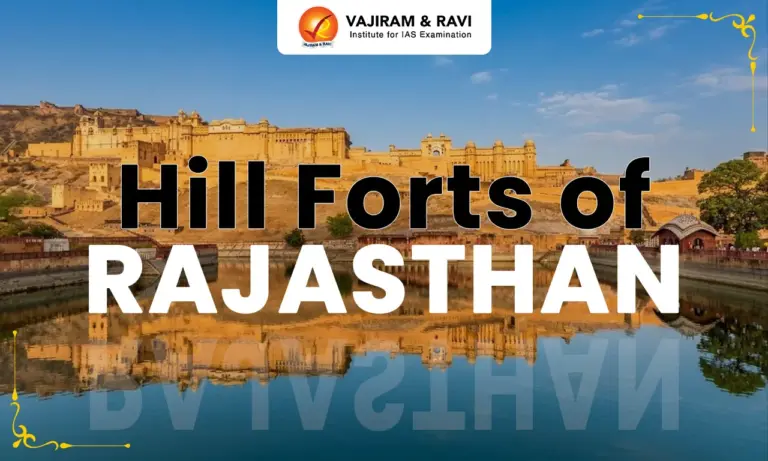
The Hill Forts of Rajasthan are a group of six historic forts that represent the military strength, architecture and cultural heritage of the Rajput kingdoms. Located across different landscapes of Rajasthan, these forts used hills, forests, rivers and deserts as natural defences. Together, Chittorgarh, Kumbhalgarh, Ranthambore, Gagron, Amer and Jaisalmer Forts were recognised as a UNESCO World Heritage Site in 2013. They contain palaces, temples, markets, water structures and other remains that reflect the social and cultural life of the Rajput period.
Hill Forts of Rajasthan History and UNESCO Significance
- The Hill Forts of Rajasthan reflect the development of Rajput centres of power between the 8th and 18th centuries. The forts were not simply military structures but also served as centres of administration, residence, trade, religion and culture.
- The six forts were carefully built according to the natural landscape of their surroundings. Hills, forests, rivers and deserts were used as additional layers of defence, reducing the need to depend entirely on artificial fortifications.
- The forts contain a combination of massive defensive walls, gateways, palaces, temples, residential areas, trading spaces and water-harvesting structures.
- This shows how these fortified settlements were designed to function even during prolonged periods of conflict or siege.
- The Hill Forts of Rajasthan were inscribed as a UNESCO World Heritage Site in 2013. Their importance lies in the way they demonstrate Rajput military architecture as well as the development of a distinctive architectural tradition influenced by different regional styles.
Six Hill Forts of Rajasthan
The six Hill Forts of Rajasthan represent the distinctive military architecture, cultural heritage and landscape adaptation of the Rajput period. Each fort was built in a different geographical setting and reflects unique features of defence, settlement planning, architecture and water management. The six forts – Chittorgarh, Kumbhalgarh, Ranthambore, Gagron, Amer and Jaisalmer are discussed below.
Chittorgarh Fort
- Chittorgarh Fort was the historic stronghold and former capital of the Mewar kingdom. Built on a prominent hill, the fort is known for its massive defensive structures, gateways, temples and towers.
- The fort is closely associated with the history and traditions of Mewar and is remembered for its role in several important episodes of Rajput history.
- Its Vijay Stambh and Kirti Stambh are among its prominent architectural features.
Kumbhalgarh Fort
- Kumbhalgarh Fort, located in the Aravalli Range, was developed under Rana Kumbha in the 15th century. Its strong defensive position and massive walls made it an important fort of Mewar.
- The fort is famous for its extensive defensive wall, which stretches for more than 30 kilometres. It contains palaces, temples, reservoirs and other structures, including the Badal Mahal.
- Kumbhalgarh is also associated with Maharana Pratap, who was born at the fort, adding to its historical importance.
Ranthambore Fort
- Ranthambore Fort is located in Sawai Madhopur within the landscape of the Ranthambore region. Its position on a hill surrounded by forests provided a strong natural defence.
- The fort combines historic fortifications, temples, gateways and other structures with the surrounding natural environment. Its location makes it an important example of how Rajput forts adapted to forested terrain.
Gagron Fort
- Gagron Fort is located in Jhalawar and is particularly notable for its unique setting. It is surrounded by the Ahu and Kali Sindh rivers, giving it the character of a water-protected fort.
- The fort demonstrates how rivers and surrounding terrain could be incorporated into a defensive system. Its architecture also reflects the interaction of different cultural and architectural traditions.
Amer Fort
- Amer Fort, also known as Amber Fort, is located near Jaipur and stands on the Aravalli hills. It was developed under Raja Man Singh I and later expanded by successive rulers.
- The fort is known for its impressive courtyards, gateways, palaces and decorative elements. Its architecture reflects a combination of Rajput and Mughal influences, making it one of Rajasthan’s most recognised historic forts.
Jaisalmer Fort
- Jaisalmer Fort, popularly known as the Golden Fort, stands on a hill in the middle of the Thar Desert. It was founded by Rawal Jaisal in 1156 and is an outstanding example of a fort adapted to a desert environment.
- Unlike many historic forts that survive mainly as monuments, Jaisalmer Fort continues to have a living settlement, with homes, temples, shops and other establishments within its fortified area.


Architectural and Natural Features of Hill Forts of Rajasthan
- One of the most important features of the Hill Forts of Rajasthan is their use of natural geography for defence. Chittorgarh and Kumbhalgarh use elevated terrain, Ranthambore benefits from forests, Gagron uses rivers, and Jaisalmer is adapted to the desert landscape.
- The forts were more than isolated military structures. They often contained palaces, temples, markets, residential areas and administrative buildings, creating self-contained settlements capable of supporting large populations.
- Water management was another important feature. Reservoirs, tanks, channels and other water-harvesting structures helped store and manage water, particularly during periods of conflict or limited rainfall.
- The architecture of these forts reflects Rajput traditions along with influences from neighbouring and contemporary architectural styles. Their decorative work, temples, palaces, gateways and defensive structures together demonstrate the artistic and engineering skills of their builders.
Significance of Hill Forts of Rajasthan
- The Hill Forts of Rajasthan are significant examples of Rajput military architecture, showing how forts were designed to protect political centres and populations from external attacks.
- These forts demonstrate the smart use of natural landscapes for defence. Hills, forests, rivers and deserts were carefully integrated into the fortification system, making each fort suited to its geographical setting.
- The forts were not merely military structures. They developed as self-contained centres of administration, residence, trade and culture, containing palaces, temples, markets and other public spaces.
- Their extensive water-harvesting and storage systems highlight the advanced understanding of water management in Rajasthan. Reservoirs, tanks and other structures helped communities survive periods of drought and prolonged sieges.
- The forts also reflect the rich cultural life of the Rajput kingdoms. Temples, palaces, sculptures, paintings and decorative elements show the development of art, architecture, religion and courtly traditions.
- The Hill Forts of Rajasthan were inscribed as a UNESCO World Heritage Site in 2013, recognising their outstanding cultural value and their importance in understanding the evolution of Rajput architecture and fortified settlements.
- From a geographical perspective, the forts are important because they demonstrate how architecture can adapt to different physical environments, from the forests of Ranthambore and rivers around Gagron to the desert landscape of Jaisalmer.

 Last updated on Oct, 2026
→ UPSC 2027 Notification will be released on 13 January 2027 at upsconline.nic.in.
→ Check Nobel Prize 2026 Winners List here.
→ Download PIB PRiSM Monthly Magazine 2026 here.
→ Check UPSC Monthly Current Affairs Magazine The Recitals here.
→ Check out the latest UPSC Syllabus here.
→ Download UPSC Model Answers for Mains 2026
→ UPSC Mains Question Paper 2026 is out now for Essay & GS Paper 1, 2, 3 & 4.
→ UPSC Calendar 2027 has been released.
→ Enroll in Vajiram & Ravi’s UPSC Mains Test Series 2027 for structured answer writing practice, expert evaluation, and exam-oriented feedback.
→ Join Vajiram & Ravi’s UPSC Mentorship Program 2027 for personalized guidance, strategy planning, and one-to-one support from experienced mentors.
→ Go through the UPSC Mains Previous Year Papers to enhance your preparation.
→ UPSC has released UPSC Toppers List 2025 with the Civil Services final result on its official website.
→ Also check Best UPSC Coaching in India
Hill Forts of Rajasthan FAQs
Q1. What are the Hill Forts of Rajasthan?+
Q2. Which are the six Hill Forts of Rajasthan?+
Q3. When were the Hill Forts of Rajasthan declared a UNESCO World Heritage Site?+
Q4. Why are the Hill Forts of Rajasthan important?+
Q5. Which Hill Fort of Rajasthan is famous for its massive wall?+
Q6. Which Hill Fort of Rajasthan is known as the Golden Fort?+
Q7. Which Hill Fort of Rajasthan is surrounded by rivers?+
Q8. Which Hill Fort of Rajasthan is located within a forested landscape?+
Q9. What is the main architectural feature of the Hill Forts of Rajasthan?+
Q10. What is the historical significance of the Hill Forts of Rajasthan?+
Tags: art and culture art and culture notes hill forts of rajasthan history history notes