Himalayan Long-Tailed Myotis Latest News
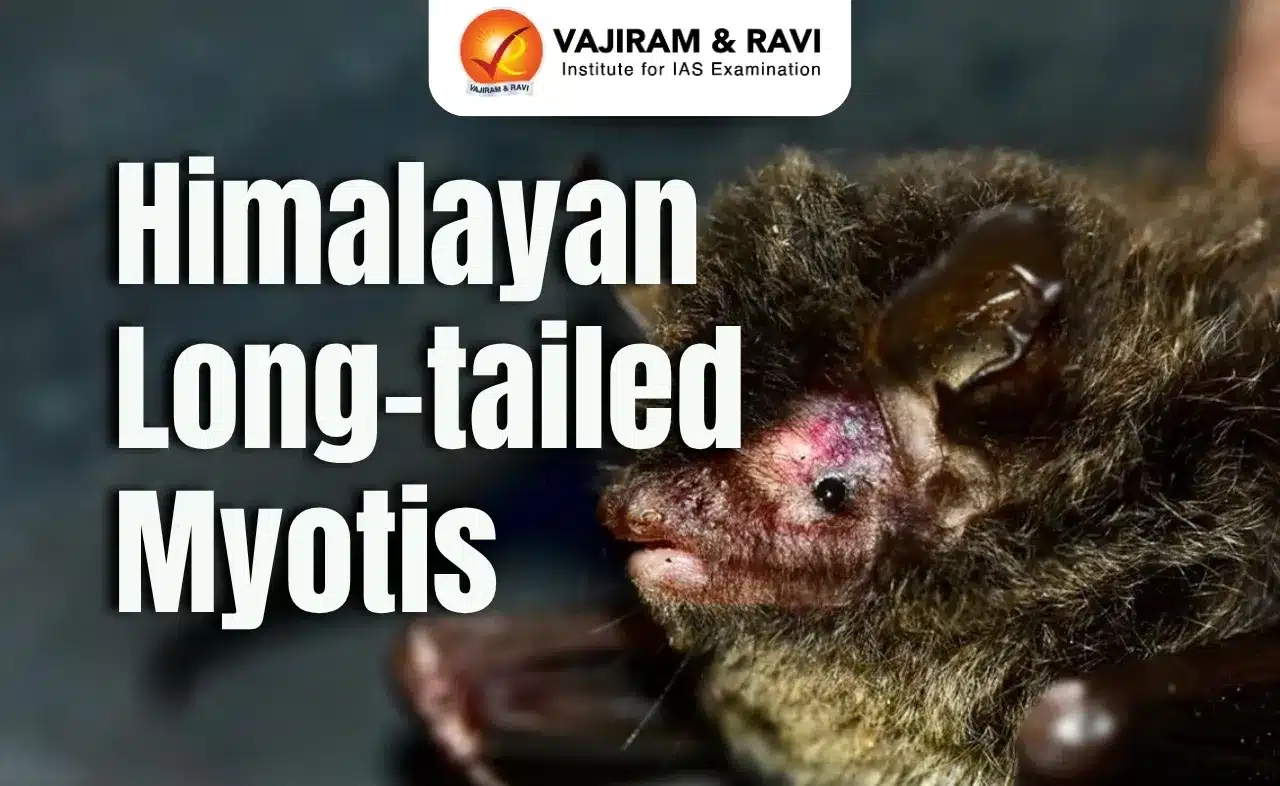
Recently, researchers have discovered a new species of bat named Himalayan long-tailed Myotis (Myotis himalaicus).
About Himalayan Long-Tailed Myotis
- It is a new species of bat found in the Western Himalayan region.
- It belongs to a group of morphologically similar species called the Myotis frater complex, which has a wide distribution from eastern China, Taiwan, central and southeastern Siberia, Korea, Japan, Tajikistan, and Uzbekistan.
- Habitat: The Himalayan long-tailed Myotis, which inhabits Deodar, Pine, and Cedar forests, appears to be a rare species native to the southern slopes of the Himalayas.
- Distribution: These bats have been found in Uttarakhand, India, and Khyber Pakhtunkhwa, Pakistan.


Features Of Himalayan Long-Tailed Myotis
- It is considered “medium-sized,” reaching about 3.5 inches in length and weighing less than an ounce
- They have “delicate” feet and “relatively long” thumbs ending in “a strong but short claw.” Their heads have “short” ears and “rather delicate” teeth.
Ecological Significance of Bats
- Bats contribute to overall biodiversity and the health of ecosystems.
- Insect Predators: Throughout the night, bats devour insects in farms, fields, forests, grasslands and around our homes, including agricultural pests and disease-causing mosquitoes.
- Bat droppings (guano) mined from caves are widely used as a fertilizer for agricultural crops as they have high concentrations of nitrogen and phosphorous.
- Pollinators: Some bats sip nectar, pollinate flowers, eat fruits, and spread the seeds of many important tree species.
Himalayan Long-Tailed Myotis FAQs
Q1: What do long-tailed bats eat?
Ans: An aerial insectivore, they feed on small moths, midges, mosquitoes and beetles.
Q2: What is the biggest bat?
Ans: The giant golden-crowned flying fox
Source: TH

 Last updated on Oct, 2026
→ UPSC 2027 Notification will be released on 13 January 2027 at upsconline.nic.in.
→ Check Nobel Prize 2026 Winners List here.
→ Download PIB PRiSM Monthly Magazine 2026 here.
→ Check UPSC Monthly Current Affairs Magazine The Recitals here.
→ Check out the latest UPSC Syllabus here.
→ Download UPSC Model Answers for Mains 2026
→ UPSC Mains Question Paper 2026 is out now for Essay & GS Paper 1, 2, 3 & 4.
→ UPSC Calendar 2027 has been released.
→ Enroll in Vajiram & Ravi’s UPSC Mains Test Series 2027 for structured answer writing practice, expert evaluation, and exam-oriented feedback.
→ Join Vajiram & Ravi’s UPSC Mentorship Program 2027 for personalized guidance, strategy planning, and one-to-one support from experienced mentors.
→ Go through the UPSC Mains Previous Year Papers to enhance your preparation.
→ UPSC has released UPSC Toppers List 2025 with the Civil Services final result on its official website.
→ Also check Best UPSC Coaching in India
Tags: himalayan long-tailed myotis prelims pointers