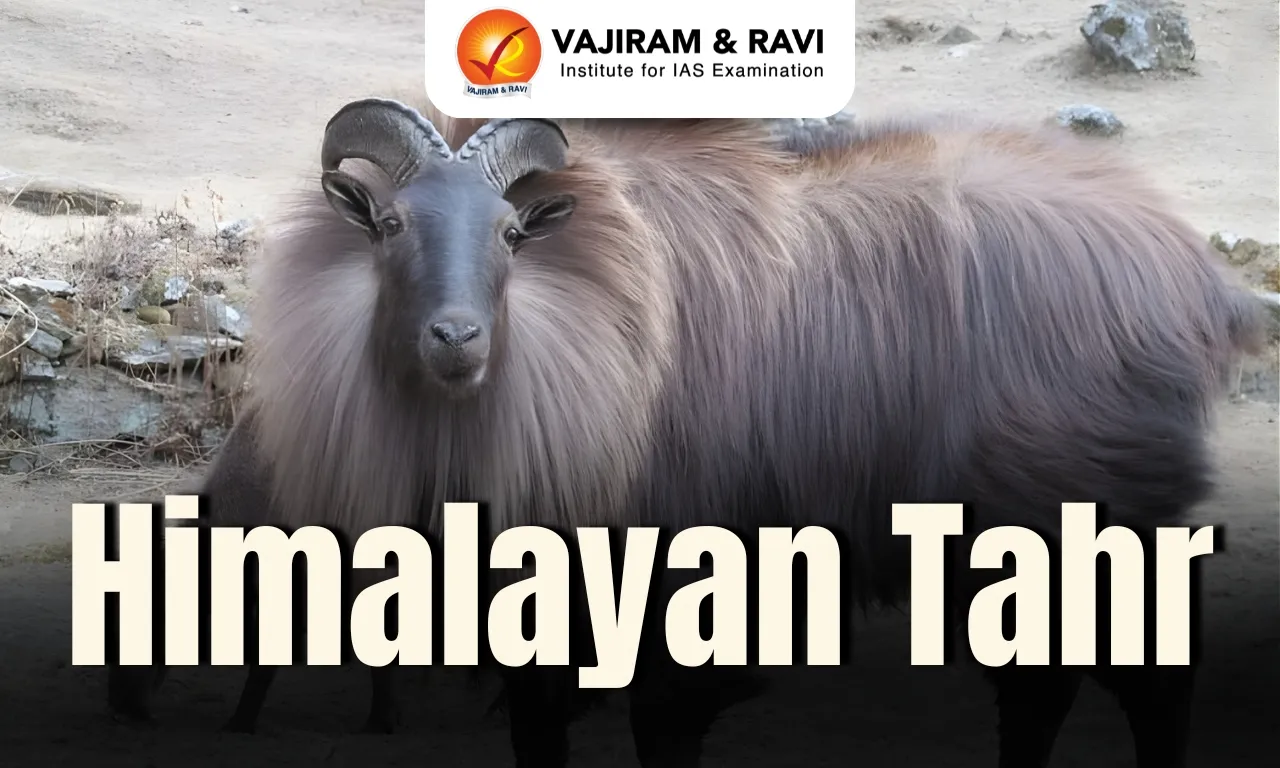
Himalayan Tahr Latest News
The Kedarnath Wildlife Division is preparing to restrict human activity in high-altitude meadows and clear rubbish from parts of its sanctuary after a survey found that visitors and local residents were feeding Himalayan tahrs.
About Himalayan Tahr
- It is a large, wild, goatlike mammal that lives on the mountain slopes and in the forests of the Himalayas.
- Scientific Name: Hemitragus jemlahicus.


Himalayan Tahr Habitat and Distribution
- It is found in southern Tibet, northern India, western Bhutan, and Nepal.
- In the Himalayas, they are mostly found on slopes between 2,500 and 5,000 meters high.
- In India, they are found in the states of Jammu and Kashmir, Himachal Pradesh, Uttarakhand, and Sikkim.
Himalayan Tahr Features
- They are shorter in height than they are long.
- They have a small head, small pointed ears, and large eyes.
- They are sexually dimorphic, with females being smaller in weight and in size and having smaller horns.
- Male horns can grow up to 46 cm long.
- The horns curve backward, which helps prevent injuries when males fight during mating season.
- The exterior of a tahr is well adapted to the harsh climate of the Himalayas.
- They are double coated with a dense, reddish to dark brown woolly coat, and a thick undercoat.
- Their coats are thin with the end of winter and become lighter in color.
- As a member of the ungulate group of mammals, the Himalayan tahr has an even number of toes. They can grip both smooth and rough surfaces.
- They are gregarious animals. They live in all-male and all-female herds that usually include up to 80 members.
- Himalayan Tahr Conservation Status
- It is classified as ‘Near Threatened‘ under the IUCN Red List.
Key Facts about Kedarnath Wildlife Sanctuary (KWS)
- The KWS, famously known as the Kedarnath Musk Deer Sanctuary, is located in the Rudraprayag and Chamoli districts of Uttarakhand.
- The area falls under the West Himalayan Zone in the Palearctic realm.
- It was named after the famous Hindu temple of Kedarnath, which lies outside the northern border of the sanctuary.
- Its alternate name comes from its primary purpose of protecting the endangered Himalayan musk deer.
- The sanctuary was established in 1972, covering a total area of 975.20 sq.km.
- It is the largest protected area in the western Himalayas.
- It lies in the upper catchment of the Alaknanda and Mandakini Rivers.
- The altitude ranges from 1,160 to 7,068 m.
- It is bordered by Kedarnath (6940 m), Mandani (6193 m), and Chaukhamba (7068 m) peaks in the north.
- Vegetation:
- It is covered with temperate forests.
- The higher and upper regions possess the sub-alpine and alpine coniferous forests.
- At high altitude, lush green meadows envelope the entire region.
- Flora: Oak, rhododendrons, Chir Pine and Alpine meadows along with several Himalayan flowering plants.
- Fauna:
- Some of the mammals are Musk deer, Himalayan Thar, Himalayan Black bear, Snow Leopard, etc.
- The birds found here are, Nepal Tree-creeper, Little Pied Flycatcher, Koklass Pheasant, Grey-cheeked Warbler, Himalayan Monal and Kalij Pheasant.
News: NIE

 Last updated on Oct, 2026
→ UPSC 2027 Notification will be released on 13 January 2027 at upsconline.nic.in.
→ Check Nobel Prize 2026 Winners List here.
→ Download PIB PRiSM Monthly Magazine 2026 here.
→ Check UPSC Monthly Current Affairs Magazine The Recitals here.
→ Check out the latest UPSC Syllabus here.
→ Download UPSC Model Answers for Mains 2026
→ UPSC Mains Question Paper 2026 is out now for Essay & GS Paper 1, 2, 3 & 4.
→ UPSC Calendar 2027 has been released.
→ Enroll in Vajiram & Ravi’s UPSC Mains Test Series 2027 for structured answer writing practice, expert evaluation, and exam-oriented feedback.
→ Join Vajiram & Ravi’s UPSC Mentorship Program 2027 for personalized guidance, strategy planning, and one-to-one support from experienced mentors.
→ Go through the UPSC Mains Previous Year Papers to enhance your preparation.
→ UPSC has released UPSC Toppers List 2025 with the Civil Services final result on its official website.
→ Also check Best UPSC Coaching in India
Himalayan Tahr FAQs
Q1. What is the Himalayan Tahr?+
Q2. Where is the Himalayan Tahr found?+
Q3. Are Himalayan Tahrs sexually dimorphic?+
Q4. What is the conservation status of the Himalayan Tahr according to the IUCN Red List?+
Tags: himalayan tahr prelims pointers upsc current affairs upsc prelims current affairs