


About Hindu Marriage Act, 1955 (HMA Act)
- It codifies the law relating to marriage among Hindus.
- It not only provides for the ceremonies and registration for Hindu marriage but also lays down rules regarding Divorce.
- Salient Features:
- A Hindu by birth or by conversion is the subject of the HMA Act.
- The definition of Hindu under the HMA Act includes Buddhist, Jain, and Sikh as well.
- Marriageable age:
- The bridegroom must be at least 21 years old, and the bride must be at least 18 years old when they get married.
- Marriage among minors is punishable with imprisonment upto 3 years and/or fine upto Rs 1 lakh.
- Significance of ceremonies:
- Customary practices (customs/ long-term usages (Reeti-Riwaz)) are well respected under the HMA Act.
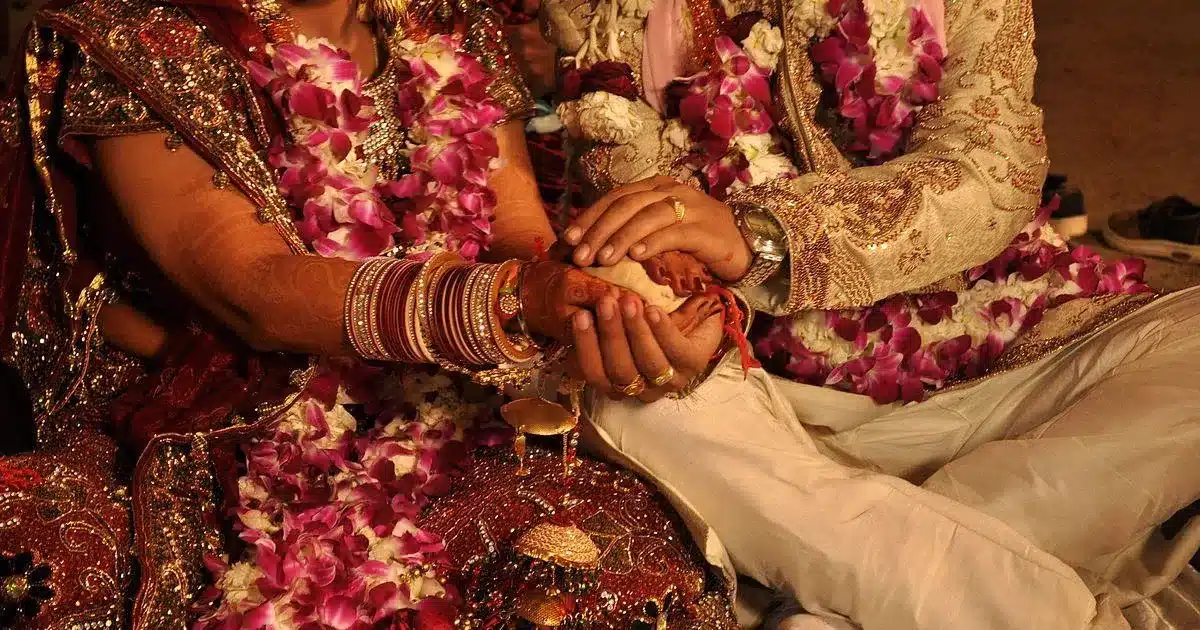
- Saptapadi, i.e., steps taken by the bride and groom before holy fire, is a necessary ritual for marriage among Hindus.
- However, marriage ceremonies are subject to customs and accepted accordingly.
- Forbidding bigamy:
- It also brought an end to the customary practice of bigamy, polygamy, or polyandry, i.e, multiple marriages.
- Section 5 of the Act specifies that it is illegal to have two living wives at once, which is known as bigamy.
- If one spouse is alive and the person remarries, such marriage is not only void, but the person is also punishable under Sections 494 and 495 of the Indian Penal Code, 1860.
- Focus on mental stability:
- A marriage is considered null and void if anyone one or both the people get married being mentally unfit.
- In such cases, the couple must get legal consent before getting married.
- Registration:
- Registration of a Hindu marriage is subject to laws applicable in particular states.
- However, a marriage is not invalid or illegal due to lack of an official certificate.
- Divorce:
- The Act also allows divorce through mutual consent.
- Although parties are legally not allowed to seek divorce within 1 year of marriage, they can go for judicial separation.
- However, divorce may be granted before completion of 1 year in special circumstances of exceptional hardship.
- It provides for the various grounds on the basis of which, divorce can be granted to one of the spouses if another does not agree to separate.
- There are special grounds which specifically allow the wife to seek divorce from her husband.
- Restitution of conjugal rights:
- Unlike any other matrimonial laws in India, the HMA Act also contains provisions for restitution of conjugal rights.
- So, if one of the spouses leaves the other without any reasonable excuse, the other spouse may reach the courtto restore their matrimonial relations and bring back the spouse.
- Legal Procedures:
- Matters of Hindu marriages and divorce follow procedure in family court in India.
- Matters under the Act are taken up by the courts of territorial jurisdiction (city/ town) where the marriage was celebrated, where one of the parties resides, or where the husband and wife last resided together.
Q1: What is the Indian Penal Code, 1860?
The Indian Penal Code is the official criminal code of India, which was drafted way back in 1860. It’s objective is to provide a general penal code for the country. It has 511 sections across 23 chapters, providing the list of crimes along with their definitions and punishments. The IPC has been amended several times and is now supplemented by other Acts.


 Last updated on Oct, 2026
→ UPSC 2027 Notification will be released on 13 January 2027 at upsconline.nic.in.
→ Check Nobel Prize 2026 Winners List here.
→ Download PIB PRiSM Monthly Magazine 2026 here.
→ Check UPSC Monthly Current Affairs Magazine The Recitals here.
→ Check out the latest UPSC Syllabus here.
→ Download UPSC Model Answers for Mains 2026
→ UPSC Mains Question Paper 2026 is out now for Essay & GS Paper 1, 2, 3 & 4.
→ UPSC Calendar 2027 has been released.
→ Enroll in Vajiram & Ravi’s UPSC Mains Test Series 2027 for structured answer writing practice, expert evaluation, and exam-oriented feedback.
→ Join Vajiram & Ravi’s UPSC Mentorship Program 2027 for personalized guidance, strategy planning, and one-to-one support from experienced mentors.
→ Go through the UPSC Mains Previous Year Papers to enhance your preparation.
→ UPSC has released UPSC Toppers List 2025 with the Civil Services final result on its official website.
→ Also check Best UPSC Coaching in India








