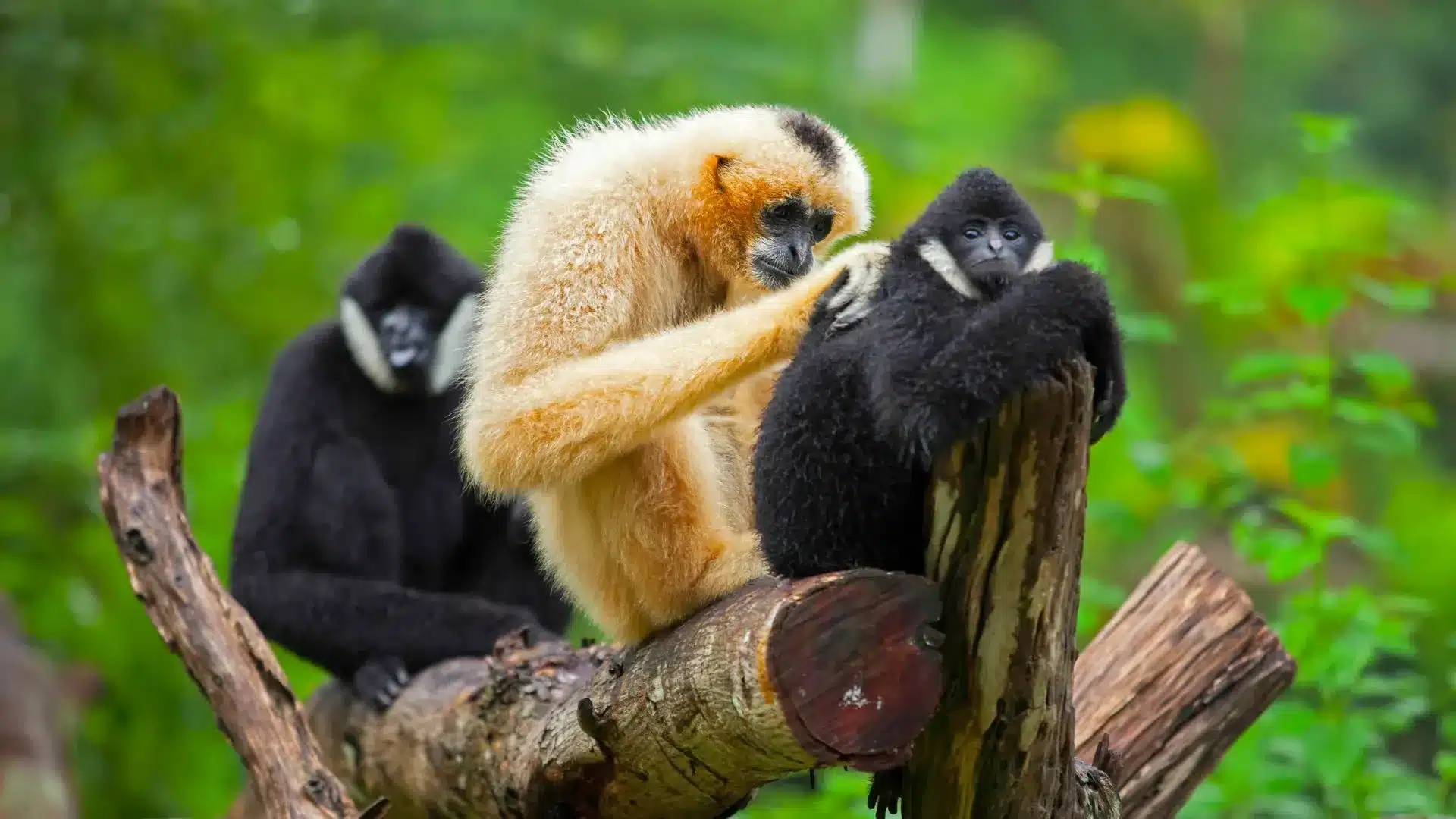
About Hoolock Gibbon:
- Gibbons, the smallest and fastest of allapes, live in tropical and subtropical forests in the southeastern part of Asia.
- The hoolock gibbon is one of 20 species of gibbons on Earth.
- Distribution:
- Its distribution in Southeast Asia spans India, Myanmar, Bangladesh, and southern China.
- It is the only ape found in India.
- In India, it is found in Assam, Meghalaya, Arunachal Pradesh, Nagaland, Manipur, Mizoram, and Tripura, south of the Brahmaputra.
- Hollongapar Gibbon Sanctuary in Assam has the largest concentration of the hoolock gibbon.
- It is categorised into Eastern Hoolock Gibbon (Hoolock leuconedys) found in a specific region of Arunachal Pradesh and Western Hoolock Gibbon (Hoolock hoolock) distributed elsewhere in the northeast.
- Features:
- Both male and female gibbons are about the same size, but they differ considerably in colors.
- Males are black colored with remarkable white brows, while females have grey-brown fur, which is darker at the chest and neck.
- White rings around the eyes and around the mouth give their faces a mask-like appearance.
- They are diurnal and arboreal, brachiating through the trees with their long arms.
- They are monogamous (same partner throughout life).
- They live in small families, including males, females and their young ones, and communicate with other gibbons by vocalisation.
- The loud calls of the gibbon are used to identify individuals within and outside the family group.
- Like all apes, they are extremely intelligent, with distinct personalities and strong family bonds.
- Life span: 25 years
- Conservation Status:
- IUCN Red List:
- Eastern Hoolock Gibbon: Vulnerable
- Western Hoolock Gibbon: Endangered
- IUCN Red List:
Both are on Schedule I of theWildlife (Protection) Act of India, 1972.
Q1: What are apes?
Apes are humanity’s closest living relatives. In fact, people are apes; humans share about 98 percent of their DNA with chimpanzees. The non-human types of apes are divided into two groups: great apes — gorillas, bonobos, chimpanzees and orangutans — and lesser apes — gibbons and siamangs. Apes are not monkeys; they belong to different branches of the Simian infraorder, and there are several physical differences. Apes do not have tails, while most monkeys do, and apes are typically larger than monkeys. Apes’ noses are short and broad, while monkeys’ noses are more snout-like. Apes also have larger brains than monkeys, and they are capable of using tools and learning language.
Source: Railways to build canopy bridges across track in Assam gibbon habitat


 Last updated on Oct, 2026
→ UPSC 2027 Notification will be released on 13 January 2027 at upsconline.nic.in.
→ Check Nobel Prize 2026 Winners List here.
→ Download PIB PRiSM Monthly Magazine 2026 here.
→ Check UPSC Monthly Current Affairs Magazine The Recitals here.
→ Check out the latest UPSC Syllabus here.
→ Download UPSC Model Answers for Mains 2026
→ UPSC Mains Question Paper 2026 is out now for Essay & GS Paper 1, 2, 3 & 4.
→ UPSC Calendar 2027 has been released.
→ Enroll in Vajiram & Ravi’s UPSC Mains Test Series 2027 for structured answer writing practice, expert evaluation, and exam-oriented feedback.
→ Join Vajiram & Ravi’s UPSC Mentorship Program 2027 for personalized guidance, strategy planning, and one-to-one support from experienced mentors.
→ Go through the UPSC Mains Previous Year Papers to enhance your preparation.
→ UPSC has released UPSC Toppers List 2025 with the Civil Services final result on its official website.
→ Also check Best UPSC Coaching in India