Sea Otters
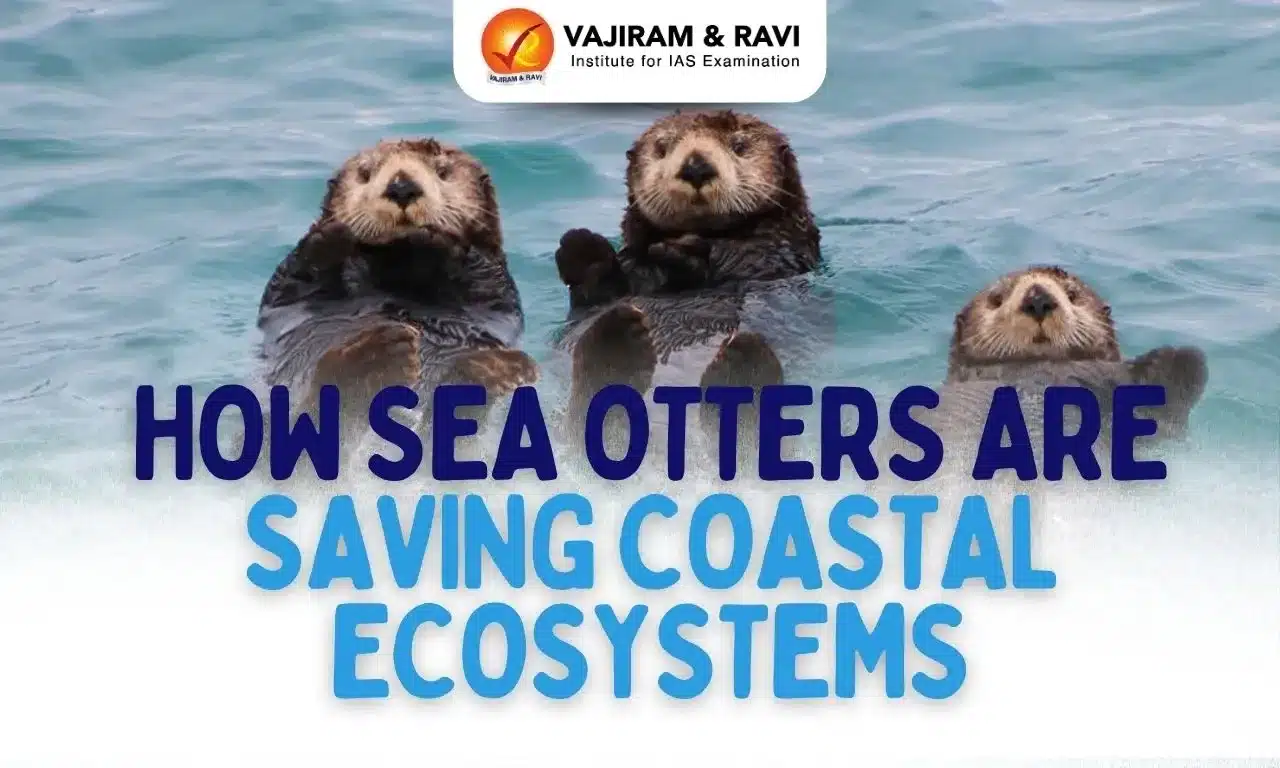
- Sea otters were extensively hunted in the 18th and 19th centuries for their thick, soft fur.
- Declared a fully protected mammal in California in 1913, but populations faced challenges from oil spills and habitat loss.
- Their numbers rebounded after being listed as threatened and federally protected in 1977.
Contribution to Limiting Green Crabs:
- Sea otters consume 50,000 to 120,000 green crabs annually, effectively controlling their population. This marks a significant solution to the invasive species problem on the West Coast of the United States.
- Unique adaptations: Unlike other marine mammals, sea otters rely on a high metabolism rather than blubber to stay warm in cold oceans. They consume about 25% of their body weight daily, making them voracious predators.
Green Crab (Portunus Sanguinolentus)
- The green crab is a common littoral crab, recognized globally by names such as shore crab or green shore crab in the British Isles.It is one of the top 100 “world’s worst alien invasive species”, showcasing its invasive nature.
- Habitat: Native to the Atlantic Ocean and Baltic Sea, but now spread to Australia, South America, and South Africa.
- Physical Features:
- At maturity, the carapace width measures about 90 mm.
- Colouration varies between green, brown, grey, and red, with delayed moulting causing red colouration.
- Red crabs are more aggressive compared to others.
- Diet: Feeds on small crustaceans, molluscs, and worms.
- Impact on Ecosystems: The green crab’s invasive behaviour harms coastal ecosystems by:
- Damaging seagrass beds, critical habitats for various marine species.
- Overhunting prey species, crucial for the survival of other native species.
- Outcompeting native species for resources like food and habitat.
Q1. What is a horseshoe crab?
A horseshoe crab is a marine arthropod known for its hard exoskeleton and horseshoe-shaped shell. Despite its name, it is more closely related to spiders and scorpions than crabs, dating back over 450 million years.
Source: IE


 Last updated on Oct, 2026
→ UPSC 2027 Notification will be released on 13 January 2027 at upsconline.nic.in.
→ Asian Games 2026 are being held in Aichi-Nagoya, Japan, from 19 September to 4 October.
→ Check Nobel Prize 2026 Winners List here.
→ Download PIB PRiSM Monthly Magazine 2026 here.
→ Check UPSC Monthly Current Affairs Magazine The Recitals here.
→ Check out the latest UPSC Syllabus here.
→ Download UPSC Model Answers for Mains 2026
→ UPSC Mains Question Paper 2026 is out now for Essay & GS Paper 1, 2, 3 & 4.
→ UPSC Calendar 2027 has been released.
→ Enroll in Vajiram & Ravi’s UPSC Mains Test Series 2027 for structured answer writing practice, expert evaluation, and exam-oriented feedback.
→ Join Vajiram & Ravi’s UPSC Mentorship Program 2027 for personalized guidance, strategy planning, and one-to-one support from experienced mentors.
→ Go through the UPSC Mains Previous Year Papers to enhance your preparation.
→ UPSC has released UPSC Toppers List 2025 with the Civil Services final result on its official website.
→ Also check Best UPSC Coaching in India