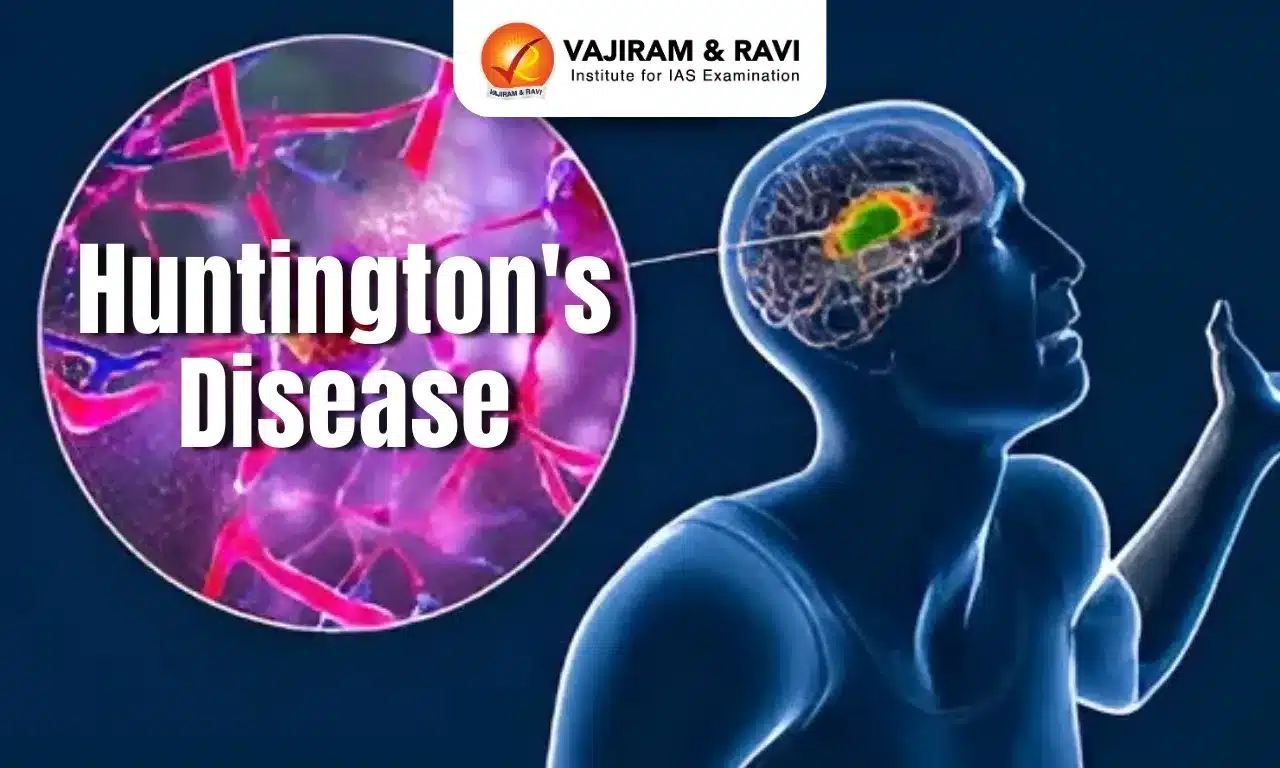
Huntington’s Disease Latest News
New treatments for Huntington’s disease could be on the horizon following research led by scientists at Lawrence Berkeley National Laboratory, United States.
About Huntington’s Disease
- It is a progressive neurodegenerative disorder that changes brain functioning over time.
- It is a rare hereditary disorder in which brain cells, or neurons, in certain areas of your brain start to break down.
- The destruction of nerve cells happens in the basal ganglia, or the region of your brain that regulates your body’s movements.
- It also affects the brain cortex (surface of your brain) that regulates your thinking, decision-making, and memory.
- As the neurons degenerate, the disease can lead to emotional disturbances, loss of intellectual abilities, and uncontrolled movements.


What causes Huntington’s Disease?
- A genetic mutation of the HTT gene causes HD. If one of your parents has HD, you have a 50% chance of also developing it.
- The HTT gene makes a protein called huntingtin. The exact function of this protein is not yet known, but researchers believe it plays a role in supporting the function of nerve cells in the brain.
- If you have HD, your DNA doesn’t have all the information needed to make the huntingtin protein.
- As a result, these proteins grow in an abnormal shape and destroy your neurons.
- Your neurons die because of this genetic mutation.
How common is HD?
HD affects an estimated 3 to 7 out of every 100,000 people, most often people of European ancestry (biological family comes from European descent).
Huntington’s Disease Symptoms
- HD symptoms can begin at any age but usually first appear between the ages of 30 and 50 years.
- About 5-10% of people have symptoms before age 20 (Juvenile HD) and 10% have onset after age 60 (late onset).
- Common symptoms include uncontrollable dance-like movements (chorea) and abnormal body postures, as well as problems with behavior, emotion, thinking, and personality.
- Other symptoms may include tremor (unintentional back-and-forth movement in the person’s muscles) and unusual eye movements. The eye movements can happen early in the disease.
- These symptoms get worse over time.
- As HD progresses, you will need constant assistance and supervision because of the debilitating nature of the disease.
Huntington’s Disease Treatment
- There is no cure for HD.
- Medicines can help manage some of the symptoms, but cannot slow down or stop the disease.
- People usually die from the disease within 15 to 20 years of developing symptoms.
News: MED

 Last updated on Oct, 2026
→ UPSC 2027 Notification will be released on 13 January 2027 at upsconline.nic.in.
→ Check Nobel Prize 2026 Winners List here.
→ Download PIB PRiSM Monthly Magazine 2026 here.
→ Check UPSC Monthly Current Affairs Magazine The Recitals here.
→ Check out the latest UPSC Syllabus here.
→ Download UPSC Model Answers for Mains 2026
→ UPSC Mains Question Paper 2026 is out now for Essay & GS Paper 1, 2, 3 & 4.
→ UPSC Calendar 2027 has been released.
→ Enroll in Vajiram & Ravi’s UPSC Mains Test Series 2027 for structured answer writing practice, expert evaluation, and exam-oriented feedback.
→ Join Vajiram & Ravi’s UPSC Mentorship Program 2027 for personalized guidance, strategy planning, and one-to-one support from experienced mentors.
→ Go through the UPSC Mains Previous Year Papers to enhance your preparation.
→ UPSC has released UPSC Toppers List 2025 with the Civil Services final result on its official website.
→ Also check Best UPSC Coaching in India
Huntington's Disease FAQs
Q1. What is Huntington's disease?+
Q2. What are the major effects of neuronal degeneration in Huntington's disease?+
Q3. Which gene mutation causes Huntington's disease?+
Q4. Is there a cure for Huntington's disease?+
Tags: huntington’s disease