Hyperkeratosis Latest News
Experts say feeding sweets to monkeys at Jaipur’s Galtaji temple is causing hyperkeratosis among them.
About Hyperkeratosis
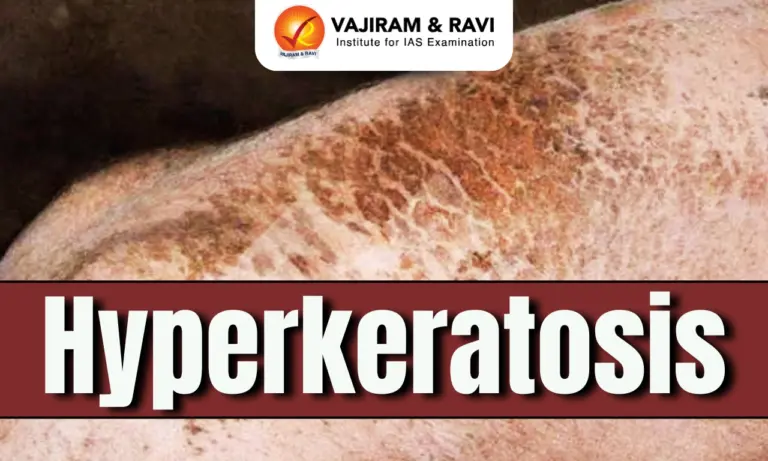
- Hyperkeratosis is a condition that causes your skin to thicken in certain places.
- The thickening occurs when your body produces too much keratin, a protein found in your skin’s outer layer.
- Keratin helps to protect the body against infiltration by water and other chemical and biological agents with which it comes in contact every day.
- Hyperkeratosis can affect any area of your body, including your hands, feet, mouth, nose and nails.
- Anyone can get hyperkeratosis. Some people have it at birth. Other people develop this condition as children or adults.
- There are two main types of hyperkeratosis:
- Non-pressure-related hyperkeratosis: Thickening of your skin due to genetics.
- Pressure-related hyperkeratosis: Thickening of your skin due to inflammation, irritation, or pressure.
- Several factors may cause hyperkeratosis, including:
- Allergies.
- Autoimmune diseases.
- Chronic inflammation of the skin (dermatitis).
- Infections of the skin, including HPV (human papillomavirus).
- Genetics.
- Medications, including chemotherapy.
- Pressure or rubbing of your skin.
- Psoriatic arthritis.
- Reactions to chemicals, including tattoo ink.
- Skin infections.
- Sun exposure.
- Vitamin A deficiency.
- Forms of hyperkeratosis include:
- actinic keratosis, which causes rough, sandpaper-like patches of skin to develop as a result of excess skin exposure
- calluses
- corns
- eczema
- epidermolytic hyperkeratosis, an inherited skin disorder present at birth
- lichen planus, a condition that causes white patches to grow on the inside of the mouth
- plantar warts
- psoriasis
- Warts
- Symptoms:
- The symptoms of hyperkeratosis can vary depending on the underlying cause and the area of the body affected.
- Common symptoms include:
- Thickened Skin: Areas of skin may appear rough and thickened.
- Dryness and Scaling: The affected skin may be dry and flaky.
- Color Changes: The skin may appear darker or discolored in the affected areas.
- Itching or Pain: Some individuals may experience discomfort or itching in the affected areas.
- Treatment depends on the type of hyperkeratosis you have.
News: IT


 Last updated on Oct, 2026
→ UPSC 2027 Notification will be released on 13 January 2027 at upsconline.nic.in.
→ Check Nobel Prize 2026 Winners List here.
→ Download PIB PRiSM Monthly Magazine 2026 here.
→ Check UPSC Monthly Current Affairs Magazine The Recitals here.
→ Check out the latest UPSC Syllabus here.
→ Download UPSC Model Answers for Mains 2026
→ UPSC Mains Question Paper 2026 is out now for Essay & GS Paper 1, 2, 3 & 4.
→ UPSC Calendar 2027 has been released.
→ Enroll in Vajiram & Ravi’s UPSC Mains Test Series 2027 for structured answer writing practice, expert evaluation, and exam-oriented feedback.
→ Join Vajiram & Ravi’s UPSC Mentorship Program 2027 for personalized guidance, strategy planning, and one-to-one support from experienced mentors.
→ Go through the UPSC Mains Previous Year Papers to enhance your preparation.
→ UPSC has released UPSC Toppers List 2025 with the Civil Services final result on its official website.
→ Also check Best UPSC Coaching in India
Hyperkeratosis FAQs
Q1. What is hyperkeratosis?+
Q2. What causes the thickening of the skin in hyperkeratosis?+
Q3. What is keratin?+
Q4. What are the two main types of hyperkeratosis?+
Q5. What causes non-pressure-related hyperkeratosis?+
Tags: hyperkeratosis