Modern Indian Science Latest News
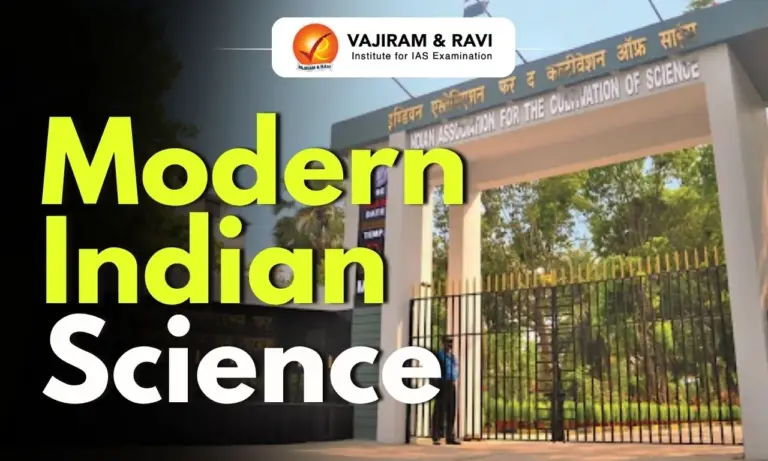
- The Indian Association for the Cultivation of Science (IACS), India’s first national institution dedicated to scientific research by Indians, is marking its 150th anniversary.
Indian Association for the Cultivation of Science
- The Indian Association for the Cultivation of Science occupies a unique place in the history of Indian science. Established in 1876, it was the first national institution in India created specifically for scientific research by Indians.
- Its founding marked not just the creation of a laboratory or academic centre, but the beginning of a larger movement for scientific self-reliance in colonial India.
- The institution emerged during the broader intellectual and cultural awakening often described as the Bengal Renaissance.
- Although similar reformist and intellectual currents were visible in other parts of the country, Bengal became the most influential centre of this awakening. It shaped modern India’s development in philosophy, literature, education, social reform, and science.
- Within this setting, IACS became one of the earliest expressions of the idea that Indians should not merely receive Western scientific knowledge, but actively produce new knowledge themselves.


Mahendralal Sircar and the Idea of Scientific Self-Reliance
- The central figure behind the founding of IACS was Mahendralal Sircar (1833-1904), one of the most important scientific thinkers of nineteenth-century India.
- He was deeply concerned that the colonial government had not created enough opportunities for Indians to pursue serious education and research in the natural sciences.
- In 1869, in an article published in the Calcutta Journal of Medicine, Sircar argued that scientific education was essential for India’s intellectual and social progress.
- He believed that the cultivation of the physical sciences was the most effective way to fully develop the Indian mind and improve society.
- A few years later, in 1872, while addressing a meeting of the Bethune Society at the Medical College Theatre in Calcutta, he openly criticised the colonial administration for failing to provide support for scientific research by Indians.
- These statements reveal the depth of his foresight. At a time when India had very limited institutional support for modern scientific inquiry, Sircar imagined an institution that would enable Indians to engage in science independently and contribute to the global growth of knowledge.
- That vision took concrete form with the establishment of IACS on July 29, 1876.
Role of IACS in Modern Indian Science
- The importance of IACS lies in the fact that it offered an Indian institutional space for scientific work at a time when such opportunities were rare. It represented an early and powerful form of national scientific assertion under colonial rule.
- Its contribution can be understood at three levels:
- First, it created a research culture in India by emphasising experimentation, inquiry, and intellectual independence rather than rote learning.
- Second, it nurtured generations of scientists and helped create a framework for scientific institution-building in India.
- Third, it embodied the larger nationalist aspiration that science must become a tool of modernisation, self-confidence, and nation-building.
- Over the past century and a half, IACS has continued to contribute to scientific research and has remained one of the country’s important centres of scientific excellence.
C.V. Raman and the Global Recognition of Indian Science
- Among the most celebrated scientists associated with IACS was C.V. Raman, whose work transformed modern physics and brought global recognition to Indian science.
- Shortly after joining the Accountant General’s Office in Calcutta in 1907, Raman came across the signboard of the Indian Association for the Cultivation of Science.
- Curious about the institution, he made enquiries and was introduced to Amrit Lal Sircar, the son of the founder.
- Recognising Raman’s passion for research, Amrit Lal Sircar allowed him to use the Association’s laboratories outside office hours.
- For nearly a decade, Raman maintained an extraordinary routine: he worked as a government officer during the day and spent early mornings and evenings conducting experiments at IACS.
- This continued until 1917, when he resigned from government service to accept the Palit Professorship of Physics at the University of Calcutta. Even after that, IACS remained the principal site of his experimental research.
- It was in the laboratories of IACS that Raman made his most famous discovery, the Raman Effect, which he announced on February 28, 1928.
- This landmark discovery earned him the Nobel Prize in Physics in 1930, making him the first Asian scientist to win a Nobel Prize in the sciences.
- Raman’s achievement symbolised the fulfilment of Mahendralal Sircar’s dream: that an institution built and sustained by Indians for the cultivation of science could produce discoveries of the highest international significance.
IACS as a Symbol of National Scientific Awakening
- The founding of IACS was much more than the creation of one research institution. It represented a deeper transformation in Indian intellectual life. It showed that:
- Science could be pursued as a national mission.
- Indians could build institutions of knowledge and research on their own.
- Scientific progress was closely tied to social reform and national development.
- Modern India’s emergence required not just political awakening, but also scientific awakening.
- In this sense, IACS became one of the foundational institutions in the making of modern Indian science.
Continuing Legacy
- The legacy of IACS continues to endure because it stands at the intersection of three important ideas Scientific excellence, Institution-building & National self-reliance.
- Its story remains relevant even today, when India is emphasising research, innovation, indigenous technology, and self-reliance in science and industry.
- The institution reminds us that scientific capability is not built overnight; it requires vision, persistence, and a social commitment to inquiry.
- As India marks the 150th anniversary of IACS, the celebration is not only about an old institution surviving through time.
- It is about recognising a turning point in Indian history when science began to be seen not as an imported body of knowledge, but as something Indians could shape, advance, and contribute to for the world.
Source: TH

 Last updated on Sep, 2026
→ UPSC 2027 Notification will be released on 13 January 2027 at upsconline.nic.in.
→ Asian Games 2026 are being held in Aichi-Nagoya, Japan, from 19 September to 4 October.
→ Check out the latest UPSC Syllabus here.
→ Download UPSC Model Answers for Mains 2026
→ UPSC Mains Question Paper 2026 is out now for Essay & GS Paper 1, 2, 3 & 4.
→ UPSC Calendar 2027 has been released.
→ Enroll in Vajiram & Ravi’s UPSC Mains Test Series 2027 for structured answer writing practice, expert evaluation, and exam-oriented feedback.
→ Join Vajiram & Ravi’s UPSC Mentorship Program 2027 for personalized guidance, strategy planning, and one-to-one support from experienced mentors.
→ Go through the UPSC Mains Previous Year Papers to enhance your preparation.
→ UPSC has released UPSC Toppers List 2025 with the Civil Services final result on its official website.
→ Also check Best UPSC Coaching in India
Modern Indian Science FAQs
Q1. When was the Indian Association for the Cultivation of Science established?+
Q2. Who founded the IACS?+
Q3. Why is IACS important in Indian history?+
Q4. Which major scientific discovery is associated with IACS?+
Q5. Why is the Raman Effect historically significant?+
Tags: mains articles modern indian science upsc current affairs upsc mains current affairs