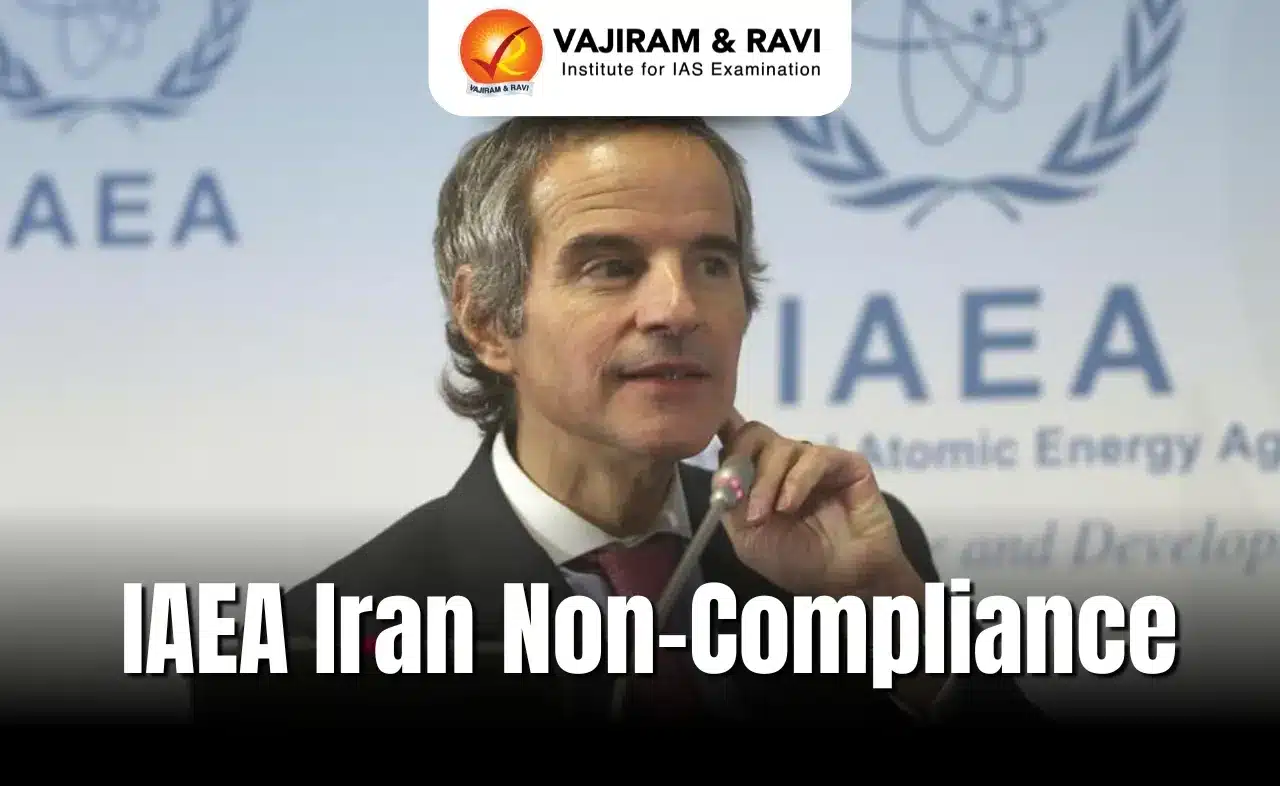
IAEA Iran Non-Compliance Latest News
- The International Atomic Energy Agency (IAEA) Board of Governors passed a resolution declaring Iran in breach of its 1974 Safeguards Agreement, citing concerns over unexplained uranium traces at multiple sites. The vote saw opposition from China, Russia, and Venezuela, with 11 abstentions.
- A day later, Israel launched “preliminary strikes” on Iranian nuclear facilities and declared a domestic state of emergency.
IAEA Safeguards Agreements
- IAEA Safeguards are embedded in legally binding agreements.
- In line with the IAEA’s Statute, States accept these Safeguards through the conclusion of such agreements with the Agency.
- As of May 2023, the IAEA has concluded comprehensive safeguards agreements with 182 countries, primarily non-nuclear-weapon states under the NPT.
- These agreements are the most common type and are designed to ensure the peaceful use of nuclear material.
1974 Safeguards Agreement
- The 1974 Safeguards Agreement refers to a legally binding accord between Iran and the IAEA, concluded under the framework of the Treaty on the Non-Proliferation of Nuclear Weapons (NPT).
- Inventory and Reporting Obligations
-
- Iran is required to:
- Declare and maintain a detailed inventory of all nuclear materials.
- Provide design information of any nuclear facility handling such materials.
- Notify the IAEA before constructing or modifying any nuclear facility.
- Iran is required to:
- Inspections
- The IAEA is authorized to conduct routine, ad hoc, and special inspections.
- Iran must allow access to facilities, materials, and relevant documents to verify compliance.
- Surveillance equipment like cameras and seals may be installed at key locations.
- Verification Mandate
- The IAEA must be able to verify that there is no diversion of declared nuclear material to weapons-related programs.
- Non-Compliance Consequences
- If Iran fails to meet its obligations, the IAEA can:
- Report the breach to its Board of Governors.
- Notify all IAEA member states.
- Refer the matter to the U.N. Security Council, which can impose sanctions or take other measures.
- If Iran fails to meet its obligations, the IAEA can:


IAEA Resolution Marks a Turning Point
- For the first time, the IAEA Board of Governors formally declared Iran non-compliant with its 1974 Safeguards Agreement, paving the way for potential escalation to the U.N. Security Council.
- The resolution follows years of urging Iran to cooperate and was welcomed by several Gulf states.
IAEA Invokes Rare Article XII.C Powers
- The IAEA Board of Governors, empowered by Article XII.C of its 1957 statute, has formally cited Iran for non-compliance.
- Thus far, this Article has been invoked only six times: against Iraq (1991), Romania (1992), North Korea (1993), Iran (2006), Libya (2004), and Syria (2011).
- This provision enables the Board to demand corrective measures, suspend technical aid, and escalate the issue to the U.N. Security Council if Iran fails to respond satisfactorily.
Iran Under Scrutiny, Technical Projects at Risk
- The IAEA currently operates around $1.5 million worth of peaceful nuclear projects in Iran, including in medicine and water desalination.
- These could now be curtailed if Iran does not cooperate.
Verification Challenges and Safeguard Breaches
- Under its 1974 Comprehensive Safeguards Agreement, Iran must provide nuclear material inventories, notify about new facilities, and allow inspections.
- The IAEA, however, has stated it is unable to verify the absence of nuclear material diversion for weapon use—a key safeguard failure.
Next Steps: Security Council in Sight
- Iran has a limited window to respond to IAEA queries. If it fails to comply, the Board may escalate the matter to the U.N. Security Council, which could respond with statements, binding resolutions, or renewed sanctions.
- A follow-up IAEA vote is likely in September 2025.
Israel Responds with Strikes and Warnings
- In response, Israel launched early morning strikes against Iranian nuclear sites and reiterated its position that it will not permit Iran to enrich uranium to weapons-grade levels (90%).
Iran Denounces Resolution, Plans Retaliatory Steps
- Tehran condemned the resolution as politically motivated and announced plans to build a new underground enrichment facility, upgrade centrifuges at Fordow, and implement “proportional measures”.
- Following Israeli attacks, Iran placed its air defence system on high alert, while Israel reported Iranian drone mobilisations.

 Last updated on Oct, 2026
→ UPSC 2027 Notification will be released on 13 January 2027 at upsconline.nic.in.
→ Check Nobel Prize 2026 Winners List here.
→ Download PIB PRiSM Monthly Magazine 2026 here.
→ Check UPSC Monthly Current Affairs Magazine The Recitals here.
→ Check out the latest UPSC Syllabus here.
→ Download UPSC Model Answers for Mains 2026
→ UPSC Mains Question Paper 2026 is out now for Essay & GS Paper 1, 2, 3 & 4.
→ UPSC Calendar 2027 has been released.
→ Enroll in Vajiram & Ravi’s UPSC Mains Test Series 2027 for structured answer writing practice, expert evaluation, and exam-oriented feedback.
→ Join Vajiram & Ravi’s UPSC Mentorship Program 2027 for personalized guidance, strategy planning, and one-to-one support from experienced mentors.
→ Go through the UPSC Mains Previous Year Papers to enhance your preparation.
→ UPSC has released UPSC Toppers List 2025 with the Civil Services final result on its official website.
→ Also check Best UPSC Coaching in India
IAEA Iran Non-Compliance FAQs
Q1. What did the IAEA resolution say about Iran? +
Q2. Why was Iran declared non-compliant by the IAEA?+
Q3. What is Article XII.C of the IAEA statute? +
Q4. How could this affect Iran’s nuclear projects?+
Q5. What are the next steps for the IAEA?+
Tags: iaea iran non-compliance mains articles upsc current affairs upsc mains current affairs