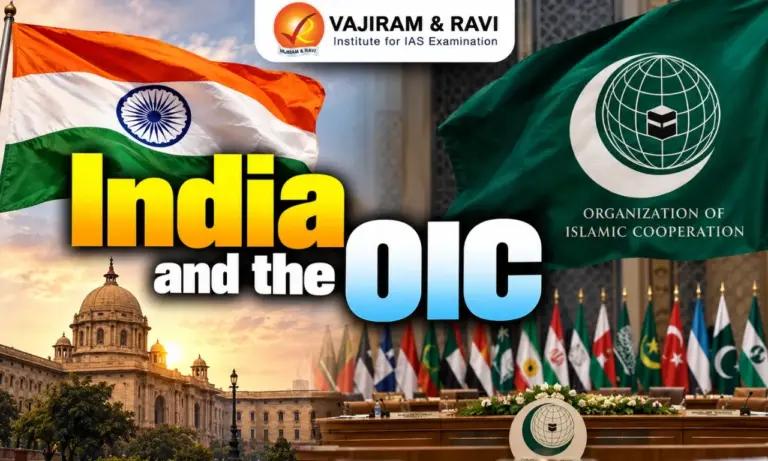
Recently, India rejected the OIC Contact Group’s remarks on Jammu and Kashmir, which called for a settlement of the Kashmir issue based on relevant United Nations Security Council resolutions. India stated that the OIC has no locus standi in India’s internal matters and reiterated that Jammu and Kashmir and Ladakh are integral parts of India.
What is the OIC?
The Organisation of Islamic Cooperation (OIC) is the second-largest intergovernmental organisation after the United Nations, with 57 member states spread across four continents.
- Established: 1969 at Rabat, Morocco, following the arson attack on the Al-Aqsa Mosque.
- Headquarters: Jeddah, Saudi Arabia.
- Role: The OIC seeks to promote solidarity and cooperation among its members and represents itself as the collective voice of the Muslim world.
OIC Objectives
The OIC seeks to promote cooperation among its members while upholding sovereignty and peaceful settlement of disputes.
- Solidarity: Strengthen unity and cooperation among member states.
- Sovereignty: Respect the independence and territorial integrity of states.
- Peace: Promote peaceful settlement of international disputes.
- Development: Encourage cooperation in trade, science, technology, education and culture.
- Common concerns: Address issues such as Palestine, terrorism, extremism and Islamophobia.


India and the OIC
India is not a member or observer of the OIC. The Government of India has consistently maintained that the OIC has no locus standi in matters concerning India’s internal affairs, including Jammu and Kashmir.
Despite this, India maintains strong bilateral relations with several OIC member states, particularly in the Gulf and West Asia.
A major diplomatic development came in 2019, when the United Arab Emirates invited India as the Guest of Honor at the 46th Session of the OIC Council of Foreign Ministers in Abu Dhabi. India’s then External Affairs Minister Sushma Swaraj addressed the inaugural plenary, marking India’s participation at a high-level OIC meeting despite not being a member.
India’s engagement has therefore largely focused on bilateral relations with individual OIC member states, while it continues to reject OIC involvement in matters it considers India’s internal affairs.
Why does the OIC Raise the Kashmir Issue?
Jammu and Kashmir has remained on the OIC agenda because the organisation has consistently framed the issue around self-determination and relevant United Nations resolutions, while Pakistan continues to raise it in OIC forums.
- The OIC continues to refer to relevant United Nations Security Council resolutions and the principle of self-determination as the basis for its position on Jammu and Kashmir.
- The issue is also institutionalised through the OIC’s Ministerial Contact Group on Jammu and Kashmir, which provides a platform for discussing the issue and issuing statements.
- Pakistan, as an OIC member, has repeatedly raised Jammu and Kashmir within OIC forums, keeping the issue prominent on the organisation’s political agenda.
India, however, rejects the OIC’s involvement, maintaining that it has no locus standi in India’s internal affairs and that Jammu and Kashmir and Ladakh are integral and inalienable parts of India.
Significance of the OIC for India
The importance of the OIC for India comes primarily from the strategic, economic and people-to-people importance of its member states, particularly in the Gulf and West Asia.
- Energy Security : OIC members are major energy partners for India, making stable relations important for crude oil and natural gas supplies.
- Diaspora and Remittances : The Gulf hosts a large Indian diaspora, making their employment, welfare and remittances an important dimension of India’s engagement.
- Trade and Investment : OIC countries provide important markets and investment opportunities for India, particularly in energy, infrastructure, technology and finance.
- Maritime Security : The Gulf and West Asia are critical to India’s energy routes and maritime trade, making regional stability strategically important.
- Counter-Terrorism : Engagement with Muslim-majority countries strengthens cooperation against terrorism and violent extremism and helps India build broader diplomatic support.
- Multilateral Diplomacy : The OIC’s 57 members constitute a significant diplomatic grouping, making engagement with its members important for India’s outreach across the Global South.
India and the OIC Challenges
The relationship combines strong bilateral partnerships with differences over political and strategic issues.
- Kashmir issue: Repeated OIC statements on Jammu and Kashmir remain a source of diplomatic friction.
- Pakistan factor: Pakistan’s role within the OIC gives continued prominence to the Kashmir issue.
- Collective vs bilateral positions: India can maintain strong relations with individual OIC members even when it disagrees with an OIC collective position.
- Balancing interests: India has to protect its economic and strategic interests in the Gulf while firmly maintaining its positions on sovereignty, territorial integrity and terrorism.
Way Forward
India can manage these differences while continuing to deepen engagement with OIC countries.
- Strengthen bilateral partnerships: Expand cooperation in energy, trade, investment, technology and defence.
- Deepen economic engagement: Greater economic interdependence can broaden the relationship beyond political disagreements.
- Strengthen counter-terrorism cooperation: Build partnerships against terrorism and violent extremism.
- Maintain diplomatic dialogue: Regular engagement can prevent differences over Kashmir from dominating the wider relationship.
- Promote people-to-people ties: Diaspora, education and cultural exchanges can strengthen India’s engagement with Muslim-majority countries.

 Last updated on Oct, 2026
→ UPSC 2027 Notification will be released on 13 January 2027 at upsconline.nic.in.
→ Check Nobel Prize 2026 Winners List here.
→ Download PIB PRiSM Monthly Magazine 2026 here.
→ Check UPSC Monthly Current Affairs Magazine The Recitals here.
→ Check out the latest UPSC Syllabus here.
→ Download UPSC Model Answers for Mains 2026
→ UPSC Mains Question Paper 2026 is out now for Essay & GS Paper 1, 2, 3 & 4.
→ UPSC Calendar 2027 has been released.
→ Enroll in Vajiram & Ravi’s UPSC Mains Test Series 2027 for structured answer writing practice, expert evaluation, and exam-oriented feedback.
→ Join Vajiram & Ravi’s UPSC Mentorship Program 2027 for personalized guidance, strategy planning, and one-to-one support from experienced mentors.
→ Go through the UPSC Mains Previous Year Papers to enhance your preparation.
→ UPSC has released UPSC Toppers List 2025 with the Civil Services final result on its official website.
→ Also check Best UPSC Coaching in India
India and the OIC FAQs
Q1. What is the Organisation of Islamic Cooperation (OIC)?+
Q2. Is India a member of the OIC?+
Q3. Why does the OIC raise the issue of Jammu and Kashmir?+
Q4. What is India’s position on the OIC’s involvement in Jammu and Kashmir?+
Q5. Why is the OIC important for India?+
Tags: india and the oic