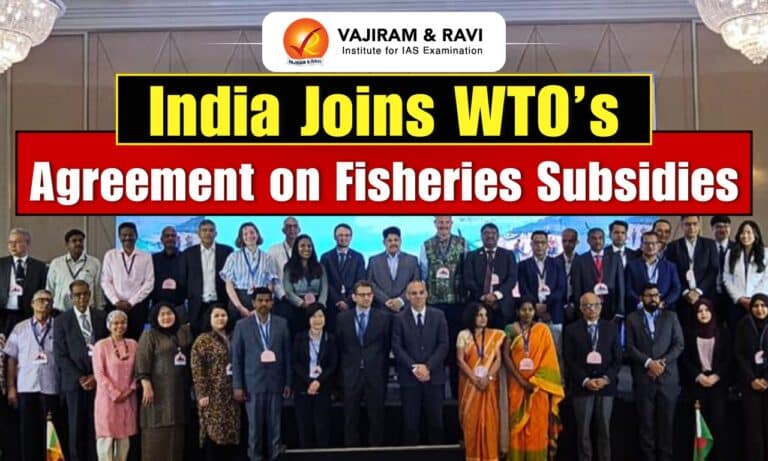
India has deposited its Instrument of Acceptance of the World Trade Organization (WTO) Agreement on Fisheries Subsidies (AFS), becoming the 123rd WTO member to join the pact. The move aims to curb harmful fishing subsidies, promote sustainable use of marine resources and protect the livelihoods of India’s traditional and small-scale fishers.
About WTO Agreement on Fisheries Subsidies
The WTO Agreement on Fisheries Subsidies was adopted by consensus at the WTO’s 12th Ministerial Conference (MC12) in Geneva in June 2022 and entered into force on 15 September 2025 after receiving acceptance from two-thirds of WTO members.
- It is the first multilateral WTO agreement that specifically focuses on environmental sustainability.
- Its main objective is to stop government subsidies that encourage illegal fishing, overfishing and the excessive expansion of fishing fleets.
Key Provisions of WTO Agreement on Fisheries Subsidies
The key provisions of WTO Agreement on Fisheries Subsidies include:
- The Agreement on fisheries subsidies prohibits subsidies that support Illegal, Unreported and Unregulated (IUU) fishing.
- It disciplines subsidies for fishing overfished stocks, subject to specified conditions.
- It targets harmful subsidies that contribute to overcapacity and overfishing, particularly by large industrial and distant-water fishing fleets.
- It applies to marine wild-capture fishing and fishing-related activities at sea.
- Aquaculture and inland fisheries are excluded from the scope of the Agreement.
- The Agreement provides flexibilities for developing and least-developed countries while promoting sustainable fisheries management.


WTO Agreement on Fisheries Subsidies Need
The global fisheries sector faces growing pressure from overfishing, depletion of marine resources and the expansion of heavily subsidised industrial fishing fleets.
- According to WTO estimates, around 37.7% of global marine fish stocks are currently overfished, compared with about 10% in 1974.
- Large-scale government subsidies, estimated at nearly USD 35 billion annually, have contributed to excessive fishing capacity and unsustainable exploitation of marine resources.
By disciplining harmful subsidies, the Agreement seeks to create a more equitable global fisheries regime and promote the conservation and sustainable use of marine resources.
Significance for India
The Agreement is important for India because its fisheries sector is largely based on traditional and small-scale fishing rather than heavily subsidised industrial fishing.
- It can help protect the livelihoods, employment and food security of India’s traditional and small-scale fishing communities.
- It can reduce the unfair advantage enjoyed by large industrial fleets that receive substantial government support.
- It promotes the conservation and sustainable use of India’s marine fisheries resources.
- It can improve India’s credibility in global seafood markets where sustainability and traceability are becoming increasingly important.
- It strengthens India’s commitment to the rules-based multilateral trading system.
A major advantage for India is that aquaculture is outside the scope of the Agreement. India is a major producer and exporter of aquaculture-based shrimp. Since such activities are not covered by the Agreement, India’s shrimp export sector will not face direct restrictions under the AFS.
Thus, India can support sustainable marine fishing while continuing to maintain the competitiveness of its important aquaculture-based seafood export sector.
India’s Domestic Preparedness
India already has several measures that support the objectives of the Agreement.
- The Sustainable Harnessing of Fisheries in the Exclusive Economic Zone (EEZ) Rules, 2025 provide a framework for the sustainable management of fisheries resources within India’s maritime zones.
- The Guidelines for Sustainable Harnessing of Fisheries in the High Seas by Indian-Flagged Fishing Vessels, 2025 promote responsible fishing practices by Indian vessels operating in international waters.
- The Pradhan Mantri Matsya Sampada Yojana (PMMSY) supports fisheries infrastructure, sustainable development, livelihood improvement and capacity building.
These measures provide a foundation for India to implement its international commitments while protecting the interests of fishing communities.
Challenges for India
India must ensure that the implementation of sustainability rules does not impose excessive financial and regulatory burdens on small-scale fishers.
- India needs better scientific assessment of fish stocks to determine the actual health of marine fisheries.
- Stronger monitoring and traceability systems are required to prevent IUU fishing.
- Greater coordination is needed between the Central Government, coastal States, fishing communities and fisheries institutions.
- India must continue to protect the policy space and special flexibilities available to developing countries in future WTO negotiations.
Way Forward
India should combine sustainable fisheries management with targeted support for small-scale fishers.
This requires better scientific data, digital monitoring of fishing activities, improved traceability, modern infrastructure, access to insurance and technology, and alternative livelihood opportunities for vulnerable fishing communities.
At the international level, India should continue to advocate a fair fisheries regime in which the major responsibility for reducing harmful subsidies is placed on countries with large industrial and distant-water fishing fleets.

 Last updated on Oct, 2026
→ UPSC 2027 Notification will be released on 13 January 2027 at upsconline.nic.in.
→ Check Nobel Prize 2026 Winners List here.
→ Download PIB PRiSM Monthly Magazine 2026 here.
→ Check UPSC Monthly Current Affairs Magazine The Recitals here.
→ Check out the latest UPSC Syllabus here.
→ Download UPSC Model Answers for Mains 2026
→ UPSC Mains Question Paper 2026 is out now for Essay & GS Paper 1, 2, 3 & 4.
→ UPSC Calendar 2027 has been released.
→ Enroll in Vajiram & Ravi’s UPSC Mains Test Series 2027 for structured answer writing practice, expert evaluation, and exam-oriented feedback.
→ Join Vajiram & Ravi’s UPSC Mentorship Program 2027 for personalized guidance, strategy planning, and one-to-one support from experienced mentors.
→ Go through the UPSC Mains Previous Year Papers to enhance your preparation.
→ UPSC has released UPSC Toppers List 2025 with the Civil Services final result on its official website.
→ Also check Best UPSC Coaching in India
India Joins the WTO Agreement on Fisheries Subsidies FAQs
Q1. What is the WTO Agreement on Fisheries Subsidies?+
Q2. When was the WTO Agreement on Fisheries Subsidies adopted?+
Q3. When did the WTO Agreement on Fisheries Subsidies enter into force?+
Q4. When did India join the WTO Agreement on Fisheries Subsidies?+
Q5. What is the primary objective of the WTO Agreement on Fisheries Subsidies?+
Q6. What is the significance of the WTO Agreement on Fisheries Subsidies for India?+