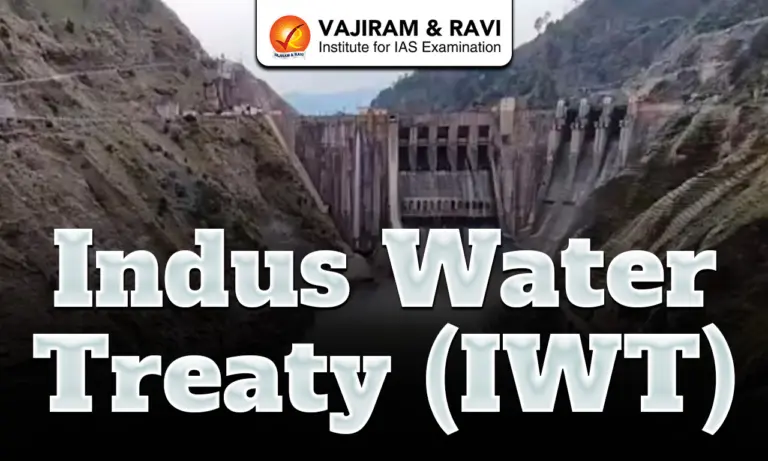
Indus Water Treaty (IWT) Latest News
- India has categorically rejected the recent “award” issued by the “illegally constituted” Court of Arbitration (CoA) concerning disputes with Pakistan under the Indus Waters Treaty (IWT).
- The development comes amid worsening India-Pakistan relations following the Pahalgam terror attack, after which India placed the Indus Waters Treaty in abeyance.
Official Position of India
- Ministry of External Affairs (MEA) spokesperson stated that:
- The Court of Arbitration (CoA) was “illegally constituted”.
- India has never recognised its jurisdiction.
- Any award or decision issued by the CoA is “null and void”.
- India’s decision to keep the IWT in abeyance continues to remain in force.
- The arbitration award reportedly concerns “maximum pondage” issues, and supplemental interpretations related to the treaty.


Indus Water Treaty (IWT)
- Historical background: The treaty was signed on September 19, 1960 between India and Pakistan after nearly nine years of negotiations, with mediation by the World Bank (WB).
- Key features:
- The treaty, which contains 12 Articles, 8 Annexures (A to H), provides for allocation of river water between India and Pakistan.
- Eastern rivers – Allocated to India: Sutlej, Beas, and Ravi. India enjoys “unrestricted use” of waters from these rivers.
- Western rivers – Allocated to Pakistan: Indus, Jhelum, and Chenab. Pakistan receives the majority share of waters from these rivers, though India retains limited rights for –
- Hydropower generation,
- Non-consumptive use, and
- Irrigation under specified conditions.
Grievance Redressal Mechanism under the IWT
- The treaty utilizes a structured, graded, three-tier mechanism to resolve all grievances, differences, and disputes concerning the interpretation or application of the treaty.
- When an issue arises (such as Pakistan objecting to the technical designs of Indian hydropower projects like Kishenganga or Ratle), the IWT provides a graded escalation process outlined in Article IX.
Three-Tier Grievance Mechanism
- Permanent Indus Commission (PIC) – The foundational tier:
- The process: The PIC consists of one Commissioner appointed by each country. They meet regularly, conduct field inspections, and endeavor to resolve minor technical queries or operational disputes through mutual consensus.
- Status: If the PIC successfully resolves an issue, it is settled. If no agreement is reached, the matter is escalated and deemed a “difference”.
- Neutral Expert (NE):
- The process: For technical differences that the PIC cannot resolve, either party can approach the WB to appoint an independent Neutral Expert.
- Status: The NE is strictly limited to reviewing factual and technical engineering questions. The NE’s decision is binding on both parties.
- CoA:
- The process: If the issues involve broader legal or treaty interpretations, or if a NE determines the matter, which is beyond their technical purview, the difference elevates to a dispute.
- Members: At this stage, a 7-member ad hoc arbitral tribunal is formed (the CoA) at The Hague.
- Status: This is the highest legal authority in the treaty.
Current Diplomatic Reality
- The treaty’s grievance mechanism has recently faced a massive diplomatic and legal deadlock.
- India has consistently maintained that Pakistan’s approach to the CoA violates the IWT, arguing that a nation cannot simultaneously pursue proceedings before both a NE and a CoA.
- Consequently, India has boycotted the CoA proceedings, reiterating that the historic treaty has effectively been suspended until mutual foundational premises (including cross-border security) are respected.
India’s Recent Actions on the IWT
- 2023: India issued its first-ever notice seeking “modification” of the treaty, citing Pakistan’s obstructionist approach, and procedural disagreements regarding dispute resolution.
- 2024: India escalated its position by seeking “review and modification” of the treaty. The inclusion of the word “review” signalled India’s intent to renegotiate, and possible reconsideration of the treaty framework itself.
- 2026: Following the Pahalgam terror attack, India decided to keep the treaty in abeyance, marking an unprecedented shift in bilateral water diplomacy.
Key Legal and Diplomatic Issues
- India argues that:
- Pakistan unilaterally approached the CoA.
- The process violated the graded dispute-resolution mechanism under the treaty.
- It instead prefers resolution through a NE mechanism.
- Question of treaty continuity: The current standoff raises larger questions regarding:
- Whether a bilateral treaty can be kept “in abeyance” unilaterally,
- The role of international arbitration in bilateral treaties,
- The balance between treaty obligations and national security concerns.
Way Forward
- Modernisation of the treaty: Possible areas for future renegotiation include climate resilience, data-sharing, hydrological changes, and modern dispute-resolution mechanisms.
- Regional water diplomacy: South Asia requires cooperative river basin management, confidence-building measures, and sustainable utilisation of shared water resources.
Conclusion
- India’s rejection of the arbitration award and its decision to keep the IWT in abeyance highlights that the dispute goes beyond water-sharing and reflects deeper tensions involving terrorism, sovereignty, international law, and strategic security.
- While India seeks greater flexibility and accountability within the treaty framework, the long-term stability of the Indus basin ultimately depends on sustained diplomacy, institutional dialogue, and cooperative water governance.
Source: IE

 Last updated on Oct, 2026
→ UPSC 2027 Notification will be released on 13 January 2027 at upsconline.nic.in.
→ Check Nobel Prize 2026 Winners List here.
→ Download PIB PRiSM Monthly Magazine 2026 here.
→ Check UPSC Monthly Current Affairs Magazine The Recitals here.
→ Check out the latest UPSC Syllabus here.
→ Download UPSC Model Answers for Mains 2026
→ UPSC Mains Question Paper 2026 is out now for Essay & GS Paper 1, 2, 3 & 4.
→ UPSC Calendar 2027 has been released.
→ Enroll in Vajiram & Ravi’s UPSC Mains Test Series 2027 for structured answer writing practice, expert evaluation, and exam-oriented feedback.
→ Join Vajiram & Ravi’s UPSC Mentorship Program 2027 for personalized guidance, strategy planning, and one-to-one support from experienced mentors.
→ Go through the UPSC Mains Previous Year Papers to enhance your preparation.
→ UPSC has released UPSC Toppers List 2025 with the Civil Services final result on its official website.
→ Also check Best UPSC Coaching in India
Indus Water Treaty (IWT) FAQs
Q1. Why is the Indus Water Treaty (IWT) considered a unique example of international water cooperation?+
Q2. What is the main dispute between India and Pakistan regarding the Court of Arbitration (CoA) under the IWT?+
Q3. How did the 2024 notice issued by India alter the discourse surrounding the Indus Waters Treaty?+
Q4. What strategic importance do the Western Rivers hold for Pakistan under the IWT?+
Q5. What emerging challenges threaten the long-term sustainability of the IWT framework?+
Tags: indus water treaty (iwt) mains articles upsc current affairs upsc mains current affairs