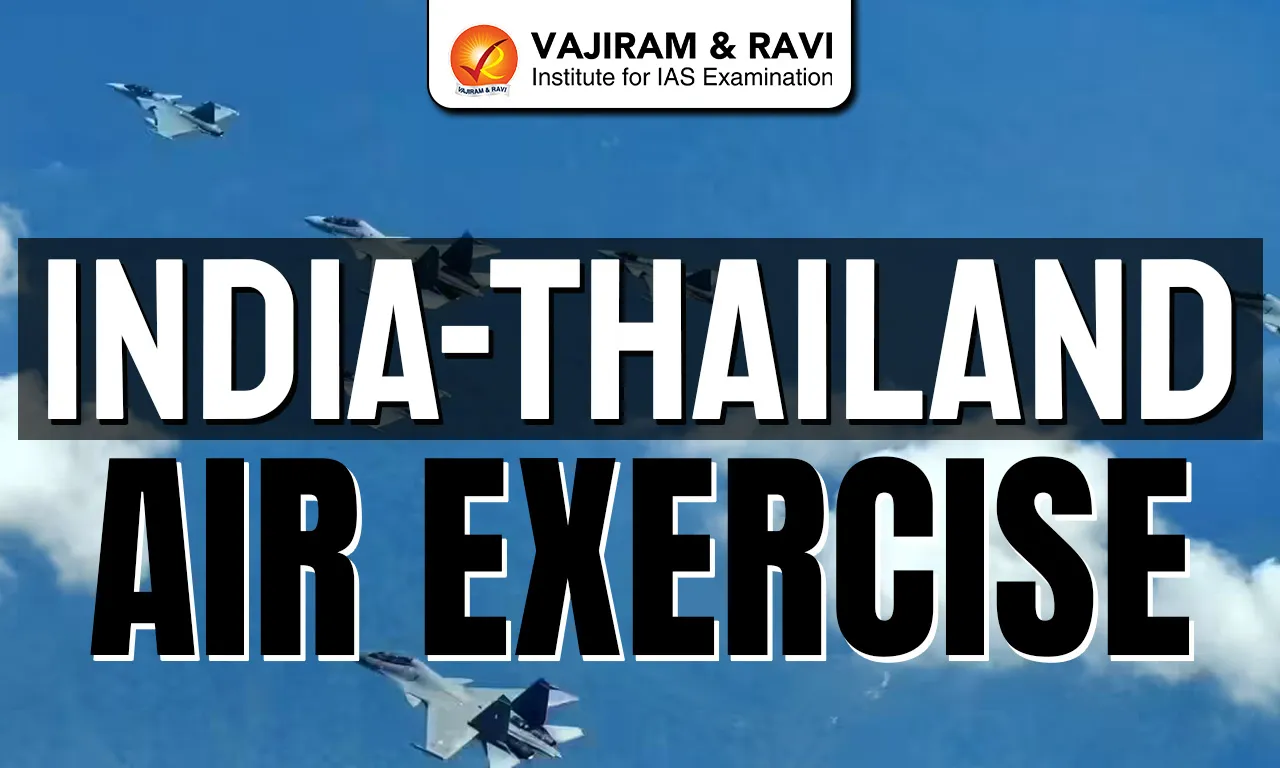
The India-Thailand Air Exercise is a joint drill between the Indian Air Force and the Royal Thai Air Force. It aims to improve coordination, air combat skills and defence cooperation. The exercise strengthens bilateral ties and supports India’s Act East Policy and regional security in the Indo-Pacific.
About India – Thailand Air Exercise 2026
- In February 2026, the Indian Air Force (IAF) conducted a joint air exercise with the Royal Thai Air Force (RTAF) in the Indian Ocean Region. The exercise aimed to strengthen defence cooperation and improve coordination between the two countries.
- India deployed Su-30MKI fighter aircraft, along with IL-78 mid-air refuelling tankers and AWACS aircraft for surveillance and command support. Thailand participated with its SAAB Gripen fighter jets. The Indian aircraft operated from the Andaman and Nicobar Islands, while the Thai aircraft flew from bases in Thailand.
India-Thailand Air Exercise Objectives
The main objective of India-Thailand Air Exercise was to improve interoperability, enhance air combat skills and demonstrate India’s operational reach in the Indian Ocean Region. It also provided both air forces an opportunity to exchange best practices and gain operational experience.


India-Thailand Air Exercise Significance
The India-Thailand Air Exercise highlights the growing defence partnership between India and Thailand under India’s Act East Policy. It also reflects Thailand’s “Act West” approach, strengthening cooperation in the Indo-Pacific region. The Andaman and Nicobar Islands played an important strategic role as a forward operating base in the region.
India’s Act East Policy
The Act East Policy was launched in 2014 by Prime Minister Narendra Modi as an upgraded version of the earlier Look East Policy. It aims to strengthen India’s engagement with Southeast Asia and the wider Indo-Pacific region, with ASEAN at its centre. The policy shifts India’s approach from only building relations to actively participating in regional affairs.
India’s Act East Policy Objectives
The main objectives are to increase trade and investment, improve connectivity, strengthen diplomatic and strategic partnerships and promote cultural exchanges. It also focuses on cooperation in areas like maritime security, counter-terrorism and disaster management to ensure regional stability.
India’s Act East Policy Pillars
The policy has three main pillars:
- Economic Pillar – Promote trade, investment and integration with regional supply chains.
- Socio-Cultural Pillar – Strengthen people-to-people ties and cultural relations.
- Political-Security Pillar – Enhance defence cooperation and ensure peace and stability in the Indo-Pacific.

 Last updated on Oct, 2026
→ UPSC 2027 Notification will be released on 13 January 2027 at upsconline.nic.in.
→ Check Nobel Prize 2026 Winners List here.
→ Download PIB PRiSM Monthly Magazine 2026 here.
→ Check UPSC Monthly Current Affairs Magazine The Recitals here.
→ Check out the latest UPSC Syllabus here.
→ Download UPSC Model Answers for Mains 2026
→ UPSC Mains Question Paper 2026 is out now for Essay & GS Paper 1, 2, 3 & 4.
→ UPSC Calendar 2027 has been released.
→ Enroll in Vajiram & Ravi’s UPSC Mains Test Series 2027 for structured answer writing practice, expert evaluation, and exam-oriented feedback.
→ Join Vajiram & Ravi’s UPSC Mentorship Program 2027 for personalized guidance, strategy planning, and one-to-one support from experienced mentors.
→ Go through the UPSC Mains Previous Year Papers to enhance your preparation.
→ UPSC has released UPSC Toppers List 2025 with the Civil Services final result on its official website.
→ Also check Best UPSC Coaching in India
India-Thailand Air Exercise FAQs
Q1. What is the India -Thailand Air Exercise?+
Q2. When and where was the 2026 exercise conducted?+
Q3. Which aircraft participated in the exercise?+
Q4. What was the main objective of the exercise?+
Q5. What is the strategic importance of the Andaman and Nicobar Islands?+
Tags: India-Thailand Air Exercise international relations international relations notes