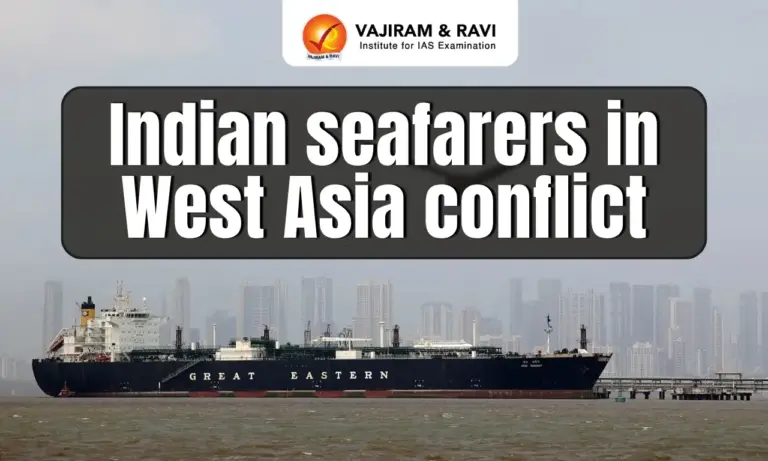
Indian Seafarers in West Asia Conflict Latest News
- Since the West Asia conflict began in February 2026, 16 Indian seafarers have been killed in attacks on merchant ships — more than any other nationality. 33 have been injured, and 3 remain missing.
- Yet India has not barred its seafarers from sailing into the conflict zone. As analysts put it: “In absolute numbers, foreign-flagged vessels have sustained more hits than Indian-flagged vessels. However, in terms of casualties, India has paid the highest cost.”
Why So Many Dead Seafarers Are Indian
- India is the world’s second-largest supplier of seafarers, after the Philippines.
- India’s seafaring workforce grew from 1.03 lakh in 2013 to 3.23 lakh in 2025.
- In the Middle East, Indians are the largest seafaring nationality.
- Over 90% of Indian seafarers (in government-tracked fleets) serve on foreign-flagged vessels — explaining why 15 of the 16 dead were on foreign ships.
- The Indian flag offers diplomatic protection, but most Indians at sea sail under other nations’ flags.


Has India Stopped Seafarers From Sailing There?
- No outright ban exists — only advisories. The Strait of Hormuz, Red Sea, and Gulf of Aden are classified as high-risk zones, with companies told to take precautions.
- The One Binding Rule — Circular 47 (August 2026):
- Shipowners/crewing agencies must inform the Directorate General of Maritime Administration (DGMA) before transiting Hormuz.
- Must obtain written consent from every Indian seafarer on board.
- No Indian may transit the strait without being informed and agreeing.
- Why Seafarers Still Agree to Go: Shipping companies offer 2–3 times normal wages, while financial necessity drives others.
Government’s Legal Position
- Merchant ships have a “right of innocent passage” under the UN Convention on the Law of the Sea (UNCLOS).
- Seafarers are now recognised as “key workers” under the Merchant Shipping Act, 2025, with a right to a safe workplace.
Are Indian Seafarers Trapped?
- Critics acknowledged that the vessels crossing Hormuz have been hit by projectiles, admitting a vessel in such a position “could be perceived as being trapped.”
- However, the DGMA’s official stance is firmer: regular crew changes are happening, and “no seafarer remains trapped or stranded… exceeding their contract.
- Current Status (as of October 8)
- DGMA monitors 38 vessels of Indian interest across the Persian Gulf, Gulf of Oman, Red Sea, and Gulf of Aden:
- 30 Indian-flagged ships carrying 750 Indian seafarers.
- 8 foreign-flagged ships with cargo bound for India.
- Includes container vessels, crude/product tankers, bulk carriers, and LPG carriers.
- DGMA monitors 38 vessels of Indian interest across the Persian Gulf, Gulf of Oman, Red Sea, and Gulf of Aden:
Rescue Efforts
- Over 4,292 Indian seafarers flown home since the DG Shipping control room was activated.
- The control room has handled 19,800 calls and nearly 55,000 emails from seafarers, families, and companies.
- eNavik tracking dashboard (launched May 2026) monitors 19,609 Indians across 1,970+ vessels in the region.
The Sanctioned Vessels Dilemma
- In June 2026, US forces struck the Palau-flagged tanker MT Settebello off Oman, killing 3 Indian seafarers.
- US Central Command said the vessel was trying to breach the US blockade of Iranian ports.
- India’s position: It recognises UN-imposed sanctions, not unilateral sanctions by individual countries. In practice, this means no Indian bar on crewing US-sanctioned vessels.
Tightened Safeguards
- RPSL (Recruitment and Placement Service Licence) agencies must now verify a vessel’s ownership, flag, insurance, and certificates before signing crew.
- Under DGS Order, 366 foreign-flagged vessels with more than 2 recorded cases of abandoning seafarers are barred from hiring Indians through approved agencies (list published on DGMA website, with flags and IMO numbers).
Compensation: What Families Receive
- On Death in a War-Like/High-Risk Zone:
- Seafarers Welfare Fund Society: ₹10 lakh ex gratia.
- National Union of Seafarers of India members: Additional ₹10 lakh.
- Maritime Union of India members: Additional ₹12 lakh.
- Plus: Shipowner’s protection and indemnity insurer compensation under the crew contract.
- For Survivors:
- DGMA (a regulator, not an employer) guides seafarers back to parent companies for re-employment, or helps those unwilling to return to sea settle wages/dues and claim insurance; lost documents replaced free of charge.
- Welfare Fund schemes: Death on Board Benefit, Survivor’s Benefit, Invalidity Benefit (₹6 lakh each); ₹2 lakh for critical illness; ₹20,000/month for up to 12 months for seafarers on abandoned ships.
The Conflict: Origins and Scale of Disruption
- February 28, 2026: US and Israel struck Iran.
- March 4: Iran declared the Strait of Hormuz closed, beginning attacks on vessels. US subsequently blockaded Iranian ports and struck tankers attempting to breach it.
- Ceasefires in April and June both collapsed.
- Traffic impact: Pre-war, 130–140 tankers passed through Hormuz daily; now just 16–17.
- Beyond the Gulf: DGMA also counts 5 Indian seafarer deaths in the Black Sea (Russia-Ukraine war), plus 8 injured, 2 missing. The Red Sea and Gulf of Aden face separate threats from Houthi attacks and piracy.
Conclusion
- India’s seafarers sit at a painful intersection of global conflict and economic necessity — sailing into war zones not because they’re compelled to, but because higher wages and livelihood pressures leave few alternatives, while the government stops short of an outright ban, citing legal rights of passage and economic realities.
- The compensation and tracking systems in place attempt to cushion the risk, but they cannot change the underlying fact: as long as global shipping depends on Indian crews and conflict zones remain active shipping lanes, Indian seafarers will continue bearing a disproportionate share of the human cost of wars they have no part in.
Source: IE

 Last updated on Oct, 2026
→ UPSC 2027 Notification will be released on 13 January 2027 at upsconline.nic.in.
→ Check Nobel Prize 2026 Winners List here.
→ Download PIB PRiSM Monthly Magazine 2026 here.
→ Check UPSC Monthly Current Affairs Magazine The Recitals here.
→ Check out the latest UPSC Syllabus here.
→ Download UPSC Model Answers for Mains 2026
→ UPSC Mains Question Paper 2026 is out now for Essay & GS Paper 1, 2, 3 & 4.
→ UPSC Calendar 2027 has been released.
→ Enroll in Vajiram & Ravi’s UPSC Mains Test Series 2027 for structured answer writing practice, expert evaluation, and exam-oriented feedback.
→ Join Vajiram & Ravi’s UPSC Mentorship Program 2027 for personalized guidance, strategy planning, and one-to-one support from experienced mentors.
→ Go through the UPSC Mains Previous Year Papers to enhance your preparation.
→ UPSC has released UPSC Toppers List 2025 with the Civil Services final result on its official website.
→ Also check Best UPSC Coaching in India
Indian Seafarers in West Asia Conflict FAQs
Q1. Why have Indian seafarers suffered heavily during the West Asia conflict? +
Q2. Has India banned seafarers from sailing through conflict-affected waters? +
Q3. What steps has India taken to monitor and rescue seafarers? +
Q4. What compensation is available to families of Indian seafarers killed in high-risk zones? +
Q5. What safeguards protect Indian seafarers recruited for foreign-flagged vessels? +
Tags: Indian seafarers in West Asia conflict mains articles upsc current affairs upsc mains current affairs