Why in News:
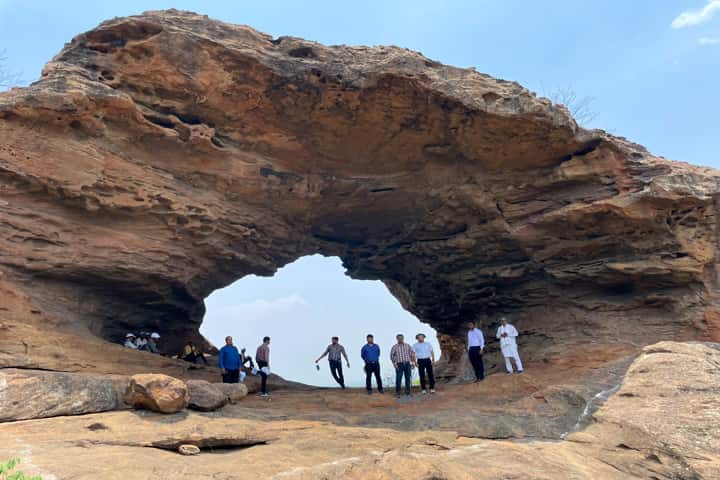
- The state unit of the Geological Survey of India (GSI) has proposed to declare the ‘Natural Arch’ in the Kanika range of Sundargarh forest division, a Geo Heritage Site.
- If it is done, it will be the biggest natural arch of the country to have the Geo Heritage tag.
- Apart from the arch at Sundargarh, India has two others- one at Tirumala hills in Tirupati and another at Andaman and Nicobar. However, both of them are smaller compared to the one in Sundargarh.
About India’s Biggest Natural Arch:
- The Sundargarh natural arch, present in the ferruginous sandstone of the Upper Kamthi formation, dates back to about 184 to 160 million years in the lower to middle Jurassic age.
- It is an oval-shaped arch and has a length of 30 metres at the base and is 12 metres high.
- The alcove of the natural arch has a maximum height and width of 7 metres and 15 metres, respectively.
- The natural arch and its surrounding area is a storehouse of different primary sedimentary structures like planner and cross-bedding along with occasional current ripples signifying high energy fluvial environment during sedimentation.
- Formation: Formation of the natural arch could be due to fault activities and the nature of lithotype, which have enhanced the process of sub-aerial weathering over a long period.
What are Geo Heritage Sites (GHSs)?
- Geoheritage sites are sites of rare and unique geological, geo-morphological, mineralogical, petrological, and paleontological significance, including caves and natural rock sculptures of national and international interest.
- GSI declares geo-heritage sites/ national geological monuments for protection and maintenance.
- GSI or the respective State governments take necessary measures to protect these sites.
Q1) What is the Geological Survey of India (GSI)?
GSI was set up in 1851 primarily to find coal deposits for the Railways. Over the years, it has grown into a repository of geo-science information required in various fields in the country.
Source: India’s biggest natural arch formed 184 million years ago discovered in Odisha by GSI


 Last updated on Oct, 2026
→ UPSC 2027 Notification will be released on 13 January 2027 at upsconline.nic.in.
→ Check Nobel Prize 2026 Winners List here.
→ Download PIB PRiSM Monthly Magazine 2026 here.
→ Check UPSC Monthly Current Affairs Magazine The Recitals here.
→ Check out the latest UPSC Syllabus here.
→ Download UPSC Model Answers for Mains 2026
→ UPSC Mains Question Paper 2026 is out now for Essay & GS Paper 1, 2, 3 & 4.
→ UPSC Calendar 2027 has been released.
→ Enroll in Vajiram & Ravi’s UPSC Mains Test Series 2027 for structured answer writing practice, expert evaluation, and exam-oriented feedback.
→ Join Vajiram & Ravi’s UPSC Mentorship Program 2027 for personalized guidance, strategy planning, and one-to-one support from experienced mentors.
→ Go through the UPSC Mains Previous Year Papers to enhance your preparation.
→ UPSC has released UPSC Toppers List 2025 with the Civil Services final result on its official website.
→ Also check Best UPSC Coaching in India