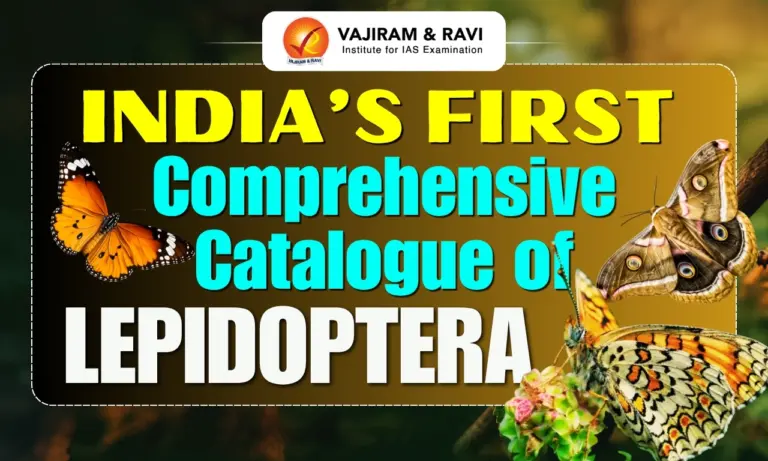
India has completed its first comprehensive national catalogue of Lepidoptera, documenting the country’s butterfly and moth diversity after nearly 12 years of research by the Zoological Survey of India (ZSI).
Published in the international peer-reviewed journal Zootaxa, the catalogue brings together scattered records collected over more than a century and provides an updated database for biodiversity research, ecological studies and conservation planning
About Lepidoptera
Lepidoptera is an insect order that includes butterflies and moths and represents one of the most diverse groups of insects.
- Lepidoptera species are characterised by their scaled wings and are found across diverse ecosystems.
- They perform important ecological functions as pollinators, herbivores and decomposers.
- They also form an important part of food chains by providing food for birds, bats and other insect-eating animals.
About India’s First Comprehensive Lepidoptera Catalogue
India’s first comprehensive Lepidoptera Catalogue is a landmark scientific effort that brings together scattered information on butterflies and moths into a single national reference.
- The catalogue was prepared by Zoological Survey of India (ZSI) scientists Navneet Singh and Rahul Joshi through nearly 12 years of field surveys, museum studies and detailed literature verification.
- The work has been compiled into 22 volumes, with the final volume completing the documentation of Indian Lepidoptera diversity.
- It provides updated information on species classification, distribution and taxonomy, resolving gaps that existed in scientific records for more than 100 years.
- The catalogue covers India’s butterfly and moth diversity across different ecosystems, creating a reliable baseline for future biodiversity studies.


Key Findings of India’s First Comprehensive Lepidoptera Catalogue
India’s First Comprehensive Lepidoptera Catalogue highlights India’s rich Lepidoptera diversity and strengthens scientific understanding of butterfly and moth species.
- India has recorded 13,703 species of Lepidoptera (butterflies and moths), which is around 8.25% of the world’s known species.
- These species are spread across different ecosystems, from the Himalayas to the Western Ghats and tropical forests, showing India’s diverse habitats.
- The recorded diversity includes 1,417 butterfly species and 12,286 moth species, indicating that moths make up the larger share of Indian Lepidoptera.
- The catalogue classifies these species into 3,705 genera, 240 subfamilies, 102 families and 31 superfamilies, helping scientists understand their relationship and diversity.
- A major section of the catalogue covers Geometroidea moths, an important group of mostly night-active moths that help in pollination when many daytime pollinators are inactive.
- India has 2,205 species of Geometroidea moths, belonging to 479 genera, 13 subfamilies and four families, accounting for about 8.8% of the world’s known Geometroidea diversity.
- Among Geometroidea moths, Geometridae is the most diverse family with 2,100 species, followed by Uraniidae (95 species), Epicopeiidae (9 species) and Pseudobistonidae (1 species).
- The most species-rich groups within Geometroidea include Ennominae (895 species), Larentiinae (565 species) and Geometrinae (309 species).
India’s First Comprehensive Lepidoptera Catalogue Significance
The comprehensive inventory strengthens India’s biodiversity conservation efforts and scientific research.
- Improved Biodiversity Knowledge: Provides an updated reference for identifying and studying butterfly and moth species.
- Conservation Planning: Helps researchers and policymakers design better strategies for protecting species and their habitats.
- Climate Change Monitoring: Enables tracking of changes in species distribution caused by environmental and climatic variations.
- Agriculture and Forestry Support: Accurate taxonomic information helps in understanding moth species that may impact crops and forests.
- Global Biodiversity Research: Positions India among countries with a well-documented and scientifically verified biodiversity database.
About Zoological Survey of India (ZSI)
The Zoological Survey of India has been instrumental in documenting India’s animal diversity.
- Established in 1916, ZSI functions under the Ministry of Environment, Forest and Climate Change.
- It undertakes taxonomic research, biodiversity surveys and ecological studies across the country.
The Lepidoptera catalogue reflects ZSI’s role in creating scientific databases essential for biodiversity conservation and environmental management.

 Last updated on Oct, 2026
→ UPSC 2027 Notification will be released on 13 January 2027 at upsconline.nic.in.
→ Check Nobel Prize 2026 Winners List here.
→ Download PIB PRiSM Monthly Magazine 2026 here.
→ Check UPSC Monthly Current Affairs Magazine The Recitals here.
→ Check out the latest UPSC Syllabus here.
→ Download UPSC Model Answers for Mains 2026
→ UPSC Mains Question Paper 2026 is out now for Essay & GS Paper 1, 2, 3 & 4.
→ UPSC Calendar 2027 has been released.
→ Enroll in Vajiram & Ravi’s UPSC Mains Test Series 2027 for structured answer writing practice, expert evaluation, and exam-oriented feedback.
→ Join Vajiram & Ravi’s UPSC Mentorship Program 2027 for personalized guidance, strategy planning, and one-to-one support from experienced mentors.
→ Go through the UPSC Mains Previous Year Papers to enhance your preparation.
→ UPSC has released UPSC Toppers List 2025 with the Civil Services final result on its official website.
→ Also check Best UPSC Coaching in India
India’s First Comprehensive Catalogue of Lepidoptera FAQs
Q1. What is India’s First Comprehensive Catalogue of Lepidoptera?+
Q2. How many Lepidoptera species are found in India according to the catalogue?+
Q3. Which organisation prepared India’s Lepidoptera catalogue?+
Q4. What is Lepidoptera?+
Q5. What percentage of the world’s Lepidoptera diversity is found in India?+
Q6. Why is the Lepidoptera catalogue significant for biodiversity conservation?+
Q7. What role do butterflies and moths play in ecosystems?+
Q8. What is the role of the Zoological Survey of India (ZSI)?+
Tags: indias first comprehensive catalogue of lepidoptera