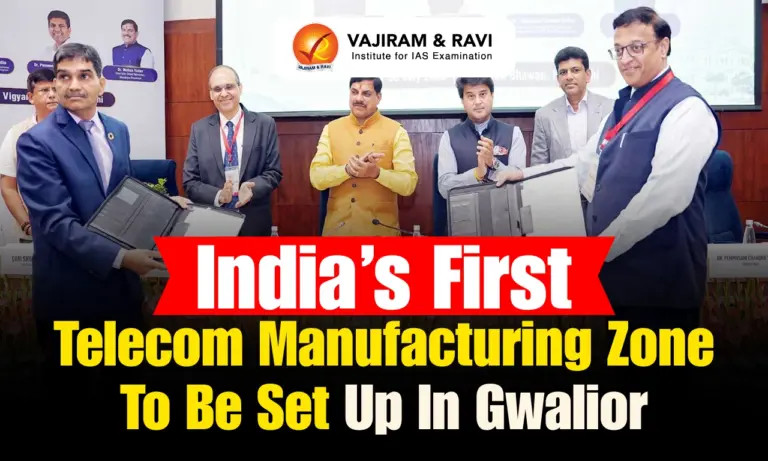
India’s first Telecom Manufacturing Zone (TMZ) will be established at Gwalior, Madhya Pradesh, following the signing of a Memorandum of Understanding (MoU) between the Department of Telecommunications (DoT) and the Government of Madhya Pradesh. The initiative aims to strengthen domestic telecom manufacturing, reduce import dependence and position India as a global hub for advanced telecom technologies.
What is the Telecom Manufacturing Zone (TMZ)?
The Telecom Manufacturing Zone (TMZ) is a dedicated industrial ecosystem designed to bring together the entire telecom value chain from research and design to manufacturing, testing and exports at a single location.
- India’s first Telecom Manufacturing Zone will be established at Gwalior, Madhya Pradesh, in a phased manner.
- The project will be developed over nearly 350 acres through a Special Purpose Vehicle (SPV) with 51% equity held by the Madhya Pradesh Government and 49% by the Department of Telecommunications (DoT).
- The Centre will provide 100% financial support of ₹493 crore for developing core infrastructure during Phase-I.
- Around 170 acres of land have been provided free of cost by the Madhya Pradesh Government, while additional land will be made available on highly concessional lease terms.
- The zone will follow a plug-and-play industrial model, enabling industries to establish manufacturing units with ready infrastructure.
- The TMZ will support the design, manufacturing, testing and certification of telecom products under one integrated ecosystem.
- It will cater to telecom equipment manufacturers, electronics companies, semiconductor firms, MSMEs, start-ups, research institutions and technology developers.
Key Features of the Telecom Manufacturing Zone
- The Telecom Manufacturing Zone will support manufacturing of mobile phones, telecom network equipment, optical fibre, routers, antennas, semiconductor components and next-generation 5G and 6G technologies.
- Dedicated Research and Development (R&D) centres, common testing laboratories and certification facilities will promote indigenous innovation and product development.
- Industries will receive incentives such as capital subsidy, employment generation assistance, skill development support, freight subsidy for exports and reimbursement for patents, trademarks and copyrights.
- The project is expected to create a complete domestic telecom manufacturing ecosystem from component production to finished products and exports.
- Leading companies including Dixon Technologies, HFCL, VVDN Technologies, Syrma SGS, Lava Mobile and Optimus Electronics are expected to anchor the manufacturing ecosystem.


Expected Outcomes of the Telecom Manufacturing Zone
The Telecom Manufacturing Zone is expected to emerge as a major centre for telecom manufacturing, investment and innovation in India.
- Attracts investments: Around ₹3,500 crore of investment commitments have already been received during the investor roundtable, with the project expected to attract substantially higher investments as it expands in subsequent phases.
- Creates employment: The project is projected to generate around 14,000 direct skilled jobs, along with substantial indirect employment opportunities.
- Strengthens domestic manufacturing: Boosts indigenous production of telecom equipment and reduces dependence on imports.
- Improves supply chains: Enhances supply chain resilience while promoting exports of telecom products.
- Develops Gwalior as a manufacturing hub: Positions Gwalior as a leading centre for telecom and electronics manufacturing in India.
Telecom Manufacturing Zone Significance for India
The Telecom Manufacturing Zone is expected to strengthen India’s telecom manufacturing ecosystem while supporting technological self-reliance, innovation and industrial growth.
- Promotes Aatmanirbhar Bharat: Strengthens indigenous manufacturing of telecom equipment and reduces import dependence.
- Boosts advanced technology: Encourages domestic development of 5G, 6G, semiconductor and other next-generation telecom technologies.
- Strengthens telecom security: Expands indigenous production of critical communication infrastructure and strategic telecom equipment.
- Enhances global competitiveness: Positions India as a global manufacturing and export hub for telecom products.
- Generates employment: Creates high-skilled jobs and promotes industrial development in the region.
- Supports flagship initiatives: Complements programmes such as Make in India, Digital India and Viksit Bharat 2047.
Linkages with Government Initiatives
The Telecom Manufacturing Zone complements several flagship government initiatives aimed at building a globally competitive electronics and telecom manufacturing ecosystem.
- India Semiconductor Mission (ISM): Supports domestic semiconductor design and manufacturing, strengthening the supply chain for telecom equipment.
- Electronics Components Manufacturing Scheme (ECMS): Promotes indigenous production of electronic components required for telecom and electronics manufacturing.
- Telecom Technology Development Fund (TTDF): Encourages research, innovation and commercialisation of indigenous telecom technologies, particularly by start-ups, MSMEs and academic institutions.

 Last updated on Oct, 2026
→ UPSC 2027 Notification will be released on 13 January 2027 at upsconline.nic.in.
→ Check Nobel Prize 2026 Winners List here.
→ Download PIB PRiSM Monthly Magazine 2026 here.
→ Check UPSC Monthly Current Affairs Magazine The Recitals here.
→ Check out the latest UPSC Syllabus here.
→ Download UPSC Model Answers for Mains 2026
→ UPSC Mains Question Paper 2026 is out now for Essay & GS Paper 1, 2, 3 & 4.
→ UPSC Calendar 2027 has been released.
→ Enroll in Vajiram & Ravi’s UPSC Mains Test Series 2027 for structured answer writing practice, expert evaluation, and exam-oriented feedback.
→ Join Vajiram & Ravi’s UPSC Mentorship Program 2027 for personalized guidance, strategy planning, and one-to-one support from experienced mentors.
→ Go through the UPSC Mains Previous Year Papers to enhance your preparation.
→ UPSC has released UPSC Toppers List 2025 with the Civil Services final result on its official website.
→ Also check Best UPSC Coaching in India
India’s First Telecom Manufacturing Zone (TMZ) in Gwalior FAQs
Q1. Where will India’s first Telecom Manufacturing Zone (TMZ) be established?+
Q2. What is the Telecom Manufacturing Zone (TMZ)?+
Q3. Why is the Telecom Manufacturing Zone being established?+
Q4. What are the key features of the Telecom Manufacturing Zone?+
Q5. What is the significance of the Telecom Manufacturing Zone for India?+