Indus River Latest News
Pakistan has discovered vast gold reserves worth approximately Rs 80,000 crore in the Indus River bed, potentially boosting the country’s struggling economy
About Indus River
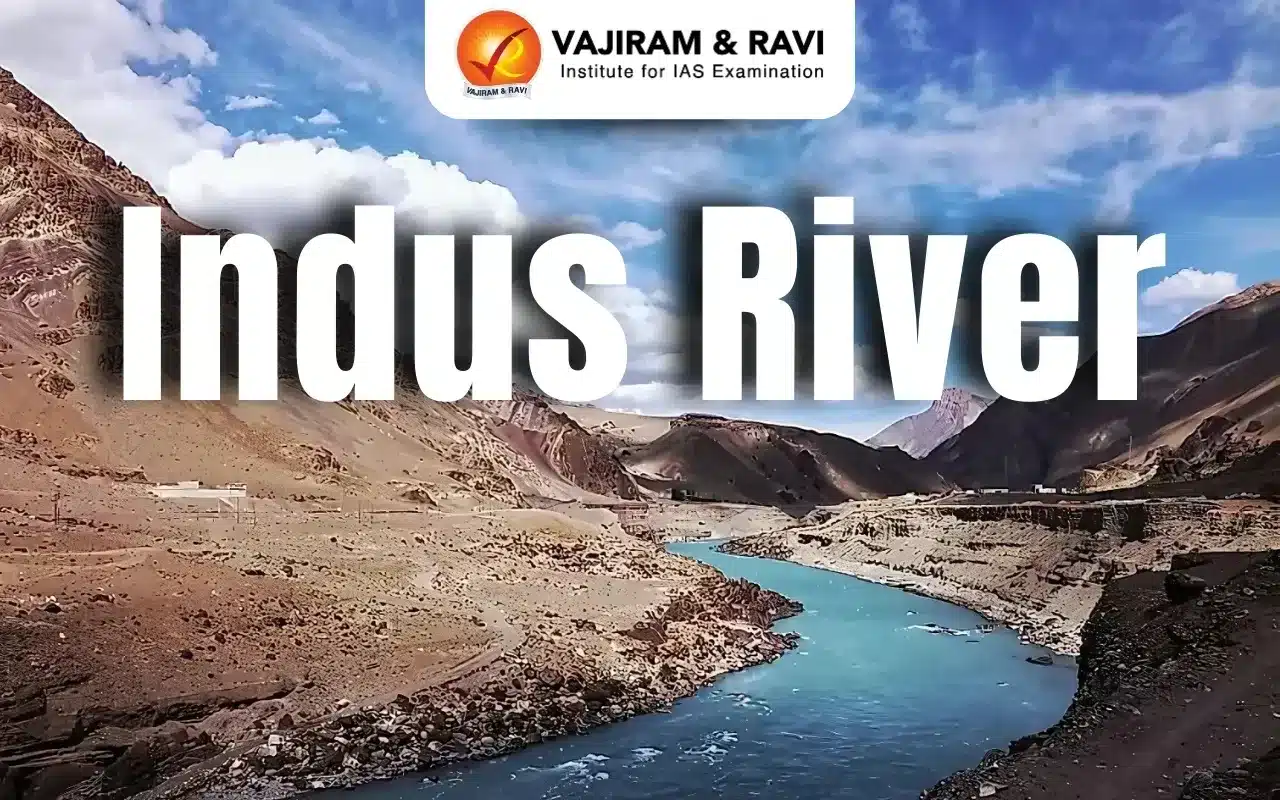
- Origin: The Indus River is one of the longest rivers in Asia. It rises from Mansarovar in Tibet at an elevation of about 5182 m and flows for about 2880 km up to its outfall into the Arabian Sea. The length of the river in India is 800.75 km.
- Tributaries: Its principal tributaries are the Sutlej, the Beas, the Ravi, the Chenab and the Jhelum.
- Countries Flowing Through: It flows through China, India, and Pakistan, serving as a vital water source for agriculture, hydropower, and human consumption.
- The Indus flows through India only through the Union Territory of Ladakh.
- Drainage System: The Indus basin extends over an area of 11,65,500 sq. km and lies in Tibet, India, Pakistan and Afghanistan.
- The drainage area in India is 321289 sq. km. which is nearly 9.8% of the total geographical area of the country.
- It is bounded on the north by the Karakoram and Haramosh ranges, on the east by the Himalayas, on the west by the Sulaiman and Kirthar ranges and on the south by the Arabian Sea.
- Historical Significance: The river has played a crucial role in the development of ancient civilizations, including the Indus Valley Civilization, one of the earliest urban cultures.
Indus River Civilisation
- Indus Valley civilization is the earliest known urban culture of the northwestern regions of the Indian subcontinent.
- It is one of the world’s three earliest civilizations along with Mesopotamia and ancient Egypt. This civilization flourished from approximately 3300 BCE to 1300 BCE.
- Most of the sites discovered earlier, Harappa and Mohenjo-Daro, are present in the Indus valley which gives the name to it. Harappa was the first excavated site therefore, it is also called Harappan culture.


Indus River FAQs
Q1: What is Indus River called in India?
Ans: The Indus River is called Sindhu in Sanskrit, which is its name in India.
Q2. Where do 5 rivers meet Indus?
Ans: Jhelum and Ravi join Chenab, Beas joins Sutlej, and then Sutlej and Chenab join to form Panjnad, 10 miles north of Uch Sharif in Muzaffar Garh district.
Q3. Why is the Indus River so important?
Ans: The Indus River has been important since early civilization. It provided humans with a source of water when little other water could be found in the region.
Source: DH

 Last updated on Oct, 2026
→ UPSC 2027 Notification will be released on 13 January 2027 at upsconline.nic.in.
→ Check Nobel Prize 2026 Winners List here.
→ Download PIB PRiSM Monthly Magazine 2026 here.
→ Check UPSC Monthly Current Affairs Magazine The Recitals here.
→ Check out the latest UPSC Syllabus here.
→ Download UPSC Model Answers for Mains 2026
→ UPSC Mains Question Paper 2026 is out now for Essay & GS Paper 1, 2, 3 & 4.
→ UPSC Calendar 2027 has been released.
→ Enroll in Vajiram & Ravi’s UPSC Mains Test Series 2027 for structured answer writing practice, expert evaluation, and exam-oriented feedback.
→ Join Vajiram & Ravi’s UPSC Mentorship Program 2027 for personalized guidance, strategy planning, and one-to-one support from experienced mentors.
→ Go through the UPSC Mains Previous Year Papers to enhance your preparation.
→ UPSC has released UPSC Toppers List 2025 with the Civil Services final result on its official website.
→ Also check Best UPSC Coaching in India