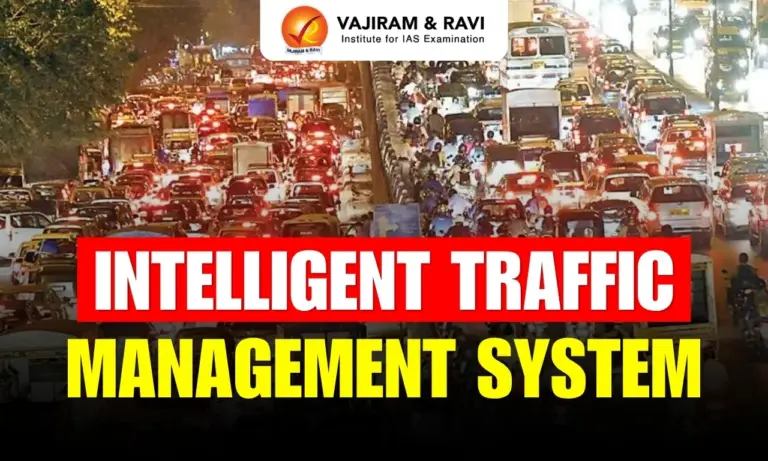
Rapid urbanisation and rising vehicle ownership have placed increasing pressure on India’s road networks. Traditional traffic management, based largely on fixed signal timings and manual monitoring, is often unable to respond quickly to changing traffic conditions.
An Intelligent Traffic Management System (ITMS) uses real-time traffic data, cameras, sensors, adaptive traffic signals, artificial intelligence and integrated control centres to make traffic management more responsive, efficient and safer.
What is an Intelligent Traffic Management System?
Intelligent Traffic Management System is a technology-based system that collects and analyses real-time information about traffic conditions and uses it to manage vehicle movement, enforce traffic rules and respond to road incidents.
Instead of treating traffic signals and enforcement as separate activities, ITMS brings them together through a common digital system.
For example, if sensors and cameras detect heavy traffic on one road, an adaptive traffic signal can modify the signal timing to give more green time to that direction. At the same time, a command centre can monitor the situation and provide information to commuters.
Thus, ITMS shifts traffic management from a fixed and reactive approach to a real-time and data-driven approach.
How Does an Intelligent Traffic Management System Work?
The working of an Intelligent Traffic Management System can be understood as a continuous cycle of data collection, analysis, decision-making and action.
- Traffic data is collected through cameras, vehicle detectors, sensors and other monitoring devices: information may include traffic volume, vehicle speed, congestion and road incidents.
- The data is analysed in real time to identify changing traffic patterns, congestion, violations or unusual events.
- Traffic signals are adjusted according to prevailing conditions: Adaptive Traffic Control Systems can change signal timings and coordinate signals along a corridor.
- Traffic authorities receive alerts about accidents, congestion, wrong-way driving and other incidents, allowing quicker intervention.
- Automated enforcement is enabled through technologies such as Automatic Number Plate Recognition and cameras that detect traffic violations.
- Commuters receive traffic information through Variable Message Signs and digital platforms, helping them choose alternative routes where necessary.
The basic process can therefore be represented as:
C-DAC’s Adaptive Traffic Control System, for instance, continuously detects traffic volume, calculates suitable signal timings and implements them at junctions. Its system is designed to respond to changing traffic patterns and reduce delays, queues and travel time.


Key Components of an Intelligent Traffic Management System
An Intelligent Traffic Management System combines several technologies that perform different but interconnected functions.
- Traffic cameras and sensors collect information on vehicle movement, traffic density, speed and road conditions.
- Adaptive Traffic Control Systems modify signal timings according to real-time traffic conditions instead of relying only on pre-set timings.
- Automatic Number Plate Recognition (ANPR) cameras identify vehicles through their registration plates and can support automated enforcement and vehicle tracking.
- Video Incident Detection Systems use cameras and artificial intelligence to identify incidents such as accidents, stopped vehicles or unsafe driving behaviour.
- Variable Message Signs (VMS) provide commuters with information about congestion, diversions, incidents and other road conditions.
- Traffic Command and Control Centres bring traffic monitoring, enforcement and information systems together on a common platform.
- Communication and data systems connect field devices with control centres and enable the rapid transmission of traffic information.
These components allow ITMS to connect traffic monitoring with traffic control, enforcement and emergency response rather than treating them as separate functions.
Intelligent Traffic Management System in India
India is increasingly using Intelligent Traffic Management System and related Intelligent Transport System technologies to address congestion, road safety and incident response.
Delhi Intelligent Traffic Management System
Delhi is a major recent example of a large-scale ITMS initiative.
In September 2026, the Cabinet Committee on Economic Affairs approved an Intelligent Traffic Management System for Delhi at an estimated cost of ₹1,789.52 crore. The project will cover 42 identified traffic corridors and will be implemented in three phases over 24 months, followed by five years of operation and maintenance.
The system will use:
- Real-time traffic data and adaptive traffic signals:
- Automated detection of traffic violations:
- Traffic Command and Control Centres:
- Real-time information for commuters:
- Priority movement for ambulances and emergency vehicles:
- Artificial intelligence-based analytics for traffic and enforcement.
The project will cover 1,092 Adaptive Traffic Control System locations and 1,029 enforcement locations. It is intended to improve the use of Delhi’s existing road capacity rather than relying only on expansion of road infrastructure.
Intelligent Traffic Management System on National Highways
On National Highways and expressways, the government uses the Advanced Traffic Management System (ATMS) as an important part of Intelligent Transport Systems.
ATMS includes technologies such as:
- AI-based Video Incident Detection and Enforcement Systems:
- Automatic Number Plate Recognition cameras:
- Pan-Tilt-Zoom cameras:
- Surveillance cameras:
- Electronic enforcement systems:
- Variable Message Signs.
These systems help detect incidents early, monitor traffic and improve the response of highway authorities. ATMS has been deployed on high-traffic corridors such as the Delhi-Meerut Expressway, Trans-Haryana and Eastern Peripheral Expressway.
The National Highways Authority of India has also upgraded its ATMS standards to incorporate AI-based video incident detection and digital enforcement. The system can identify several violations and incidents, including wrong-way driving, helmet and seat-belt violations and other unsafe road conditions.
Intelligent Traffic Management System in Indian Cities
Indian cities have also adopted technologies for adaptive traffic control, red-light violation detection, traffic monitoring and smart parking.
C-DAC has developed and deployed Intelligent Transport System solutions in cities including Indore, Jaipur, Pune, Ahmedabad, Kolkata and Thiruvananthapuram. These include urban traffic control, red-light violation detection, vehicle tracking and smart parking solutions.
Such systems are particularly important in Indian cities because traffic is often heterogeneous, with cars, buses, two-wheelers, auto-rickshaws, pedestrians and other road users sharing limited road space.
Intelligent Traffic Management System Benefits
The major advantage of an Intelligent Traffic Management System is that it allows traffic authorities to respond to actual road conditions rather than relying only on fixed arrangements.
- Reduced congestion: adaptive signals can respond to changing traffic volumes and reduce unnecessary waiting at intersections.
- Shorter travel time: coordinated traffic signals and better route management can improve traffic flow.
- Improved road safety: automated detection of speeding, red-light violations, wrong-way driving and other violations can strengthen enforcement.
- Faster incident response: real-time detection of accidents and congestion allows authorities to respond more quickly.
- Priority for emergency vehicles: green corridors and signal priority can facilitate faster movement of ambulances and other emergency vehicles.
- Better commuter information: real-time information on congestion, diversions and incidents can help commuters make informed travel decisions.
- Better use of existing infrastructure: intelligent management can improve the efficiency of existing roads without depending entirely on road expansion.
- Data-driven traffic planning: historical traffic data can help authorities identify recurring congestion points and plan future interventions.
Intelligent Traffic Management System Challenges
Technology alone cannot solve every traffic problem. Effective implementation requires reliable infrastructure, skilled personnel and appropriate urban planning.
- High initial cost: cameras, sensors, communication networks, control centres and software require significant investment.
- Maintenance requirements: field equipment must remain functional despite dust, weather conditions, power issues and continuous use.
- Data integration: different agencies and systems may use different platforms, making interoperability difficult.
- Cybersecurity risks: connected traffic systems can become targets for cyberattacks that may disrupt traffic operations or compromise sensitive data.
- Privacy concerns: extensive use of cameras and vehicle-recognition technologies requires appropriate safeguards for the collection and use of personal data.
- Technical capacity: cities need trained personnel to operate, maintain and analyse these systems effectively.
- Mixed traffic conditions: Indian roads often have heterogeneous and non-lane-based traffic, making traffic prediction and signal optimisation more complex.
- Technology cannot replace better urban planning: poor road design, inadequate public transport, encroachment and insufficient pedestrian infrastructure can continue to create congestion even after the introduction of ITMS.
Way Forward for Intelligent Traffic Management System
The effectiveness of an Intelligent Traffic Management System will depend on how well technology is integrated with broader transport planning.
- Interoperable systems should be developed using open standards and common interfaces so that different traffic and mobility systems can communicate with each other.
- Public transport should be integrated with intelligent traffic management so that buses and other high-capacity modes receive appropriate priority.
- Emergency response should be strengthened by linking traffic control centres with ambulance, police and disaster-response systems.
- Data protection and cybersecurity should be built into the system from the design stage.
- Pedestrian and cyclist safety should remain an important part of intelligent mobility rather than focusing only on vehicular movement.
- Performance should be measured through outcomes such as reduced travel time, fewer accidents, faster incident response and improved compliance rather than merely counting the number of cameras or sensors installed.

 Last updated on Oct, 2026
→ UPSC 2027 Notification will be released on 13 January 2027 at upsconline.nic.in.
→ Asian Games 2026 are being held in Aichi-Nagoya, Japan, from 19 September to 4 October.
→ Check Nobel Prize 2026 Winners List here.
→ Download PIB PRiSM Monthly Magazine 2026 here.
→ Check UPSC Monthly Current Affairs Magazine The Recitals here.
→ Check out the latest UPSC Syllabus here.
→ Download UPSC Model Answers for Mains 2026
→ UPSC Mains Question Paper 2026 is out now for Essay & GS Paper 1, 2, 3 & 4.
→ UPSC Calendar 2027 has been released.
→ Enroll in Vajiram & Ravi’s UPSC Mains Test Series 2027 for structured answer writing practice, expert evaluation, and exam-oriented feedback.
→ Join Vajiram & Ravi’s UPSC Mentorship Program 2027 for personalized guidance, strategy planning, and one-to-one support from experienced mentors.
→ Go through the UPSC Mains Previous Year Papers to enhance your preparation.
→ UPSC has released UPSC Toppers List 2025 with the Civil Services final result on its official website.
→ Also check Best UPSC Coaching in India
Intelligent Traffic Management System FAQs
Q1. What is an Intelligent Traffic Management System?+
Q2. How does an Intelligent Traffic Management System work?+
Q3. What are the major components of an Intelligent Traffic Management System?+
Q4. What are the benefits of an Intelligent Traffic Management System?+
Q5. What are the challenges in implementing an Intelligent Traffic Management System in India?+
Tags: intelligent traffic intelligent traffic management system