Intercrystals Latest News
Researchers at Rutgers University–New Brunswick have discovered a new class of materials called intercrystals, which possess unique electronic properties that could drive future technologies.
What are Intercrystals?
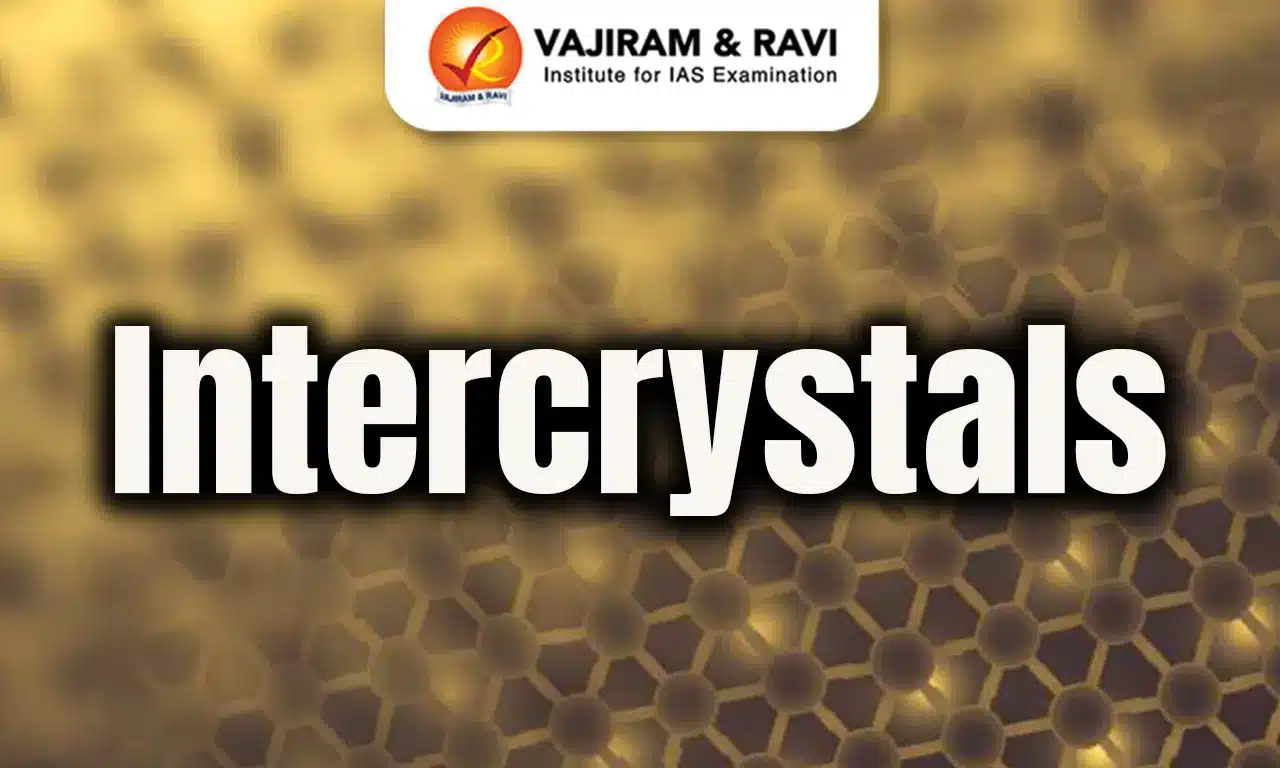
- Intercrystals are created by stacking two layers of twisted graphene atop hexagonal boron nitride (h-BN), resulting in moiré patterns that significantly alter electron behaviour.
- The material is based on the principle of “twistronics”, where ultrathin atomic layers are rotated at small angles to form moiré superlattices.
- The misalignment of layers causes new electronic phases, not found in regular crystals.
- This approach builds upon earlier work by the same team, who in 2009 first showed that twisted graphene displays unusual electronic properties.


Structural Properties of Intercrystals
- Regular crystals possess repeating atomic arrangements and show symmetry under specific translations or rotations.
- Quasicrystals, discovered in 1982, are ordered but non-repeating, defying traditional crystallography.
- Intercrystals combine traits of both:
- They exhibit non-repeating atomic patterns (like quasicrystals),
- But retain certain crystalline symmetries.
- The structure creates geometric frustration, enabling new quantum phases.
Unique Electronic Characteristics
- In intercrystals, electronic properties change dramatically with minor structural variations, unlike conventional materials.
- These materials exhibit novel quantum behaviours, including: Superconductivity (zero-resistance current), Magnetism, and other quantum electronic states.
Intercrystals FAQs
Q1: What are Intercrystals?
Ans: Intercrystals refer to structures formed between individual crystals in solid-state materials, often affecting their mechanical and optical properties.
Q2: In which fields are Intercrystals significant?
Ans: They are important in materials science, mineralogy, semiconductor physics, and nanotechnology.
Source: PHY

 Last updated on Oct, 2026
→ UPSC 2027 Notification will be released on 13 January 2027 at upsconline.nic.in.
→ Check Nobel Prize 2026 Winners List here.
→ Download PIB PRiSM Monthly Magazine 2026 here.
→ Check UPSC Monthly Current Affairs Magazine The Recitals here.
→ Check out the latest UPSC Syllabus here.
→ Download UPSC Model Answers for Mains 2026
→ UPSC Mains Question Paper 2026 is out now for Essay & GS Paper 1, 2, 3 & 4.
→ UPSC Calendar 2027 has been released.
→ Enroll in Vajiram & Ravi’s UPSC Mains Test Series 2027 for structured answer writing practice, expert evaluation, and exam-oriented feedback.
→ Join Vajiram & Ravi’s UPSC Mentorship Program 2027 for personalized guidance, strategy planning, and one-to-one support from experienced mentors.
→ Go through the UPSC Mains Previous Year Papers to enhance your preparation.
→ UPSC has released UPSC Toppers List 2025 with the Civil Services final result on its official website.
→ Also check Best UPSC Coaching in India
Tags: intercrystals prelims pointers upsc current affairs upsc prelims current afffairs