International Atomic Energy Agency Latest News
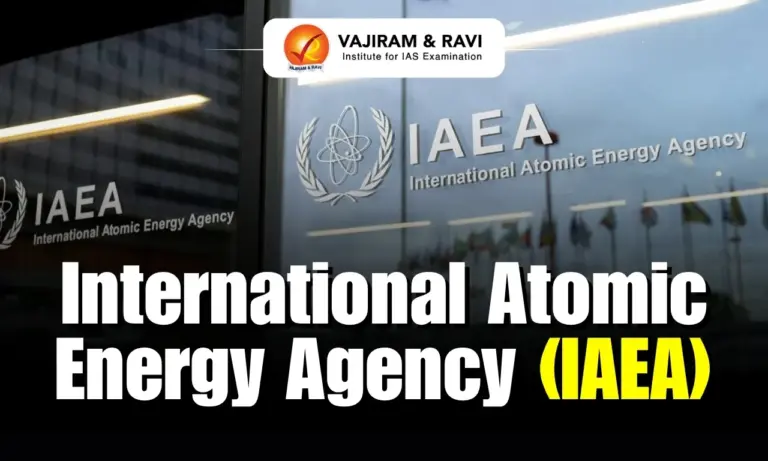
The International Atomic Energy Agency (IAEA) reported Iran to the UN Security Council for the first time in 20 years recently.
About International Atomic Energy Agency
- It is the world’s leading intergovernmental organisation for scientific and technical cooperation in the nuclear field.
- The Agency’s genesis was U.S. President Eisenhower’s “Atoms for Peace” address to the United Nations General Assembly (UNGA) on 8 December 1953.
- The IAEA Statute was approved on 23 October 1956 and came into force on 29 July 1957.
- It is an autonomous organization within the United Nations system.
- It reports to both the UNGA and the UN Security Council.
- Its primary goal is to ensure that nuclear energy is not diverted for weapons purposes.
- The IAEA works with its Member States and multiple partners worldwide to promote the safe, secure, and peaceful use of nuclear technologies.
- It is widely known as the world’s “Atoms for Peace and Development” organization.
- Member Countries: The agency currently has 180 member states, reflecting its wide international mandate and credibility.
- The IAEA is headquartered in Vienna, Austria, and has regional and liaison offices in Toronto, Tokyo, New York, and Geneva.


International Atomic Energy Agency Functions
- Promoting Peaceful Uses of Nuclear Energy: The IAEA encourages the use of nuclear technology for peaceful purposes, emphasizing sustainability and safety.
- Safety and Security: The agency establishes safety standards and provides assistance to ensure that nuclear operations are conducted safely and securely.
- Verification: The IAEA conducts inspections and monitoring to verify compliance with nuclear non-proliferation agreements.
- The IAEA is not a party to the Treaty on the Non-Proliferation of Nuclear Weapons (NPT) but is entrusted with a key verification role under it.
- As part of the NPT, all non-nuclear powers are required to negotiate a safeguards agreement with the IAEA; as part of that agreement, the IAEA is given authority to monitor nuclear programs and to inspect nuclear facilities.
- The IAEA has no power to force the cooperation of its member states; however, each state can choose to follow or ignore the guidelines set by the IAEA.
International Atomic Energy Agency Governance Structure
- General Conference: The General Conference, composed of all member states, meets annually to approve budgets and set general policy directions.
- Board of Governors: The Board of Governors, comprising 35 members, meets about five times a year to: approve safeguards agreements, carry out statutory functions, and appoint the Director General.
- Secretariat: The Secretariat, led by the Director General, handles the IAEA’s daily operations.
News: TH

 Last updated on Oct, 2026
→ UPSC 2027 Notification will be released on 13 January 2027 at upsconline.nic.in.
→ Asian Games 2026 are being held in Aichi-Nagoya, Japan, from 19 September to 4 October.
→ Check Nobel Prize 2026 Winners List here.
→ Download PIB PRiSM Monthly Magazine 2026 here.
→ Check UPSC Monthly Current Affairs Magazine The Recitals here.
→ Check out the latest UPSC Syllabus here.
→ Download UPSC Model Answers for Mains 2026
→ UPSC Mains Question Paper 2026 is out now for Essay & GS Paper 1, 2, 3 & 4.
→ UPSC Calendar 2027 has been released.
→ Enroll in Vajiram & Ravi’s UPSC Mains Test Series 2027 for structured answer writing practice, expert evaluation, and exam-oriented feedback.
→ Join Vajiram & Ravi’s UPSC Mentorship Program 2027 for personalized guidance, strategy planning, and one-to-one support from experienced mentors.
→ Go through the UPSC Mains Previous Year Papers to enhance your preparation.
→ UPSC has released UPSC Toppers List 2025 with the Civil Services final result on its official website.
→ Also check Best UPSC Coaching in India
International Atomic Energy Agency FAQs
Q1. What is the International Atomic Energy Agency (IAEA)?+
Q2. When did the International Atomic Energy Agency (IAEA) Statute come into force?+
Q3. What is the primary goal of the International Atomic Energy Agency (IAEA)?+
Q4. Where is the headquarters of the International Atomic Energy Agency (IAEA) located?+
Tags: international atomic energy agency