International Centre for Integrated Mountain Development Latest News
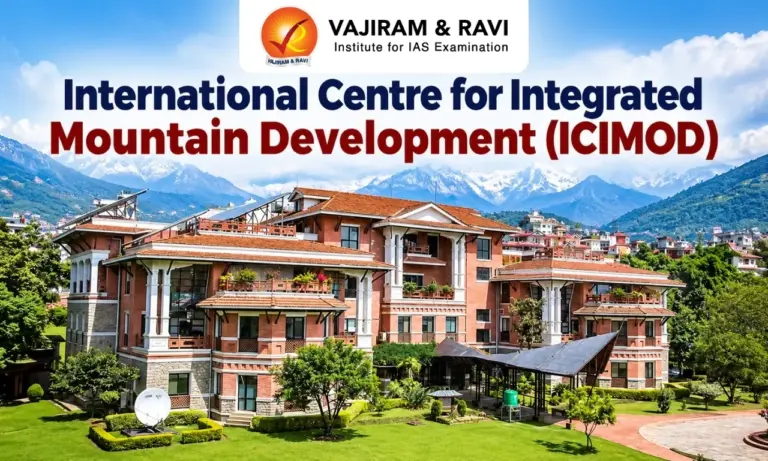
The Union ministry of environment, forest & climate change (MoEFCC) recently tasked Almora’s GB Pant National Institute of Himalayan Environment (GBPNIHE) with coordinating activities of the International Centre for Integrated Mountain Development (ICIMOD) in India.
About International Centre for Integrated Mountain Development
- It is an intergovernmental knowledge and learning centre working on behalf of the people of the Hindu Kush Himalaya (HKH).
- It was formally established and inaugurated on 5 December 1983.
- It is based in Kathmandu, Nepal.
- It works in and for its eight regional member countries (RMCs) of HKH: Afghanistan, Bangladesh, Bhutan, China, India, Myanmar, Nepal, and Pakistan.
- Mission: Build and share knowledge that drives regional policy and action and attracts investment that enables the diverse countries and communities of the HKH to transition to greener, more inclusive, and climate-resilient development.
- Globalization and climate change have an increasing influence on the stability of fragile mountain ecosystems and the livelihoods of mountain people.
- ICIMOD aims to assist mountain people to understand these changes, adapt to them, and make the most of new opportunities, while addressing upstream-downstream issues.
- It supports regional transboundary programmes through partnerships with regional partner institutions, facilitates the exchange of experience, and serves as a regional knowledge hub.
- It also strengthens networking among regional and global centres of excellence.


Key Facts about Hindu Kush Himalaya
- It is a vast mountain region that extends 3500 km over eight countries: Afghanistan, Bangladesh, Bhutan, China, India, Myanmar, Nepal, and Pakistan.
- It is considered the Third Pole (after the North and South Poles) and has significant implications for climate.
- It forms the largest area of permanent ice cover outside of the North and South Poles and is home to 4 global biodiversity hotspots.
- It is the source of ten large Asian river systems: the Amu Darya, Indus, Ganges, Brahmaputra, Irrawaddy, Salween, Mekong, Yangtse, Yellow River, and Tarim.
- The basins of these rivers provide water to 1.9 billion people, a fourth of the world’s population.
News: TOI

 Last updated on Nov, 2026
→ UPSC 2027 Notification will be released on 13 January 2027 at upsconline.nic.in.
→ Check Nobel Prize 2026 Winners List here.
→ Download PIB PRiSM Monthly Magazine 2026 here.
→ Check UPSC Monthly Current Affairs Magazine The Recitals here.
→ Check out the latest UPSC Syllabus here.
→ Download UPSC Model Answers for Mains 2026
→ UPSC Mains Question Paper 2026 is out now for Essay & GS Paper 1, 2, 3 & 4.
→ UPSC Calendar 2027 has been released.
→ Enroll in Vajiram & Ravi’s UPSC Mains Test Series 2027 for structured answer writing practice, expert evaluation, and exam-oriented feedback.
→ Join Vajiram & Ravi’s UPSC Mentorship Program 2027 for personalized guidance, strategy planning, and one-to-one support from experienced mentors.
→ Go through the UPSC Mains Previous Year Papers to enhance your preparation.
→ UPSC has released UPSC Toppers List 2025 with the Civil Services final result on its official website.
→ Also check Best UPSC Coaching in India
International Centre for Integrated Mountain Development FAQ's
Q1. What is the International Centre for Integrated Mountain Development (ICIMOD)?+
Q2. When was the International Centre for Integrated Mountain Development (ICIMOD) formally established and inaugurated?+
Q3. Where is the headquarters of International Centre for Integrated Mountain Development (ICIMOD) located?+
Q4. Which countries are the regional member countries of International Centre for Integrated Mountain Development (ICIMOD)?+
Tags: international centre for integrated mountain development prelims pointers upsc current affairs upsc prelims current affairs