About Ionosphere
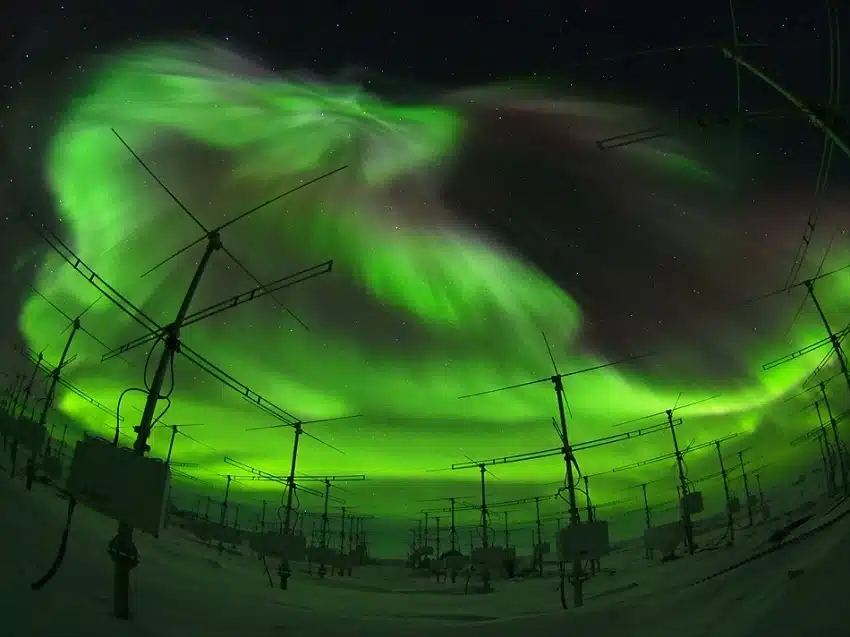
- It is a part of Earth’s upper atmosphere, which is partially ionized extending from 100-1000km.
- The ionosphere at polar regions is highly dynamic and acts as a major energy sink for space weather events, and related processes in magnetosphere-ionosphere systems as the magnetic field lines are vertical in this region.
- It is an interesting layer which overlaps the mesosphere, thermosphere, and exosphere.
- It’s a very active part of the atmosphere, and it grows and shrinks depending on the energy it absorbs from the sun.
- The ionospheric observations in Antarctica are few compared to the Arctic region due to geographic limitations and limited number of stations.
Key points
- Decade-long ionospheric observations at Bharati station, Antarctica, found a substantial seasonal variation with maximum total electron count (TEC) in equinoctial months followed by the summer and winter.
- The scientists attributed the peak ionization to particle precipitation and transportation of convectional plasma from high latitudes.
- Also, the maximum ionospheric density in the summer months where 24 hours sunlight is present (polar days), was about twice more than that of polar nights at the Bharati region.
- Significance of the study: Such long-term studies can help understand effects of the ionosphere on satellite-based navigation and communication systems and to mitigate them.
Q1) What is the mesosphere?
The mesosphere is a layer of Earth’s atmosphere. The mesosphere is directly above the stratosphere and below the thermosphere. It extends from about 50 to 85 km (31 to 53 miles) above our planet. Temperature decreases with height throughout the mesosphere.
Source: Ionospheric secrets traced in the White continent can help satellite-based navigation


 Last updated on Oct, 2026
→ UPSC 2027 Notification will be released on 13 January 2027 at upsconline.nic.in.
→ Check Nobel Prize 2026 Winners List here.
→ Download PIB PRiSM Monthly Magazine 2026 here.
→ Check UPSC Monthly Current Affairs Magazine The Recitals here.
→ Check out the latest UPSC Syllabus here.
→ Download UPSC Model Answers for Mains 2026
→ UPSC Mains Question Paper 2026 is out now for Essay & GS Paper 1, 2, 3 & 4.
→ UPSC Calendar 2027 has been released.
→ Enroll in Vajiram & Ravi’s UPSC Mains Test Series 2027 for structured answer writing practice, expert evaluation, and exam-oriented feedback.
→ Join Vajiram & Ravi’s UPSC Mentorship Program 2027 for personalized guidance, strategy planning, and one-to-one support from experienced mentors.
→ Go through the UPSC Mains Previous Year Papers to enhance your preparation.
→ UPSC has released UPSC Toppers List 2025 with the Civil Services final result on its official website.
→ Also check Best UPSC Coaching in India