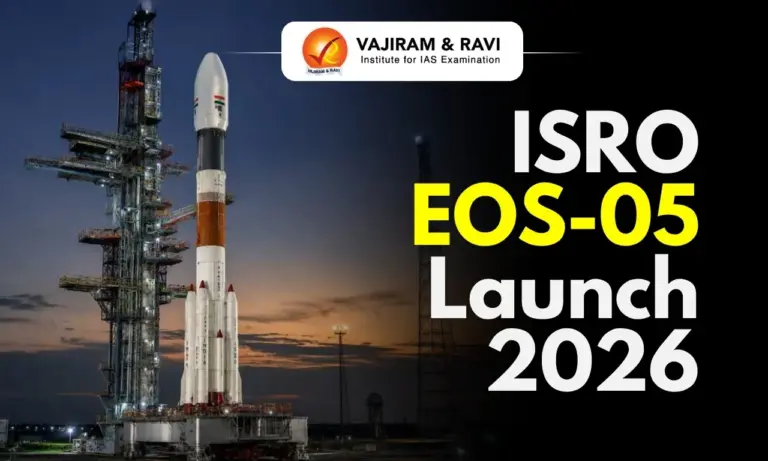
The Indian Space Research Organisation (ISRO) has launched the GSLV-F17/EOS-05 mission on September 4, 2026, at 2:55 AM IST. The mission lift off from the Second Launch Pad (SLP) at Satish Dhawan Space Centre (SDSC-SHAR), Sriharikota.
The GSLV-F17 carried EOS-05, an advanced Earth observation satellite, and placed it into a Sub-Geosynchronous Transfer Orbit (Sub-GTO). A major feature of the mission is that EOS-05 is India’s first imaging satellite designed for operation from a geosynchronous orbit.
What is GSLV-F17?
GSLV-F17 is the launch vehicle assigned to place EOS-05 into its designated orbit. It belongs to India’s Geosynchronous Satellite Launch Vehicle (GSLV) family, which is designed to launch heavier spacecraft into high-energy orbits.
For the GSLV-F17 mission, ISRO is using a 4-metre diameter Ogive composite payload fairing. The fairing protects the satellite from atmospheric conditions during the initial phase of flight.
The vehicle will inject EOS-05 into a Sub-Geosynchronous Transfer Orbit (Sub-GTO). From there, the spacecraft can be manoeuvred towards its operational orbit.
What is EOS-05?
EOS-05 is a state-of-the-art Earth observation spacecraft developed by ISRO. It is particularly significant because it is described by ISRO as India’s first-ever imaging satellite from a geosynchronous orbit.
Earth observation satellites collect information about the Earth’s surface and atmosphere. Their data can support applications such as:
- Land and resource monitoring
- Agricultural assessment
- Disaster management
- Environmental monitoring
- Weather and climate-related studies
- Mapping and planning


EOS-05 and Geosynchronous Orbit
A key aspect of the mission is the use of a geosynchronous orbit for Earth imaging.
A geosynchronous satellite has an orbital period approximately equal to Earth’s rotation period. Such an orbit allows a satellite to repeatedly observe a particular region at regular intervals.
The use of geosynchronous orbit for Earth observation can be particularly useful for frequent monitoring of large areas. This makes the EOS-05 mission important from the perspective of India’s remote sensing and Earth observation capabilities.
What is Sub-Geosynchronous Transfer Orbit?
The Sub-Geosynchronous Transfer Orbit (Sub-GTO) is the target orbit into which GSLV-F17 will place EOS-05.
A transfer orbit is used to move a spacecraft from the launch vehicle’s initial injection conditions towards its intended operational orbit. After reaching the transfer orbit, the satellite can undertake additional orbital manoeuvres to reach its final position.
The distinction between GTO, Sub-GTO, geosynchronous orbit and geostationary orbit is important while understanding India’s space missions.
ISRO EOS-05 Launch 2026 Significance
GSLV-F17/EOS-05 Mission is significant for strengthening India’s Earth observation capabilities and demonstrating the use of a geosynchronous orbit for imaging applications.
- First geosynchronous imaging satellite: EOS-05 is India’s first-ever imaging satellite from a geosynchronous orbit.
- Strengthens Earth observation: The mission will enhance India’s ability to obtain space-based Earth observation data.
- Advances satellite applications: Earth observation data can support resource monitoring, environmental studies, agriculture and disaster management.
- Demonstrates GSLV capability: GSLV-F17 marks the 19th flight of the GSLV, adding to India’s experience with high-energy orbital missions.
- Technological advancement: The mission reflects progress in developing advanced spacecraft and launch vehicle technologies.
- Strategic importance: Improved space-based observation capabilities can contribute to better planning, monitoring and management of natural resources.
- Expands orbital applications: EOS-05 demonstrates the potential of geosynchronous orbit for Earth imaging, broadening India’s remote-sensing capabilities.
Importance of Earth Observation Satellites
Earth observation satellites are an important part of modern space-based infrastructure. They provide data that can be used by governments, researchers and other organisations for monitoring changes on Earth.
Their applications include:
- Agriculture: Monitoring crops and agricultural conditions.
- Disaster Management: Assessing floods, cyclones, landslides and other disasters.
- Water Resources: Monitoring water bodies and changes in water resources.
- Forestry: Tracking forest cover and environmental changes.
- Urban Planning: Supporting mapping and development planning.
- Environmental Monitoring: Studying changes in ecosystems and land use.
- Climate Studies: Providing observations useful for understanding environmental and climatic changes.

 Last updated on Oct, 2026
→ UPSC 2027 Notification will be released on 13 January 2027 at upsconline.nic.in.
→ Check Nobel Prize 2026 Winners List here.
→ Download PIB PRiSM Monthly Magazine 2026 here.
→ Check UPSC Monthly Current Affairs Magazine The Recitals here.
→ Check out the latest UPSC Syllabus here.
→ Download UPSC Model Answers for Mains 2026
→ UPSC Mains Question Paper 2026 is out now for Essay & GS Paper 1, 2, 3 & 4.
→ UPSC Calendar 2027 has been released.
→ Enroll in Vajiram & Ravi’s UPSC Mains Test Series 2027 for structured answer writing practice, expert evaluation, and exam-oriented feedback.
→ Join Vajiram & Ravi’s UPSC Mentorship Program 2027 for personalized guidance, strategy planning, and one-to-one support from experienced mentors.
→ Go through the UPSC Mains Previous Year Papers to enhance your preparation.
→ UPSC has released UPSC Toppers List 2025 with the Civil Services final result on its official website.
→ Also check Best UPSC Coaching in India
ISRO EOS-05 Launch 2026 FAQs
Q1. What is ISRO EOS-05 Launch 2026?+
Q2. When will EOS-05 be launched?+
Q3. Which launch vehicle launched EOS-05?+
Q4. Where will the EOS-05 launch take place?+
Q5. What type of satellite is EOS-05?+
Q6. What is special about EOS-05?+
Q7. Into which orbit will GSLV-F17 place EOS-05?+
Q8. What is the significance of the GSLV-F17 mission?+
Tags: eos-05 isro eos-05 isro eos-05 launch isro eos-05 launch 2026