


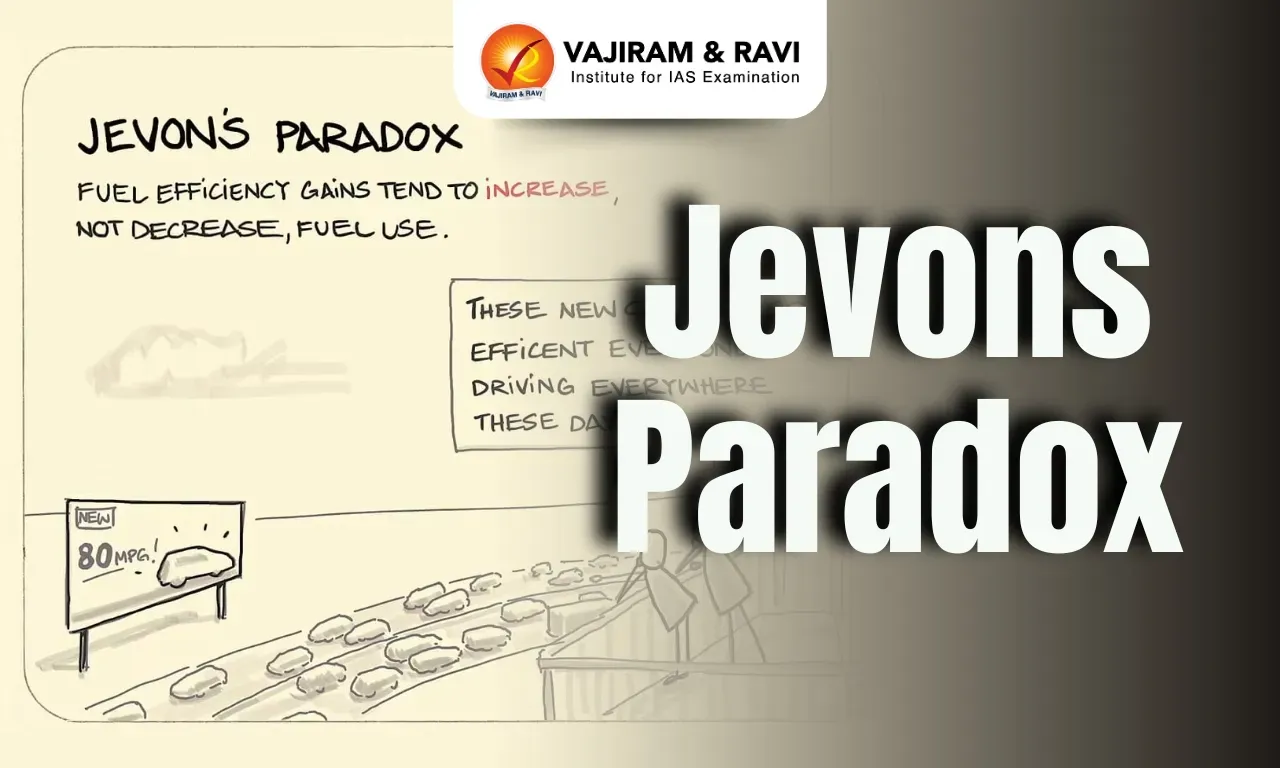
Jevons Paradox Latest News
Recently, Microsoft CEO Satya Nadella discussed Jevons Paradox, noting that improved efficiency in AI may boost its demand and make it a commodity.
About Jevons Paradox
- It is the idea that technological progress that makes a resource cheaper or more efficient to use often leads to an increase in demand for that resource.
- This refers to a form of induced demand wherein efficiency improvements in the use of a resource causes increased consumption of the resource rather than a decrease in its use.
- Origin of Jevons Paradox
- It was proposed by the English economist, William Stanley Jevons, in his 1865 book The Coal Question .
- Jevons observed that the efficient use of coal made possible by technology actually caused more coal to be extracted and consumed rather than allowing the preservation of existing reserves.
- Technological progress, in other words, only allows people to satisfy demands that could not be satisfied earlier in the absence of an appropriate technology.


Examples of Jevons Paradox
- Fuel Efficiency and Vehicle Usage: Vehicle fuel efficiency improvements can also increase consumption. When cars become more fuel-efficient, the cost of driving per mile decreases, making it more affordable for individuals to use their vehicles — often increasing vehicle miles travelled, offsetting any energy conservation benefits from improved fuel efficiency.
- Energy Efficiency and Consumption: As energy-efficient technologies emerge, individuals and businesses are motivated to increase their consumption due to reduced costs. For instance, the advent of energy-efficient lighting, such as LED bulbs,
- Digital Technology and Energy Consumption: The rise of digital technology and the internet has undoubtedly brought numerous benefits to society. Yet, the proliferation of intelligent devices and data centres has substantially increased energy consumption.
Jevons Paradox FAQs
Q1: What is the concept of Jevons Paradox?
Ans: The Jevons Paradox states that, in the long term, an increase in efficiency in resource use will generate an increase in resource consumption rather than a decrease.
Q2: What is an example of the Jevons Paradox?
Ans: More energy-efficient cars, appliances and light bulbs may fail to reduce our consumption of fossil fuels.
Q3:Who created Jevons Paradox?
Ans: William Stanley Jevons
Source: LM

 Last updated on Oct, 2026
→ UPSC 2027 Notification will be released on 13 January 2027 at upsconline.nic.in.
→ Check Nobel Prize 2026 Winners List here.
→ Download PIB PRiSM Monthly Magazine 2026 here.
→ Check UPSC Monthly Current Affairs Magazine The Recitals here.
→ Check out the latest UPSC Syllabus here.
→ Download UPSC Model Answers for Mains 2026
→ UPSC Mains Question Paper 2026 is out now for Essay & GS Paper 1, 2, 3 & 4.
→ UPSC Calendar 2027 has been released.
→ Enroll in Vajiram & Ravi’s UPSC Mains Test Series 2027 for structured answer writing practice, expert evaluation, and exam-oriented feedback.
→ Join Vajiram & Ravi’s UPSC Mentorship Program 2027 for personalized guidance, strategy planning, and one-to-one support from experienced mentors.
→ Go through the UPSC Mains Previous Year Papers to enhance your preparation.
→ UPSC has released UPSC Toppers List 2025 with the Civil Services final result on its official website.
→ Also check Best UPSC Coaching in India








