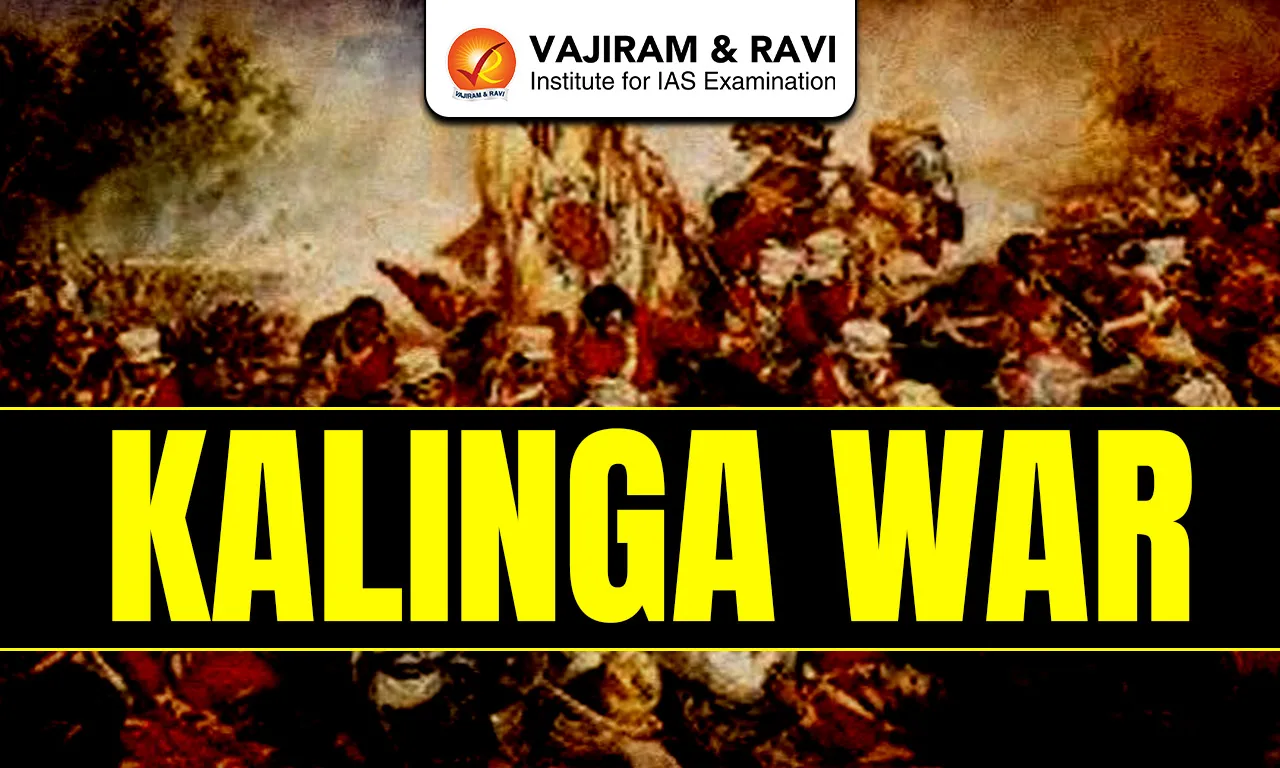
The Kalinga War was fought in 261 BCE between Emperor Ashoka of the Mauryan Empire and the powerful state of Kalinga. Ancient Kalinga was located in east-central India and covered present day northern Telangana, northeastern Andhra Pradesh, most of Odisha and parts of Madhya Pradesh. It was a prosperous maritime region with major ports like Kakinada, Visakhapatnam and Srikakulam and inland cities such as Rajahmundry and Vizianagaram. The war became one of the bloodiest conflicts of ancient India and deeply transformed Ashoka’s political and moral outlook.
Kalinga War Reasons
Kalinga’s strategic and economic strength made it vital for imperial control and thus resulted in the Kalinga War. The major highlighting causes of the war has been listed below:
- Strategic Location: Kalinga lay between the Indo-Gangetic Plain and peninsular India, controlling land routes from Pataliputra to the southern regions. Its forested hinterland connected central India through tribal territories, making it militarily significant.
- Maritime Power: Ports such as Kakinada, Visakhapatnam and Srikakulam enabled rich sea trade with Burma, Malay, Java and Ceylon. Control over these ports meant dominance over Bay of Bengal commerce.
- Political Independence: After the fall of the Nanda dynasty in 321 BCE, Kalinga regained independence despite earlier Magadhan control under Mahapadma Nanda. Mauryan rulers Chandragupta and Bindusara failed to annex it.
- Imperial Expansion Policy: Ashoka, in the 12th year of his reign, demanded submission from Kalinga’s ruler. The refusal directly triggered armed conflict in 261 BCE.
- Military Strength of Kalinga: Historical accounts mention 60,000 infantry, 1,000 cavalry and 700 elephants in Kalinga’s army, indicating organized resistance capacity.
Also Read: List of maratha wars
Kalinga War Course
The Kalinga War unfolded with intense resistance and large scale mobilization of forces on both sides. The major features of the war are:
- Battlefield Location: The main confrontation occurred near Dhauli Hills along the Daya River, turning the region into a massive battleground marked by heavy casualties.
- Year of Conflict: The decisive campaign occurred in 261 BCE during Ashoka’s early reign.
- Kalinga Army Strength: Approximately 60,000 infantry, 1,000 cavalry and 700 war elephants defended the state.
- Mauryan Military Power: Greek ambassador Megasthenes described Mauryan forces as about one lakh soldiers with 1,700 horses and thousands of elephants.
- Leadership of Kalinga: Sources mention Raja Ananta Padmanabha or republican chiefs leading resistance, reflecting either monarchical or confederated governance structure.
- Massive War Casualties: Rock Edict XIII records 100,000 deaths and 150,000 deported captives after the battle.
- Civilian Suffering: Many additional deaths occurred from famine, displacement and post war devastation.
- Territorial Annexation: Kalinga was incorporated as a province within the expanding Mauryan Empire.


Kalinga War Outcomes
Ashoka won the Kalinga War and it ended with annexation but massive devastation. The major
- Kalinga became the fifth province of the Magadhan Empire, joining Prachaya, Avanti, Uttarapatha and Dakshinapatha under Mauryan administration.
- Ashoka recorded the deportation of more than 150,000 people and acknowledged widespread suffering among civilians, including families and tribal communities.
- The region’s ports and urban centers like Rajahmundry and Vizianagaram were incorporated into Mauryan fiscal and trade networks.
- After witnessing battlefield destruction, Ashoka publicly renounced further conquest wars, marking the end of aggressive Mauryan expansion.
- Rock Edict XIII records Ashoka’s remorse, stating sorrow over killing and deportation, especially among Brahmanas, Shramanas and householders.
Also Read:
Kalinga War Impact
The major impacts and aftermath of the Kalinga War has been listed below:
- Adoption of Dhamma Policy: Ashoka replaced conquest by sword with “Dharma-Vijaya,” promoting moral governance, tolerance and welfare administration across his empire.
- Spread of Buddhism: Following the war, Ashoka supported Buddhist missions extending from the Himalayas to Ceylon and toward regions including Burma and even Greek territories.
- Welfare Measures: He initiated public works such as planting trees, digging wells, building hospitals for humans and animals and appointing Dhamma Mahamatras for ethical oversight.
- Long Peace Phase: The empire experienced nearly 40 years of relative internal stability after 261 BCE, with no major recorded expansionist wars.
- Inscriptional Legacy: Ashoka’s edicts carved on rocks and pillars across the subcontinent documented moral principles, making the Kalinga episode one of the earliest recorded examples of ethical state reflection.
Kalinga War Significance
The Kalinga War stands as a transformative event in ancient Indian history. Its significance lies in:
- It marked the conclusion of the Mauryan tradition of territorial conquest that began under Chandragupta Maurya and continued under Bindusara.
- For the first time in recorded history, a victorious emperor openly regretted bloodshed and institutionalized nonviolence as state policy.
- Control of eastern coastal trade routes strengthened imperial economic networks across the Bay of Bengal.
- Royal patronage helped Buddhism expand beyond India to Sri Lanka and Southeast Asia, shaping Asian religious history for centuries.
- The Kalinga War remains one of the bloodiest ancient battles, remembered not only for 250,000 combined casualties but for transforming imperial ideology from conquest to compassion.

 Last updated on Oct, 2026
→ UPSC 2027 Notification will be released on 13 January 2027 at upsconline.nic.in.
→ Check Nobel Prize 2026 Winners List here.
→ Download PIB PRiSM Monthly Magazine 2026 here.
→ Check UPSC Monthly Current Affairs Magazine The Recitals here.
→ Check out the latest UPSC Syllabus here.
→ Download UPSC Model Answers for Mains 2026
→ UPSC Mains Question Paper 2026 is out now for Essay & GS Paper 1, 2, 3 & 4.
→ UPSC Calendar 2027 has been released.
→ Enroll in Vajiram & Ravi’s UPSC Mains Test Series 2027 for structured answer writing practice, expert evaluation, and exam-oriented feedback.
→ Join Vajiram & Ravi’s UPSC Mentorship Program 2027 for personalized guidance, strategy planning, and one-to-one support from experienced mentors.
→ Go through the UPSC Mains Previous Year Papers to enhance your preparation.
→ UPSC has released UPSC Toppers List 2025 with the Civil Services final result on its official website.
→ Also check Best UPSC Coaching in India
Kalinga War FAQs
Q1. When was the Kalinga War fought?+
Q2. Where did the Kalinga War take place?+
Q3. Who won the Kalinga War?+
Q4. What were the reasons behind the Kalinga War?+
Q5. Which Rock Edict mentions the Kalinga War?+
Tags: kalinga war