


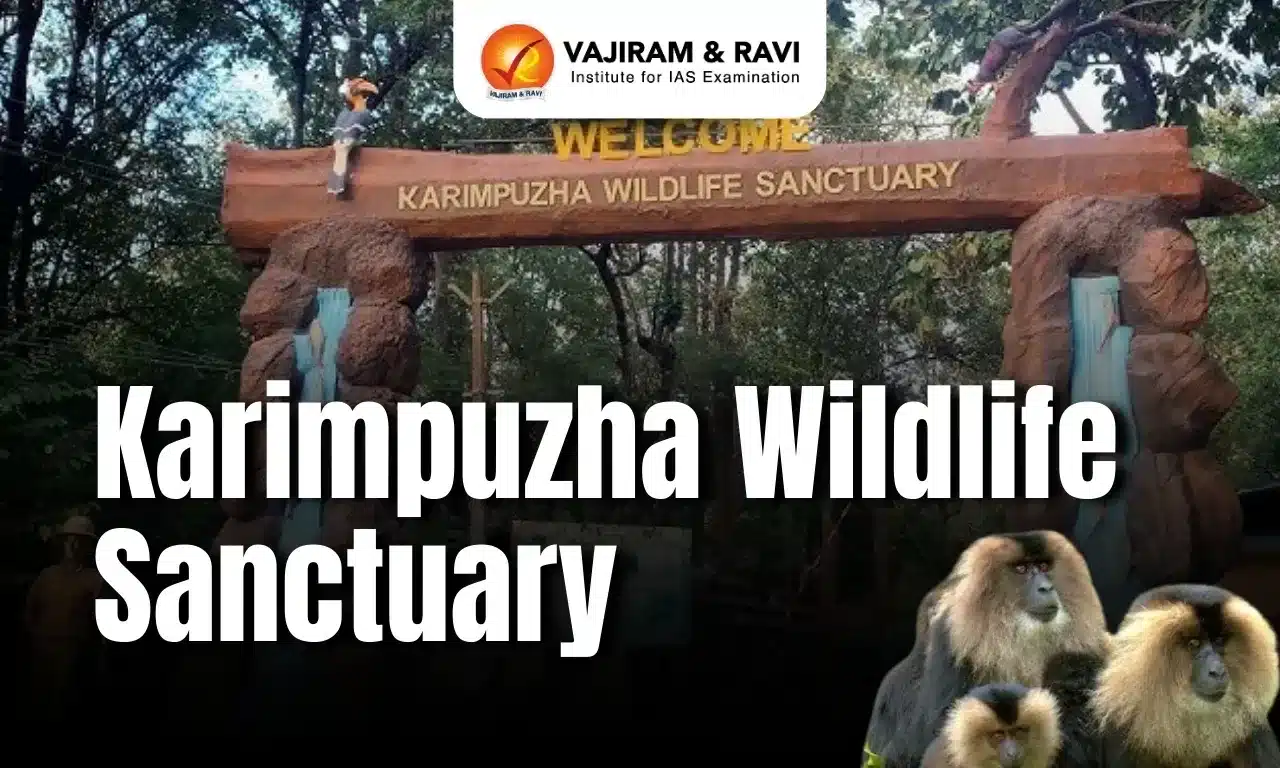
Karimpuzha Wildlife Sanctuary Latest News
A faunal survey conducted recently in the Karimpuzha Wildlife Sanctuary has added significantly to the biodiversity records of Kerala’s youngest protected area.
About Karimpuzha Wildlife Sanctuary
- It is located in the Malappuram District of Kerala.
- It is located on the western slopes of the Nilgiris.
- The name ‘Karimpuzha’ is derived from the Karimpuzha River, a tributary of the river Chaliyar.
- The forest areas of Karimpuzha WLS form part of the Nilgiri Biosphere Reserve (NBR).
- It forms part of the Nilambur Elephant Reserve (Nilambur ER), one of the four ERs notified in the country.
- It shares a boundary with Mukurthi NP (Tamil Nadu) on the eastern side and Silent Valley NP (Kerala) on the southern side.
- The sharp topographical gradient of the hills, ranging from 40 m to 2550 m, is the primary reason for the unique biodiversity of the sanctuary.
- The nomadic tribes, the Cholanaikans, Cave men of Kerala, are living inside the Karimpuzha WLS.
- They form a small group of tribes with a total population of 217 individuals.
- They are classified as a Particularly Vulnerable Tribal Group (PVTG) by the Government of India.
- Vegetation: It is unique in Kerala for encompassing all seven forest types found in the state, including evergreen rainforest, semi-evergreen forest, moist deciduous forest, subtropical savannah, subtropical hill forest, montane wet temperate forest, and montane wet grasslands.
- Flora: It supports rich flora, including teak, rosewood, bamboo, medicinal plants, and endemic orchids.
- Fauna:
- It harbors a wide variety of fauna, including endangered species like the Nilgiri Tahr, lion-tailed macaque, elephants, tigers, leopards, sloth bears, gaur (Indian bison), and diverse birdlife with over 150 species recorded.
- Its pristine forests also shelter endangered fish species like the Malabar Mahseer.
Source: TH


 Last updated on Oct, 2026
→ UPSC 2027 Notification will be released on 13 January 2027 at upsconline.nic.in.
→ Check Nobel Prize 2026 Winners List here.
→ Download PIB PRiSM Monthly Magazine 2026 here.
→ Check UPSC Monthly Current Affairs Magazine The Recitals here.
→ Check out the latest UPSC Syllabus here.
→ Download UPSC Model Answers for Mains 2026
→ UPSC Mains Question Paper 2026 is out now for Essay & GS Paper 1, 2, 3 & 4.
→ UPSC Calendar 2027 has been released.
→ Enroll in Vajiram & Ravi’s UPSC Mains Test Series 2027 for structured answer writing practice, expert evaluation, and exam-oriented feedback.
→ Join Vajiram & Ravi’s UPSC Mentorship Program 2027 for personalized guidance, strategy planning, and one-to-one support from experienced mentors.
→ Go through the UPSC Mains Previous Year Papers to enhance your preparation.
→ UPSC has released UPSC Toppers List 2025 with the Civil Services final result on its official website.
→ Also check Best UPSC Coaching in India
Karimpuzha Wildlife Sanctuary FAQs
Q1. Where is the Karimpuzha Wildlife Sanctuary located?+
Q2. Karimpuzha Wildlife Sanctuary forms part of which Biosphere Reserve?+
Q3. Which protected areas share boundaries with Karimpuzha Wildlife Sanctuary?+
Q4. Which tribal community lives inside Karimpuzha Wildlife Sanctuary?+
Tags: karimpuzha wildlife sanctuary








