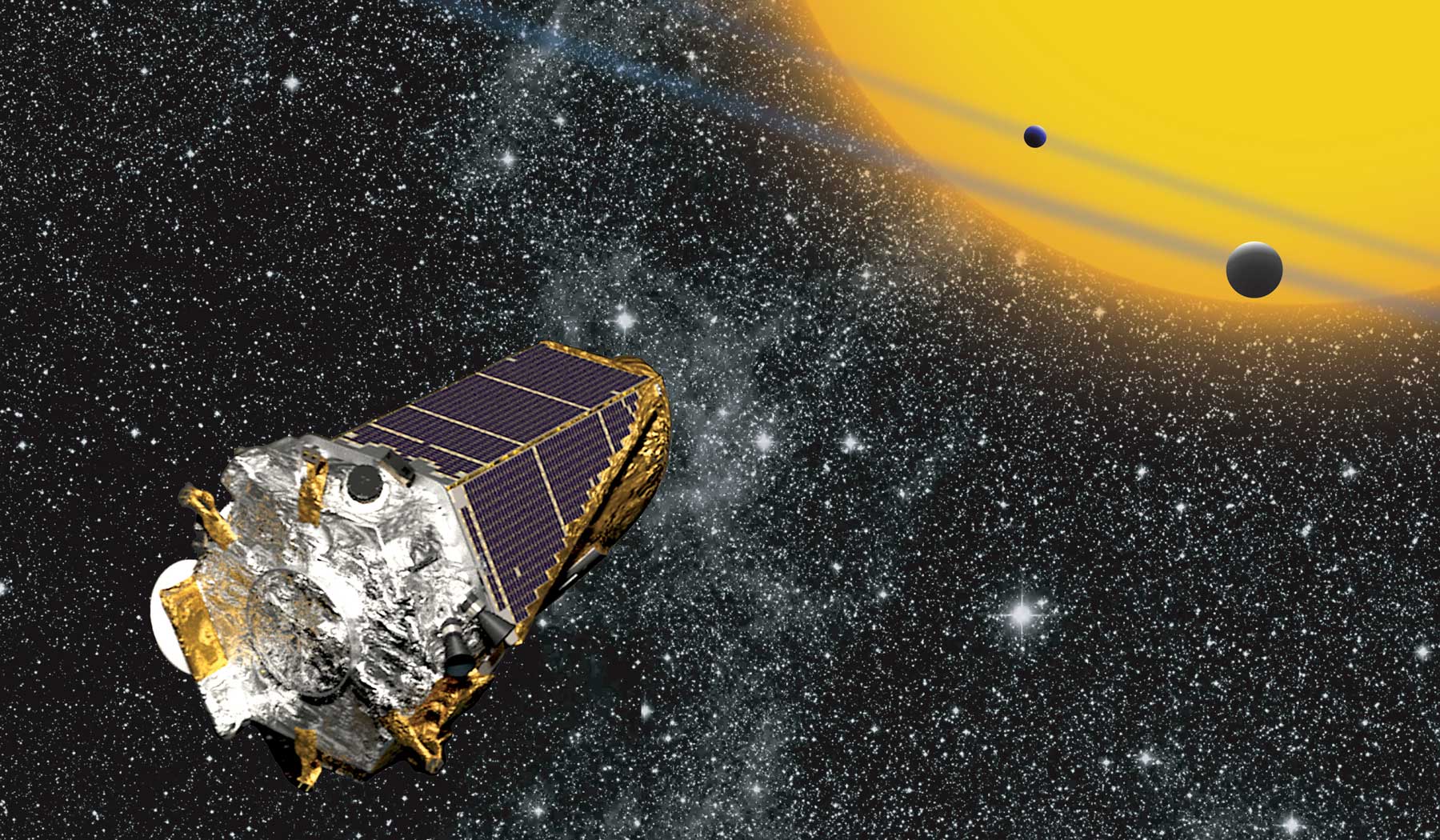
About Kepler Space Telescope
- It was NASA’s first planet-hunting mission, assigned to search a portion of the Milky Way galaxy for Earth-sized planets orbiting stars outside our solar system.
- It was launched on March 6, 2009.
- The spacecraft was named after the famed German astronomer Johannes Kepler (1571-1630).
- Its scientific goals included determining the abundance of earth-sized planets and the distribution of sizes and shapes of their orbits, estimating the number of planets in multiple-star systems, and determining the properties of stars that have planetary systems.
- In December 2011, NASA announced that Kepler had found its first planet, Kepler-22b, in the habitable zone of a star.
- On October 30, 2018, after nine years in deep space collecting data, NASA announced that Kepler had run out of fuel. The spacecraft was retired in its current, safe orbit, away from Earth.
- Kepler left behind a legacy of more than 2,600 planet discoveries from outside our solar system, many of which could be promising places for life.
- Features:
- Kepler detected planets by observing transits, or tiny dips in the brightness of a star that occur when a planet crosses in front of the star.
- The spacecraft was basically a single instrument – a specially designed 3-foot (1-meter) diameter aperture telescope and image sensor array – with a spacecraft built around it.
- The diameter of the telescope’s mirror was 4 feet, 7 inches (1.4 meters), making it one of the largest mirrors beyond Earth’s orbit.
Q1) What is the aperture of a telescope?
A telescope’s aperture refers to the diameter of the lens or mirror the telescope uses to collect light. A bigger lens or mirror has a higher aperture, meaning it’s able to collect more light. The more light that’s collected, the better you’ll be able to see faint objects. Aperture power increases dramatically as you size up the lens or mirror; for example, a telescope with a 200 mm aperture will be able to collect four times as much light as a 100 mm aperture.
Source: Scorching, Seven-Planet System Revealed by New Kepler Exoplanet List


 Last updated on Oct, 2026
→ UPSC 2027 Notification will be released on 13 January 2027 at upsconline.nic.in.
→ Check Nobel Prize 2026 Winners List here.
→ Download PIB PRiSM Monthly Magazine 2026 here.
→ Check UPSC Monthly Current Affairs Magazine The Recitals here.
→ Check out the latest UPSC Syllabus here.
→ Download UPSC Model Answers for Mains 2026
→ UPSC Mains Question Paper 2026 is out now for Essay & GS Paper 1, 2, 3 & 4.
→ UPSC Calendar 2027 has been released.
→ Enroll in Vajiram & Ravi’s UPSC Mains Test Series 2027 for structured answer writing practice, expert evaluation, and exam-oriented feedback.
→ Join Vajiram & Ravi’s UPSC Mentorship Program 2027 for personalized guidance, strategy planning, and one-to-one support from experienced mentors.
→ Go through the UPSC Mains Previous Year Papers to enhance your preparation.
→ UPSC has released UPSC Toppers List 2025 with the Civil Services final result on its official website.
→ Also check Best UPSC Coaching in India