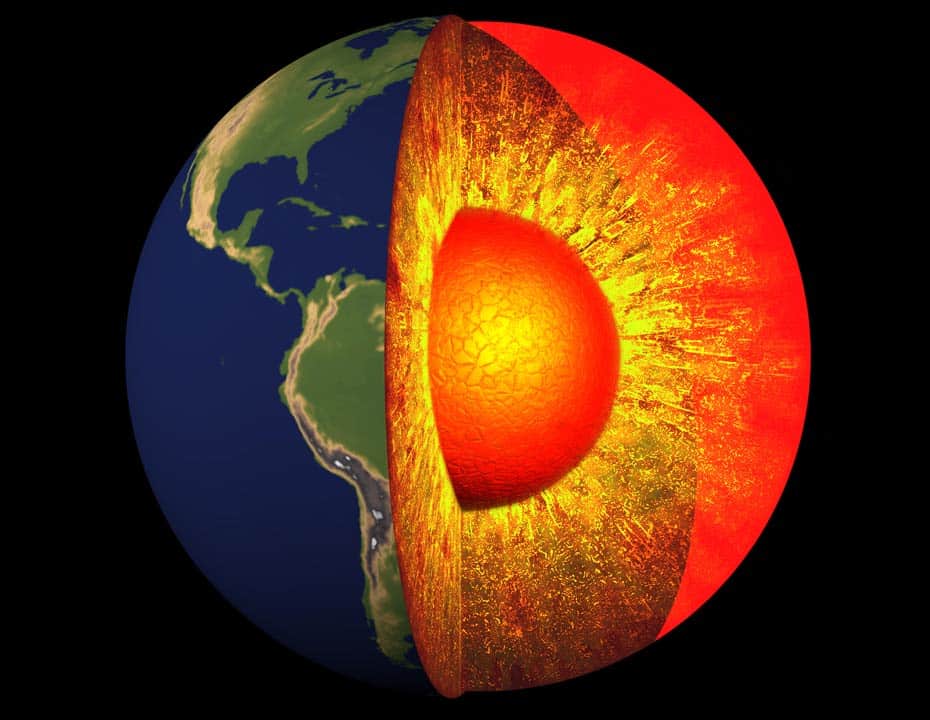
About Earth’s Inner Core:
- It is the innermost layer of the Earth.
- Structure:
It is a solid metallic ball primarily composed of iron and nickel.
The inner core is solid due to the pressure caused by the weight put on it by the Earth’s other top layers.
It is distinct from the outer core, which is a liquid.
- Depth:
The inner core is located at the Earth’s center, approximately 5,150 kilometers (3,219 miles) beneath the Earth’s surface.
The boundary between the inner and outer cores is called the Lehman Seismic Discontinuity.
- Radius:
The inner core has an average radius of 1220 km.
- Temperature:
Inner core temperatures reach extraordinary levels, estimated to be between 7,200–8,500ºF (4,000–4,700ºC).
The primary contributors to the inner core’s heat are the decay of radioactive elements such as uranium, thorium, and potassium in Earth’s crust and mantle, residual heat from planetary formation, and heat emitted by the solidification of the outer core.
- Other Features:
It is predicted to have very high thermal and electrical conductivity.
The inner core generates its own magnetic field.
Despite its small volume (less than 1% of the Earth’s volume), the Earth’s inner core contains about 10% of the total magnetic field energy.
It plays a crucial role in outer core liquid motions and the geodynamo, which generates the Earth’s magnetic field.
It rotates in the same direction as the surface of the planet but abit faster than the rest of the planet.
- What are the different layers of the Earth?
The earth is made up of three different layers: the crust, the mantle, and the core.
The crust: This is the outside layer of the earth and is made of solid rock, mostly basalt and granite.
The mantle:
It lies below the crust and is up to 2900 km thick.
It consists of hot, dense, iron and magnesium-rich solid rock.
- The core:
It is the center of the earth and is made up of two parts: the liquid outer core and solid inner core.
The outer core is made of nickel, iron, and molten rock.
Q1: What creates Earth’s magnetic field?
Earth’s magnetic field is caused by a dynamo effect.The effect works in the same way as a dynamo light on a bicycle. On Earth, flowing liquid metal in the outer core of the planet generates electric currents. The rotation of Earth on its axis causes these electric currents to form a magnetic field which extends around the planet. The magnetic field is extremely important to sustaining life on Earth.
Source: Iron atoms discovered on the move in Earth’s solid inner core


 Last updated on Oct, 2026
→ UPSC 2027 Notification will be released on 13 January 2027 at upsconline.nic.in.
→ Check Nobel Prize 2026 Winners List here.
→ Download PIB PRiSM Monthly Magazine 2026 here.
→ Check UPSC Monthly Current Affairs Magazine The Recitals here.
→ Check out the latest UPSC Syllabus here.
→ Download UPSC Model Answers for Mains 2026
→ UPSC Mains Question Paper 2026 is out now for Essay & GS Paper 1, 2, 3 & 4.
→ UPSC Calendar 2027 has been released.
→ Enroll in Vajiram & Ravi’s UPSC Mains Test Series 2027 for structured answer writing practice, expert evaluation, and exam-oriented feedback.
→ Join Vajiram & Ravi’s UPSC Mentorship Program 2027 for personalized guidance, strategy planning, and one-to-one support from experienced mentors.
→ Go through the UPSC Mains Previous Year Papers to enhance your preparation.
→ UPSC has released UPSC Toppers List 2025 with the Civil Services final result on its official website.
→ Also check Best UPSC Coaching in India