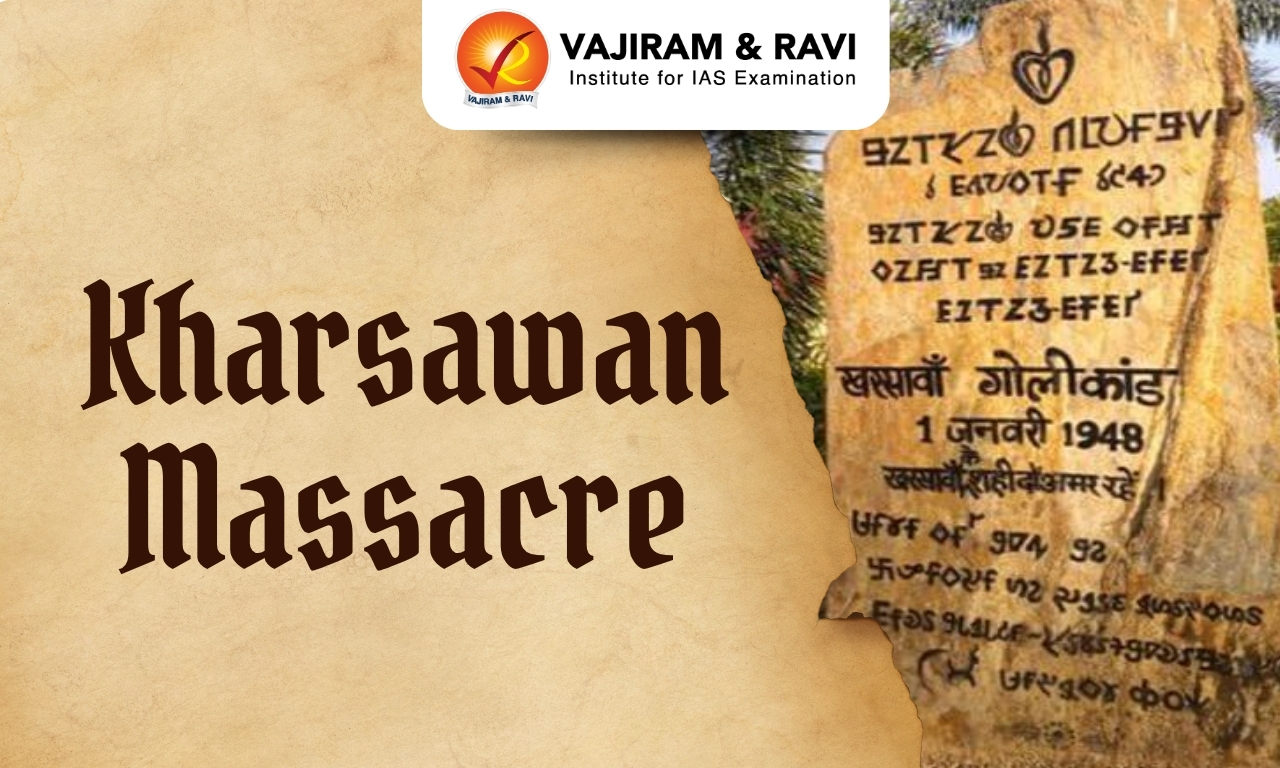
The Kharsawan Massacre, also known as the Kharsawan Golikaand, took place on 1 January 1948 in the then Kharsawan princely state (present-day Jharkhand). It involved police firing on a large gathering of unarmed Adivasis protesting the merger of Kharsawan with Odisha. The incident is often referred to as the “Jallianwala Bagh of Independent India” due to the scale of violence and the absence of accountability.
Kharsawan Massacre Historical Background
After independence in 1947, princely states were being merged into the Indian Union. Kharsawan, a small princely state in the Chotanagpur region, was merged with Odisha, along with nearby Seraikela. The decision was largely influenced by linguistic considerations, as the region had a significant Odia-speaking population.
However, the Adivasi population strongly opposed this merger, arguing that their cultural identity and political aspirations were not being considered. They demanded a separate tribal state rather than joining either Odisha or Bihar. This dissatisfaction created widespread resentment and led to organised protests.
Kharsawan Massacre Incident (1 January 1948)
- On New Year’s Day, which also coincided with the weekly market (haat), a large Adivasi gathering assembled in Kharsawan.
- Estimates suggest that around 50,000 people gathered to protest the merger and to hear the expected address of tribal leader Jaipal Singh Munda, who ultimately did not arrive.
- The area was heavily controlled by the Orissa Military Police, and the situation became tense as the crowd grew restless.
- Without adequate warning or effective crowd control measures, police opened fire on the unarmed protestors.
- The firing reportedly continued for a significant period, leading to mass panic and large-scale casualties. Many bodies were later allegedly disposed of in nearby wells and forests.
Official reports recorded only 35 deaths. However, local accounts, oral histories, and some historical writings suggest that the death toll could range from hundreds to nearly 2,000 people.


Kharsawan Massacre Legacy
The Kharsawan Massacre did not receive immediate national attention and remained largely absent from mainstream historical narratives for decades. No individual or authority was ever held accountable for the firing, and no final official report was made public.
- Over time, the incident became a powerful symbol of Adivasi resistance and identity assertion in the Chotanagpur region.
- It also contributed to the long-term political consciousness that eventually supported the demand for a separate Jharkhand state, which was created in 2000.
- Today, 1 January is observed as Martyrs’ Day (Shaheed Diwas) in parts of Jharkhand in remembrance of those killed in the massacre.

 Last updated on Oct, 2026
→ UPSC 2027 Notification will be released on 13 January 2027 at upsconline.nic.in.
→ Asian Games 2026 are being held in Aichi-Nagoya, Japan, from 19 September to 4 October.
→ Check Nobel Prize 2026 Winners List here.
→ Download PIB PRiSM Monthly Magazine 2026 here.
→ Check UPSC Monthly Current Affairs Magazine The Recitals here.
→ Check out the latest UPSC Syllabus here.
→ Download UPSC Model Answers for Mains 2026
→ UPSC Mains Question Paper 2026 is out now for Essay & GS Paper 1, 2, 3 & 4.
→ UPSC Calendar 2027 has been released.
→ Enroll in Vajiram & Ravi’s UPSC Mains Test Series 2027 for structured answer writing practice, expert evaluation, and exam-oriented feedback.
→ Join Vajiram & Ravi’s UPSC Mentorship Program 2027 for personalized guidance, strategy planning, and one-to-one support from experienced mentors.
→ Go through the UPSC Mains Previous Year Papers to enhance your preparation.
→ UPSC has released UPSC Toppers List 2025 with the Civil Services final result on its official website.
→ Also check Best UPSC Coaching in India
Kharsawan Massacre FAQs
Q1. What was the Kharsawan Massacre?+
Q2. Why did the Kharsawan Massacre happen?+
Q3. How many people died in the Kharsawan Massacre?+
Q4. Why is the Kharsawan Massacre compared to Jallianwala Bagh?+
Q5. What is the significance of the Kharsawan Massacre today?+
Tags: kharsawan massacre