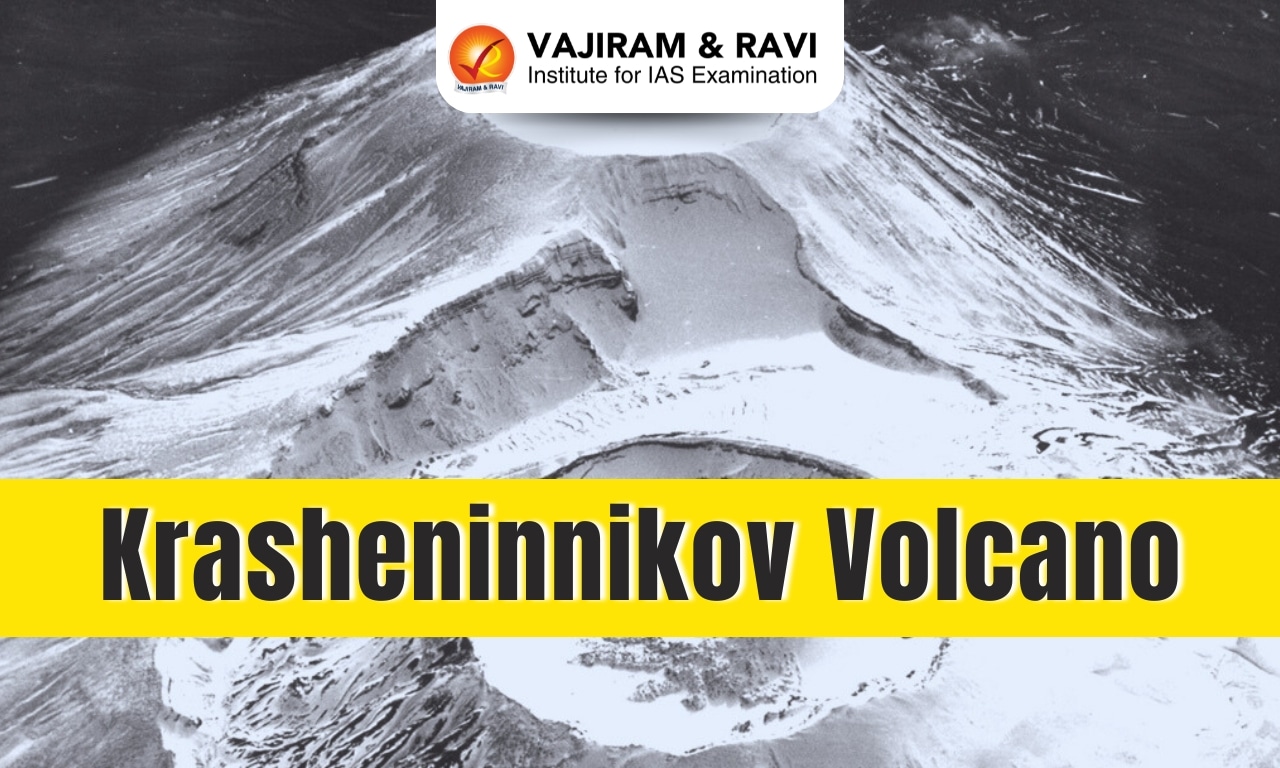
Krasheninnikov Volcano Latest News
The Nasa-ISRO Nisar satellite recently captured detailed radar views of Russia’s Krasheninnikov volcano as lava spread across Kamchatka.
About Krasheninnikov Volcano
- It is an active stratovolcano located in the Eastern Kamchatka Peninsula, Russia.
- The Kamchatka Peninsula lies along the Pacific “Ring of Fire.”
- There are 114 volcanoes on the Kamchatka Peninsula that have erupted during the Holocene Epoch (approximately 12,000 years ago to the present).
- The summit of the volcano reaches an elevation of 1,856 meters and lies within a collapse-originated caldera measuring 9 by 11 kilometers, dating back to 39,000 years ago.
- The volcanic complex consists of two adjacent main stratovolcano cones.
- The southern cone is crowned by a crater approximately 800 to 900 meters in diameter, while the northern cone is younger and exhibits a telescopic structure.
- Within the northern cone, smaller craters measuring 800 meters in diameter and lava cones have formed.
- The sides of both cones are covered with ejecta.
- Volcanic Activity:
- Its last eruption took place about 400 or 600 years ago.
- 2025 Eruption: Krasheninnikov volcano erupted on 2 August 2025, three days after a nearby magnitude 8.8 earthquake. Ash emissions reached an altitude of 20,000 ft.


Key Facts about NISAR Mission
- NISAR (NASA-ISRO Synthetic Aperture Radar) is a joint Earth observation satellite mission between NASA and ISRO.
- It is a satellite equipped with advanced radar instruments for Earth observation.
- It was successfully launched on July 30, 2025, by ISRO’s GSLV-F16 rocket from the Satish Dhawan Space Centre in Sriharikota, India.
- It marks the first-ever collaboration of its kind between India and the United States in radar-based Earth monitoring from space.
- NISAR maps the entire Earth’s surface every 12 days, enabling high-frequency, precise, and repeat observations.
- It is the first satellite mission to use two different radar frequencies (L-band and S-band) to measure changes in our planet’s surface less than a centimeter across.
- NISAR will monitor earthquakes, volcanic activity, land deformation, and environmental changes, providing critical data for hazard assessment, disaster response, and resource management.
News: IT

 Last updated on Oct, 2026
→ UPSC 2027 Notification will be released on 13 January 2027 at upsconline.nic.in.
→ Check Nobel Prize 2026 Winners List here.
→ Download PIB PRiSM Monthly Magazine 2026 here.
→ Check UPSC Monthly Current Affairs Magazine The Recitals here.
→ Check out the latest UPSC Syllabus here.
→ Download UPSC Model Answers for Mains 2026
→ UPSC Mains Question Paper 2026 is out now for Essay & GS Paper 1, 2, 3 & 4.
→ UPSC Calendar 2027 has been released.
→ Enroll in Vajiram & Ravi’s UPSC Mains Test Series 2027 for structured answer writing practice, expert evaluation, and exam-oriented feedback.
→ Join Vajiram & Ravi’s UPSC Mentorship Program 2027 for personalized guidance, strategy planning, and one-to-one support from experienced mentors.
→ Go through the UPSC Mains Previous Year Papers to enhance your preparation.
→ UPSC has released UPSC Toppers List 2025 with the Civil Services final result on its official website.
→ Also check Best UPSC Coaching in India
Krasheninnikov Volcano FAQs
Q1. What type of volcano is Krasheninnikov Volcano?+
Q2. Where is Krasheninnikov Volcano located?+
Q3. How many main stratovolcano cones make up the Krasheninnikov volcanic complex?+
Q4. What major geological event occurred near Krasheninnikov Volcano before its 2025 eruption?+
Tags: krasheninnikov volcano prelims pointers upsc current affairs upsc prelims current affairs