About Kuchipudi
- It is one of the Indian Classical dance belonging to Andhra Pradesh.
- History
- It was originally performed by a group of itinerant actors known as Bhagavathalu, who would travel from village to village, performing plays and dances based on Hindu mythology.
- In the 15th century, the great poet and musician, Siddhendra Yogi, played a major role in the development of Kuchipudi. He is credited with transforming the dance form from a simple folk art to a sophisticated and refined classical dance form.
- Features
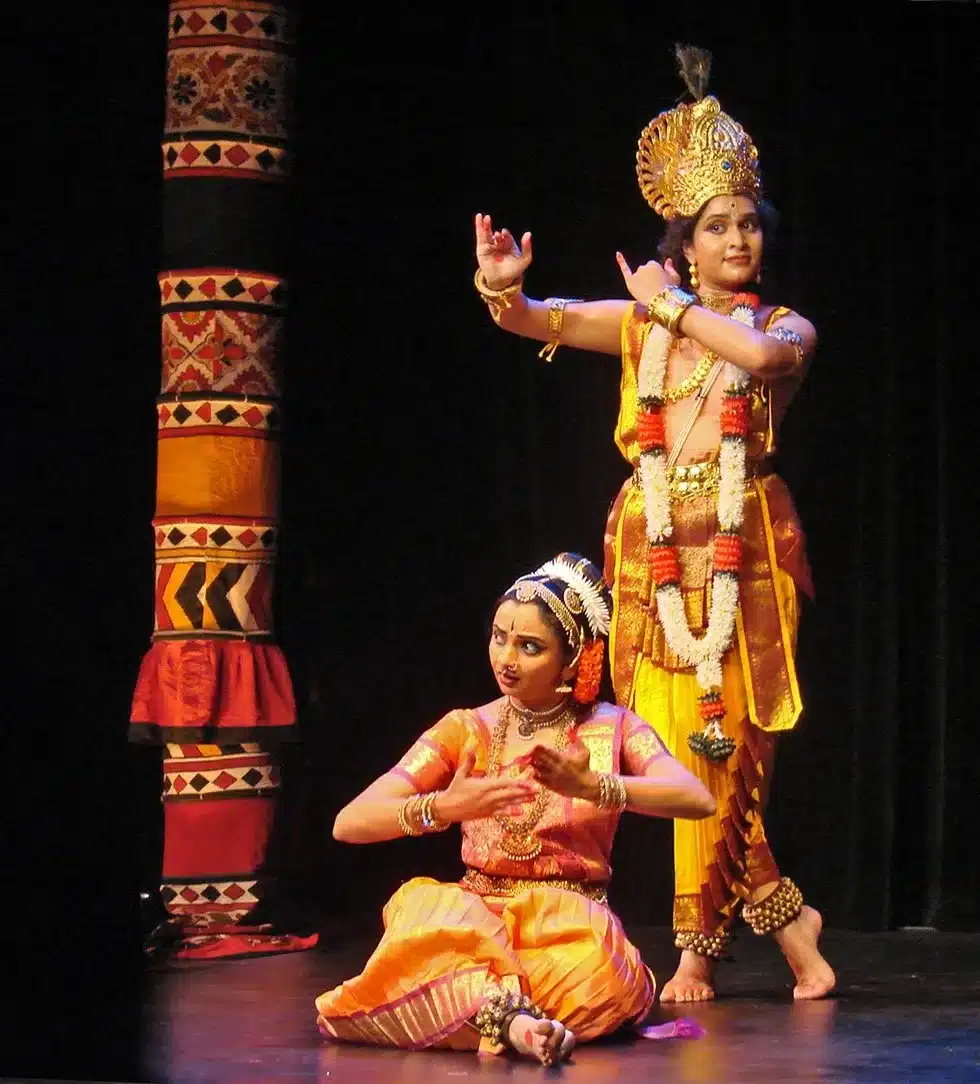
- The dance form is characterized by its intricate footwork, graceful movements, and subtle facial expressions.
- It incorporates both pure dance (Nritta) and expressive dance (Nritya) elements, as well as storytelling through dance (Natya).
- It is also performed on the edge of a brass plate (known as Tarangam) on the beats of Carnatic music.
- It is largely developed as a Hindu god Krishna-oriented Vaishnavism tradition, and it is most closely related to Bhagavata Mela.
- The Kuchipudi performer apart from being a dancer and actor has to be skilled in Sanskrit and Telugu languages, music and manuscripts of the performance.
- The Kuchipudi dancers wear light make-up and ornaments like the Rakudi (head ornament), Chandra Vanki (arm band), Adda Bhasa and Kasina Sara (necklace). A long plait is decorated with flowers and jewelry. The ornaments are made of light wood called Boorugu.
- The typical musical instruments in Kuchipudi are mridangam, cymbals, veena, flute and the tambura.
Q1: What is Natyashastra?
It is a classic on dramatics and aesthetics which has been commonly attributed to Bharata, the sage for its authorship. It has been founded on human psychology prevailing under conditions of India’s cultural system with a focus on stage performance.
Source: Kuchipudi: a tale of artistes’ struggle for survival


 Last updated on Oct, 2026
→ UPSC 2027 Notification will be released on 13 January 2027 at upsconline.nic.in.
→ Asian Games 2026 are being held in Aichi-Nagoya, Japan, from 19 September to 4 October.
→ Check Nobel Prize 2026 Winners List here.
→ Download PIB PRiSM Monthly Magazine 2026 here.
→ Check UPSC Monthly Current Affairs Magazine The Recitals here.
→ Check out the latest UPSC Syllabus here.
→ Download UPSC Model Answers for Mains 2026
→ UPSC Mains Question Paper 2026 is out now for Essay & GS Paper 1, 2, 3 & 4.
→ UPSC Calendar 2027 has been released.
→ Enroll in Vajiram & Ravi’s UPSC Mains Test Series 2027 for structured answer writing practice, expert evaluation, and exam-oriented feedback.
→ Join Vajiram & Ravi’s UPSC Mentorship Program 2027 for personalized guidance, strategy planning, and one-to-one support from experienced mentors.
→ Go through the UPSC Mains Previous Year Papers to enhance your preparation.
→ UPSC has released UPSC Toppers List 2025 with the Civil Services final result on its official website.
→ Also check Best UPSC Coaching in India