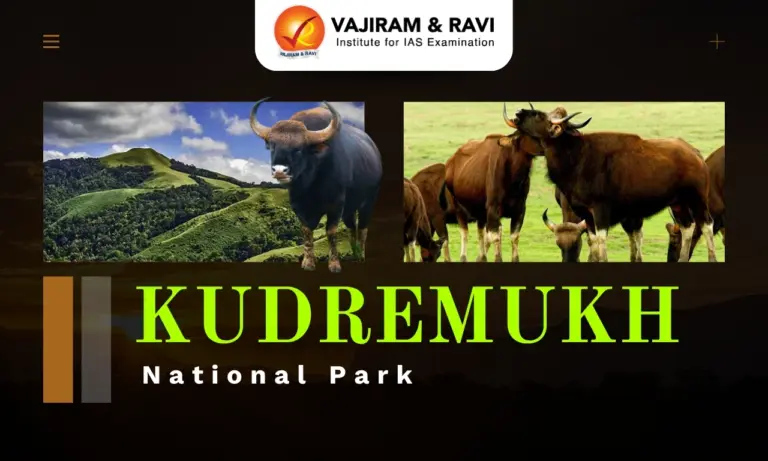
Kudremukh National Park is one of India’s most ecologically significant protected areas, located in the Central Western Ghats of Karnataka. It is renowned for its rich biodiversity, unique shola-grassland ecosystem, critical watershed functions and landmark contribution to India’s environmental conservation history.
About Kudremukh National Park
- Location: The Kudremukh National Park is situated at the tri-junction of Chikkamagaluru, Dakshina Kannada and Udupi districts in Karnataka, forming part of the Central Western Ghats.
- Origin of Name: The park derives its name from Kudremukh Peak (1,894 m), the second-highest peak in Karnataka after Mullayanagiri. The mountain resembles the face of a horse, giving rise to the name Kudremukh (“Horse Face”). It was historically known as Samseparvata.
- Legal Status: The region was notified as a Reserved Forest in 1916 and was declared a National Park in 1987 following biodiversity surveys that highlighted its exceptional ecological value, particularly its Lion-tailed Macaque population.
- Area and Landscape: Spread across 600.32 sq. km, Kudremukh is one of the largest protected tropical evergreen forest landscapes in the Western Ghats. The altitude ranges from nearly 100 metres to 1,894 metres, creating remarkable habitat diversity.
The park falls within the Western Ghats Biodiversity Hotspot and has been recognised under the Global Tiger Conservation Priority-I Landscape.
Kudremukh National Park Geographical and Hydrological Importance
Kudremukh National Park functions as one of the most important watershed landscapes of Peninsular India and is often referred to as the “Water Tower of Karnataka.”
- Source of Major Rivers: The Gangamoola Hills within the park are the origin of the Tunga, Bhadra and Netravathi rivers, making the park crucial for Karnataka’s water security.
- Contribution to River Systems: The Tunga and Bhadra rivers flow eastwards and merge to form the Tungabhadra, a major tributary of the Krishna River, while the Netravathi flows westwards into the Arabian Sea.
- Support to Multiple Drainage Systems: Several smaller rivers, including the Gurupura, Swarna, Seethanadhi and Yenehole, also originate here, highlighting the park’s role in sustaining both coastal and interior river basins.
- Water Security: These rivers provide drinking water, irrigation and ecological services to large parts of coastal Karnataka and the Deccan Plateau.
- Forest Ecosystem: The park comprises tropical wet evergreen forests, shola forests, montane grasslands and moist deciduous forests, representing one of the least disturbed ecosystems in the Western Ghats.


Kudremukh National Park Biodiversity
Kudremukh National Park is one of the richest biodiversity landscapes in the Western Ghats and forms an integral part of one of the world’s globally recognised biodiversity hotspots.
- Mammalian Diversity: The park supports the world’s largest contiguous population of the endangered Lion-tailed Macaque, besides housing tigers, leopards, dholes, gaurs, sloth bears, Malabar giant squirrels and sambar deer.
- Bird Diversity: Nearly 200 bird species have been recorded, including endemic species such as the Malabar Trogon, Malabar Whistling Thrush and Imperial Pigeon.
Kudremukh serves as an important wildlife corridor connecting Bhadra Tiger Reserve and protected areas such as Someshwara, Mookambika, Pushpagiri, Talacauvery, Brahmagiri and Nagarahole, facilitating movement of elephants, tigers and other wildlife.
Kudremukh Mining Controversy
The Kudremukh Iron Ore Company Limited (KIOCL), a Government of India PSU, was granted a 30-year mining lease in 1969 to extract low-grade magnetite iron ore. Even after the area was declared a National Park in 1987, mining continued, leading to forest degradation, habitat fragmentation and siltation of the Bhadra river system. In the landmark T.N. Godavarman Thirumulpad vs. Union of India case, the Supreme Court ordered a phased closure of mining, directed KIOCL to deposit ₹25 crore for ecological restoration, and prohibited all mining after 31 December 2005. Mining finally ceased on 1 January 2006, making the case a landmark in India’s environmental jurisprudence that reinforced the primacy of conservation over commercial interests and upheld the Polluter Pays Principle.

 Last updated on Oct, 2026
→ UPSC 2027 Notification will be released on 13 January 2027 at upsconline.nic.in.
→ Check Nobel Prize 2026 Winners List here.
→ Download PIB PRiSM Monthly Magazine 2026 here.
→ Check UPSC Monthly Current Affairs Magazine The Recitals here.
→ Check out the latest UPSC Syllabus here.
→ Download UPSC Model Answers for Mains 2026
→ UPSC Mains Question Paper 2026 is out now for Essay & GS Paper 1, 2, 3 & 4.
→ UPSC Calendar 2027 has been released.
→ Enroll in Vajiram & Ravi’s UPSC Mains Test Series 2027 for structured answer writing practice, expert evaluation, and exam-oriented feedback.
→ Join Vajiram & Ravi’s UPSC Mentorship Program 2027 for personalized guidance, strategy planning, and one-to-one support from experienced mentors.
→ Go through the UPSC Mains Previous Year Papers to enhance your preparation.
→ UPSC has released UPSC Toppers List 2025 with the Civil Services final result on its official website.
→ Also check Best UPSC Coaching in India
Kudremukh National Park FAQs
Q1. In which state is Kudremukh National Park located?+
Q2. When was Kudremukh declared a National Park?+
Q3. Which major rivers originate from Kudremukh National Park?+
Q4. Which endangered species is most closely associated with Kudremukh National Park?+
Q5. Why is Kudremukh National Park ecologically important?+
Q6. Why is the Kudremukh mining case important?+
Tags: kudremukh national park