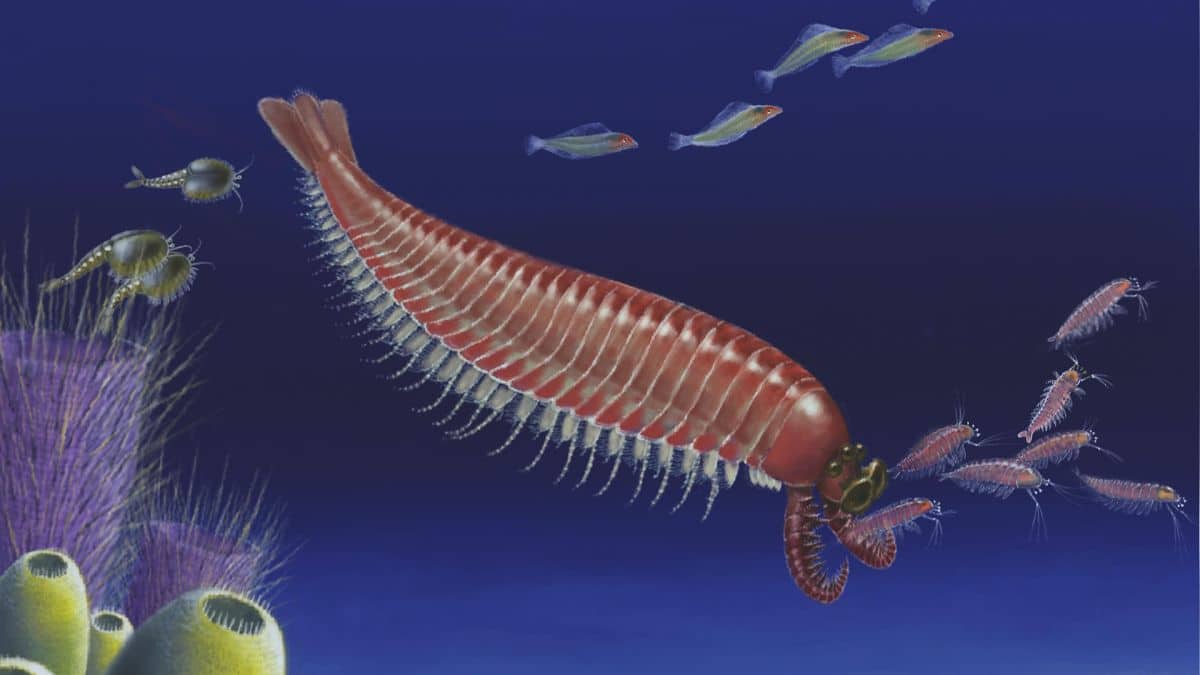
About Kylinxia Zhangi
- It is an extinct arthropod that lived in the early Cambrian period, about 520 million years ago.
- The fossil of the species was uncovered near the town of Chengjiang in the Yunan Province of southern China.
- Kylinxia is among the 250 or so extremely well-preserved fossil animals described from the region, which are together known as Cambrian Chengjiang biota.
- Features:
- It had a segmented body with a head, thorax, and abdomen.
- Kylinxia sported three eyes on its head, along with a pair of fearsome claws that was possibly used to catch prey.
- It had a fused head shield, a segmented trunk, and jointed legs.
- The creature had a head with six segments, which is similar to modern insects.
What are Arthropods?
- They are invertebrates with jointed legs.
- They make up about 75% of all animals on Earth.
- They can be found in almost every habitat on Earth, from deep-sea hydrothermal vents to the highest mountains.
- Arthropods are divided into four major groups:
- insects;
- myriapods (including centipedes and millipedes);
- arachnids (including spiders, mites and scorpions);
- crustaceans (including slaters, prawn and crabs).
- They are characterized by several key features:
- Exoskeleton: Arthropods have a hard exoskeleton made of chitin, a complex sugar. This exoskeleton serves as both protection and structural support for their bodies.
- Segmented Bodies: They have segmented bodies, which are divided into distinct regions, including the head, thorax, and abdomen in insects. This segmentation allows for flexibility and specialization of body parts.
- Jointed Appendages: Arthropods have jointed appendages (legs, antennae, claws, etc.) that are attached to their body segments.
- Bilateral Symmetry: They exhibit bilateral symmetry, meaning their bodies are symmetrical on both sides when divided along a central axis.
- Open Circulatory System: Arthropods typically have an open circulatory system in which blood-like fluid called hemolymph circulates in body cavities and directly bathes the internal organs.
Q1) What are Vertebrates?
Vertebrates are a subgroup of animals within the phylum Chordata. They are characterized by the presence of a vertebral column or backbone, which is made up of a series of individual bones called vertebrae. This backbone provides structural support and protection for the spinal cord, which is a key part of the central nervous system. Vertebrates are known for their complex and well-developed internal structures.
Source: Scientists study exquisitely preserved three-eyed predator from 520 million years ago


 Last updated on Oct, 2026
→ UPSC 2027 Notification will be released on 13 January 2027 at upsconline.nic.in.
→ Check Nobel Prize 2026 Winners List here.
→ Download PIB PRiSM Monthly Magazine 2026 here.
→ Check UPSC Monthly Current Affairs Magazine The Recitals here.
→ Check out the latest UPSC Syllabus here.
→ Download UPSC Model Answers for Mains 2026
→ UPSC Mains Question Paper 2026 is out now for Essay & GS Paper 1, 2, 3 & 4.
→ UPSC Calendar 2027 has been released.
→ Enroll in Vajiram & Ravi’s UPSC Mains Test Series 2027 for structured answer writing practice, expert evaluation, and exam-oriented feedback.
→ Join Vajiram & Ravi’s UPSC Mentorship Program 2027 for personalized guidance, strategy planning, and one-to-one support from experienced mentors.
→ Go through the UPSC Mains Previous Year Papers to enhance your preparation.
→ UPSC has released UPSC Toppers List 2025 with the Civil Services final result on its official website.
→ Also check Best UPSC Coaching in India