About Lab-grown Minibrains
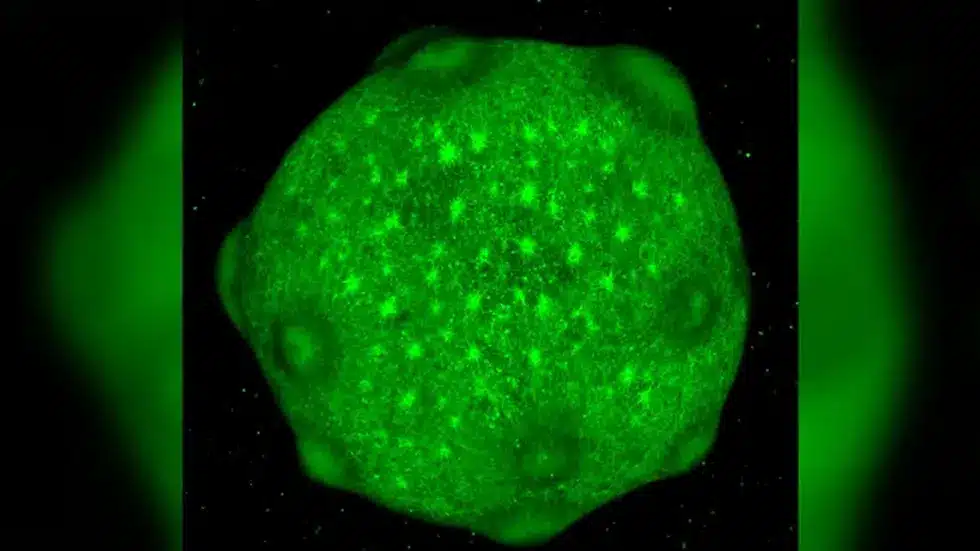
- These are scientifically known as brain organoids, but often called “minibrains” and serve as miniature, simplified models of full-size human brains.
- How are minibrains made?
- Scientists typically grow brain organoids from stem cells, a type of immature cell that can give rise to any cell type, whether blood, skin, bowel or brain.
- The stem cells used to grow organoids can either come from adult human cells, or more rarely, human embryonic tissue.
- Scientists collect adult cells and then expose them to chemicals in order to revert them into a stem cell-like state. The resulting stem cells are called “induced pluripotent stem cells” (iPSC), which can be made to grow into any kind of tissue.
- To give rise to a minibrain, scientists embed these stem cells in a protein-rich matrix, a substance that supports the cells as they divide and form a 3D shape. Alternatively, the cells may be grown atop a physical, 3D scaffold.
Application: These organoids can potentially be useful in basic research, drug development and even computer science.
Q1: What are Stem Cells?
These are cells with the potential to develop into many different types of cells in the body. Under the right conditions in the body or a laboratory, stem cells divide to form more cells called daughter cells. These daughter cells become either new stem cells or specialized cells (differentiation) with a more specific function, such as blood cells, brain cells, heart muscle cells or bone cells.
Source: Lab-grown ‘minibrains’ help reveal why traumatic brain injury raises dementia risk


 Last updated on Oct, 2026
→ UPSC 2027 Notification will be released on 13 January 2027 at upsconline.nic.in.
→ Asian Games 2026 are being held in Aichi-Nagoya, Japan, from 19 September to 4 October.
→ Check Nobel Prize 2026 Winners List here.
→ Download PIB PRiSM Monthly Magazine 2026 here.
→ Check UPSC Monthly Current Affairs Magazine The Recitals here.
→ Check out the latest UPSC Syllabus here.
→ Download UPSC Model Answers for Mains 2026
→ UPSC Mains Question Paper 2026 is out now for Essay & GS Paper 1, 2, 3 & 4.
→ UPSC Calendar 2027 has been released.
→ Enroll in Vajiram & Ravi’s UPSC Mains Test Series 2027 for structured answer writing practice, expert evaluation, and exam-oriented feedback.
→ Join Vajiram & Ravi’s UPSC Mentorship Program 2027 for personalized guidance, strategy planning, and one-to-one support from experienced mentors.
→ Go through the UPSC Mains Previous Year Papers to enhance your preparation.
→ UPSC has released UPSC Toppers List 2025 with the Civil Services final result on its official website.
→ Also check Best UPSC Coaching in India