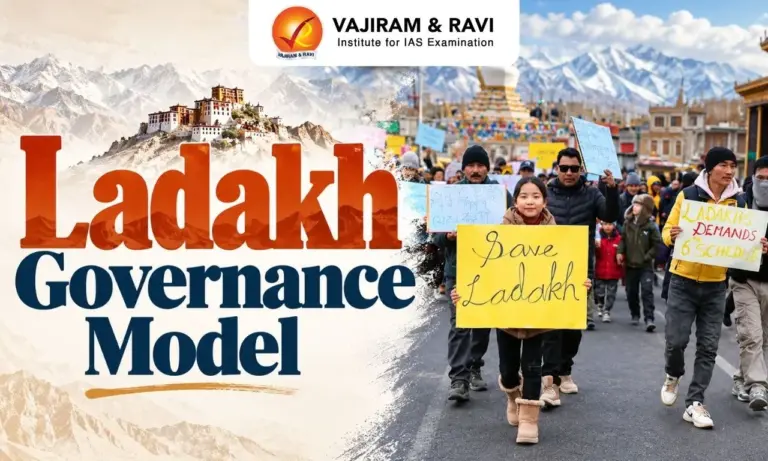
Ladakh Governance Model Latest News
- Ladakh’s demand for Sixth Schedule status has been accompanied by a proposal to create a directly elected legislative body through a new constitutional provision, Article 371-K.
Ladakh’s Governance Context
- Ladakh became a Union Territory without a Legislative Assembly under the Jammu and Kashmir Reorganisation Act, 2019.
- The change generated concerns among local groups regarding protection of the region’s culture, language, traditions, customary practices and land rights, along with demands for greater political representation.
- The Sixth Schedule emerged as a major demand because it provides constitutionally recognised mechanisms for autonomous local governance, particularly in areas with significant tribal populations.
- The current debate therefore concerns how Ladakh can receive greater local participation and institutional protection while retaining its status as a Union Territory.


About the Sixth Schedule
- The Sixth Schedule is implemented through Articles 244(2) and 275(1) of the Constitution and currently applies to specified tribal areas in Assam, Meghalaya, Tripura and Mizoram.
- It provides for Autonomous District Councils with substantial powers over local governance.
- A district council can have a maximum of 30 members, with the institutional structure designed to provide greater autonomy to communities in designated areas.
- The historical basis of the Sixth Schedule lies partly in the administrative treatment of several tribal areas during British rule. Meghalaya, Tripura and Mizoram subsequently became separate States while retaining Sixth Schedule protections in specified areas.
- The underlying objective is to provide institutional mechanisms through which distinct tribal communities can participate in governing matters affecting their social, cultural and economic interests.
Why Has Ladakh Demanded Sixth Schedule Status?
- Ladakh has a distinctive ethnic, cultural and geographical character, which has contributed to demands for stronger constitutional safeguards.
- The major concerns include:
- Protection of local languages, traditions and customary practices.
- Safeguarding local land rights against excessive acquisition by outsiders.
- Greater political representation for the local population.
- Greater participation in decisions affecting development and governance.
- The demand also reflects the broader constitutional objective of accommodating India’s diverse social and cultural communities within democratic institutions.
Proposed Article 371-K
- Instead of extending Sixth Schedule provisions to Ladakh, the Central Government has proposed inserting Article 371-K into Part XXI of the Constitution, which deals with temporary, transitional and special provisions.
- The proposed framework seeks to create a directly elected legislative authority for Ladakh while maintaining the Union Territory’s existing constitutional position.
- The proposed institution could potentially be placed above the existing Ladakh Autonomous Hill Development Councils (LAHDCs) while retaining panchayats and other district-level institutions.
- The objective is to establish a governance structure that combines local democratic participation with Union-level administration.
Key Questions Under the Proposed Model
- Role of the Lieutenant Governor
- The precise relationship between the proposed legislative authority and the Lieutenant Governor would need to be defined, particularly regarding executive and administrative powers.
- Financial Autonomy
- The extent of financial powers available to the proposed authority is another important issue. This includes questions concerning taxation, expenditure and control over financial resources.
- Relationship with Existing Institutions
- The proposed body would have to function alongside the LAHDCs, panchayats and district-level institutions. Clear allocation of functions would be necessary to avoid overlapping jurisdictions.
- National Security
- Ladakh’s strategic geographical location makes national security an important consideration in designing its governance framework. The proposed model therefore seeks to balance local autonomy with the Union’s responsibilities relating to territorial security.
Is Special Constitutional Status for a UT Possible?
- Providing a special governance arrangement to a Union Territory is constitutionally possible.
- India’s constitutional framework does not follow a completely uniform model for every territorial unit.
- Parliament has previously created special arrangements for Union Territories, including the National Capital Territory of Delhi under Articles 239AA and 239AB.
- Therefore, a special constitutional provision for Ladakh would represent another example of differentiated governance within India’s federal structure.
Balancing Local Autonomy and National Administration
- The Ladakh debate illustrates an important feature of Indian federalism: constitutional governance can accommodate different institutional arrangements for different territories.
- The challenge is to create sufficient space for local democratic participation and protection of cultural interests while maintaining administrative coordination and national responsibilities.
- A directly elected legislative authority under a special constitutional provision could potentially provide a framework for this balance, although its effectiveness would depend on the precise distribution of legislative, administrative and financial powers.
Source: TH

 Last updated on Oct, 2026
→ UPSC 2027 Notification will be released on 13 January 2027 at upsconline.nic.in.
→ Check Nobel Prize 2026 Winners List here.
→ Download PIB PRiSM Monthly Magazine 2026 here.
→ Check UPSC Monthly Current Affairs Magazine The Recitals here.
→ Check out the latest UPSC Syllabus here.
→ Download UPSC Model Answers for Mains 2026
→ UPSC Mains Question Paper 2026 is out now for Essay & GS Paper 1, 2, 3 & 4.
→ UPSC Calendar 2027 has been released.
→ Enroll in Vajiram & Ravi’s UPSC Mains Test Series 2027 for structured answer writing practice, expert evaluation, and exam-oriented feedback.
→ Join Vajiram & Ravi’s UPSC Mentorship Program 2027 for personalized guidance, strategy planning, and one-to-one support from experienced mentors.
→ Go through the UPSC Mains Previous Year Papers to enhance your preparation.
→ UPSC has released UPSC Toppers List 2025 with the Civil Services final result on its official website.
→ Also check Best UPSC Coaching in India
Ladakh Governance Model FAQs
Q1. When did Ladakh become a Union Territory?+
Q2. Which States are currently covered by the Sixth Schedule?+
Q3. Which Articles govern the Sixth Schedule?+
Q4. What is proposed under Article 371-K?+
Q5. What are the existing major local governance institutions in Ladakh?+
Tags: ladakh governance model mains articles upsc current affairs upsc mains current affairs