


Large Phased Array Radar Latest News
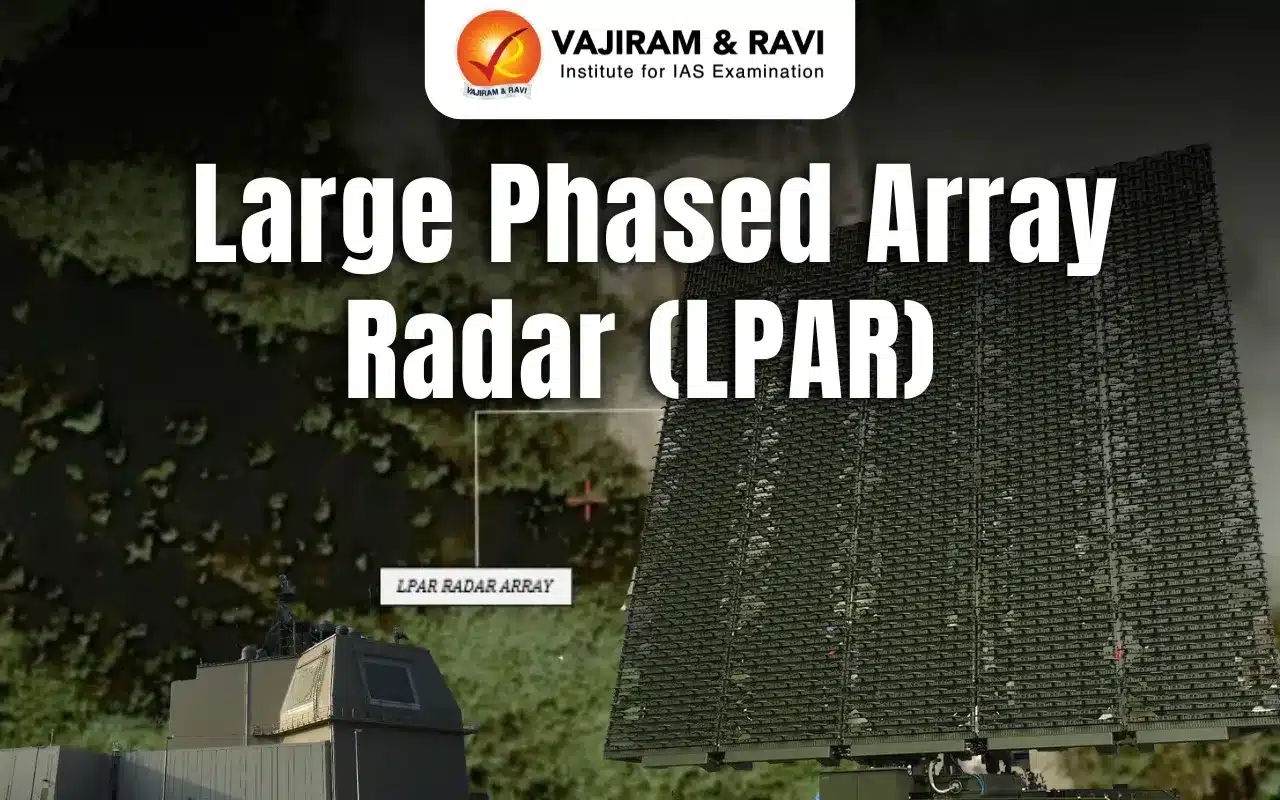
China recently deployed a powerful Large Phased Array Radar (LPAR) in Yunnan province, near the China-Myanmar border.
About Large Phased Array Radar
- It was established by China in Yunnan province, near the China-Myanmar border.
- It boasts a surveillance range exceeding 5,000 kilometers, allowing China to monitor extensive areas of the Indian Ocean and deep into Indian territory.
- It possesses the capability to detect and track ballistic missile launches in real time.
- Unlike traditional radars, which rely on mechanical rotation, LPARs use electronically controlled antennas to scan vast areas almost instantly.
- This allows them to track multiple targets, including ballistic missiles, with high precision.
- Such radars play a critical role in early warning systems and air defence networks.


How does China’s Large Phased Array Radar (LPAR) Compare to the World?
- Besides China, only the US and Russia have the LPAR system.
- The capabilities of China’s LPAR are being compared to the US PAVE PAWS (Precision Acquisition Vehicle Entry Phased Array Warning System), a Cold War-era radar designed to detect long-range missile launches.
- The American system has a detection range of approximately 5,600 km and can track multiple projectiles, including submarine-launched ballistic missiles.
Concerns for India
- The Yunnan-based LPAR can monitor deep into Indian territory and track missile tests conducted from Dr APJ Abdul Kalam Island off India’s eastern coast.
- This site is crucial for testing strategic weapons like the Agni-V intercontinental ballistic missile and the K-4 submarine-launched missile.
- By capturing vital data on missile trajectories, speeds, and distances, China gains a strategic advantage, enabling it to analyse and develop countermeasures.
Large Phased Array Radar FAQs
Q1. What is a phased array radar?
Ans. It is a type of radar system that uses an array of antennas to direct and steer the radar beam electronically, without the need for moving parts.
Q2. What is the range of China’s Large Phased Array Radar (LPAR)?
Ans. It boasts a surveillance range exceeding 5,000 kilometers.
Q3. Which other countries have Large Phased Array Radar systems?
Ans. Besides China, only the US and Russia have the LPAR system.
Source: IT

 Last updated on Oct, 2026
→ UPSC 2027 Notification will be released on 13 January 2027 at upsconline.nic.in.
→ Check Nobel Prize 2026 Winners List here.
→ Download PIB PRiSM Monthly Magazine 2026 here.
→ Check UPSC Monthly Current Affairs Magazine The Recitals here.
→ Check out the latest UPSC Syllabus here.
→ Download UPSC Model Answers for Mains 2026
→ UPSC Mains Question Paper 2026 is out now for Essay & GS Paper 1, 2, 3 & 4.
→ UPSC Calendar 2027 has been released.
→ Enroll in Vajiram & Ravi’s UPSC Mains Test Series 2027 for structured answer writing practice, expert evaluation, and exam-oriented feedback.
→ Join Vajiram & Ravi’s UPSC Mentorship Program 2027 for personalized guidance, strategy planning, and one-to-one support from experienced mentors.
→ Go through the UPSC Mains Previous Year Papers to enhance your preparation.
→ UPSC has released UPSC Toppers List 2025 with the Civil Services final result on its official website.
→ Also check Best UPSC Coaching in India








