


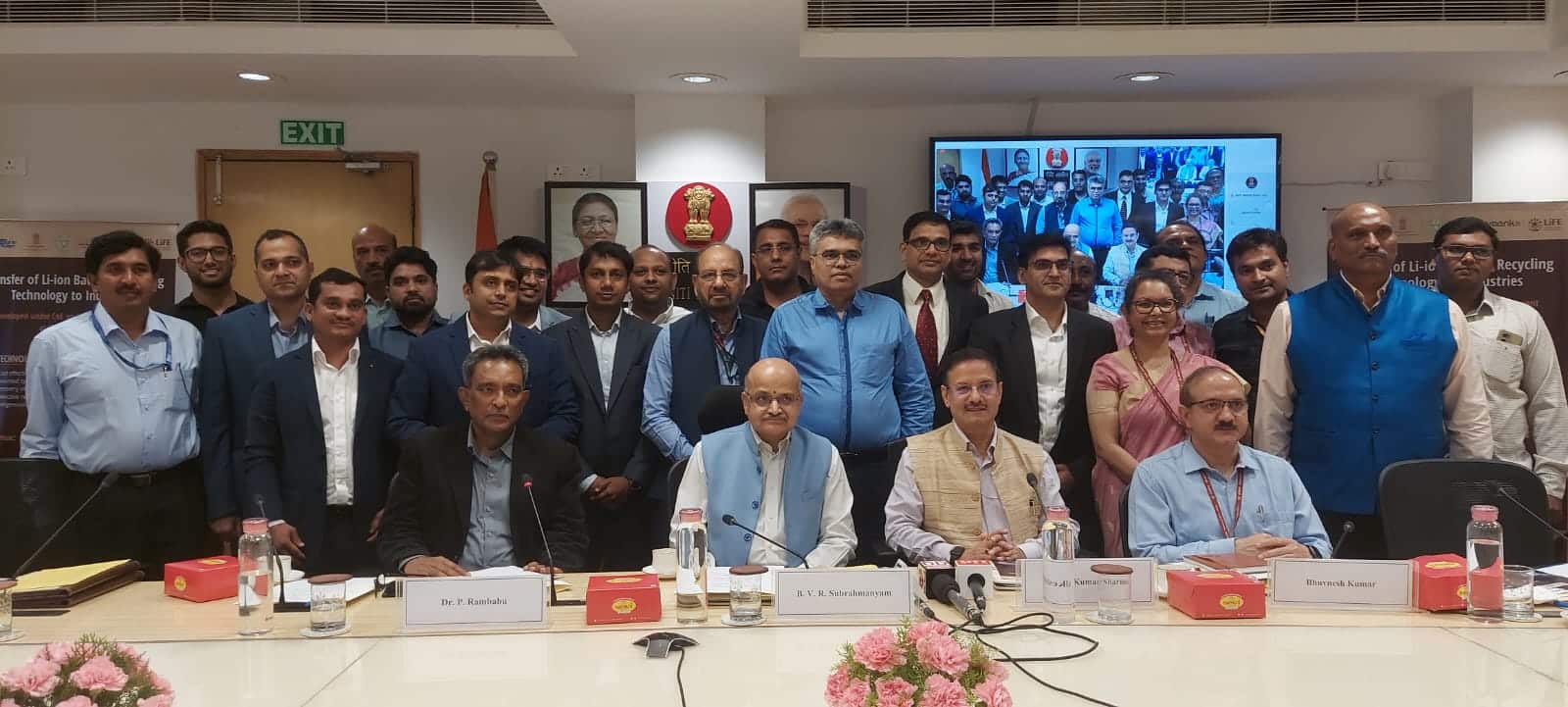
About Li-ion battery recycling technology:
- It is the indigenously developed technology that could process assorted types of discarded Li-ion batteries.
- It has the capacity of recovering more than 95 per cent Lithium (Li), Cobalt (Co), Manganese (Mn) and Nickel (Ni) contents in the form of their corresponding oxides/carbonates of about 98 per cent purity.
- The recycling process involves leaching followed by hierarchical selective extraction of metal values through the solvent extraction process.
- These secondary raw materials could be used for battery manufacturing or in other potential applications.
- This technology has been developed under the Centre of Excellence on E-waste Management.
Key facts about Lithium
- It is a soft, silvery-white metal that heads group 1, the alkali metals group, of the periodic table of the elements.
- It has the lowest density of all metals and the lightest of the solid elements.
- It reacts vigorously with water.
- It does not occur as a metal in nature but is found combined in small amounts in igneous rocks.
- Major Reserves: Lithium reserves are concentrated in the lithium triangle in South America – Argentina, Bolivia & Chile, with 50% of the deposits concentrated in these regions.
Q1) What is E-waste?
E-waste, short for electronic waste, refers to discarded electronic devices that have reached the end of their useful life or are no longer wanted by their users. It includes a wide range of electronic items, such as computers, mobile phones, televisions, refrigerators, washing machines, and other household appliances.


 Last updated on Oct, 2026
→ UPSC 2027 Notification will be released on 13 January 2027 at upsconline.nic.in.
→ Check Nobel Prize 2026 Winners List here.
→ Download PIB PRiSM Monthly Magazine 2026 here.
→ Check UPSC Monthly Current Affairs Magazine The Recitals here.
→ Check out the latest UPSC Syllabus here.
→ Download UPSC Model Answers for Mains 2026
→ UPSC Mains Question Paper 2026 is out now for Essay & GS Paper 1, 2, 3 & 4.
→ UPSC Calendar 2027 has been released.
→ Enroll in Vajiram & Ravi’s UPSC Mains Test Series 2027 for structured answer writing practice, expert evaluation, and exam-oriented feedback.
→ Join Vajiram & Ravi’s UPSC Mentorship Program 2027 for personalized guidance, strategy planning, and one-to-one support from experienced mentors.
→ Go through the UPSC Mains Previous Year Papers to enhance your preparation.
→ UPSC has released UPSC Toppers List 2025 with the Civil Services final result on its official website.
→ Also check Best UPSC Coaching in India








