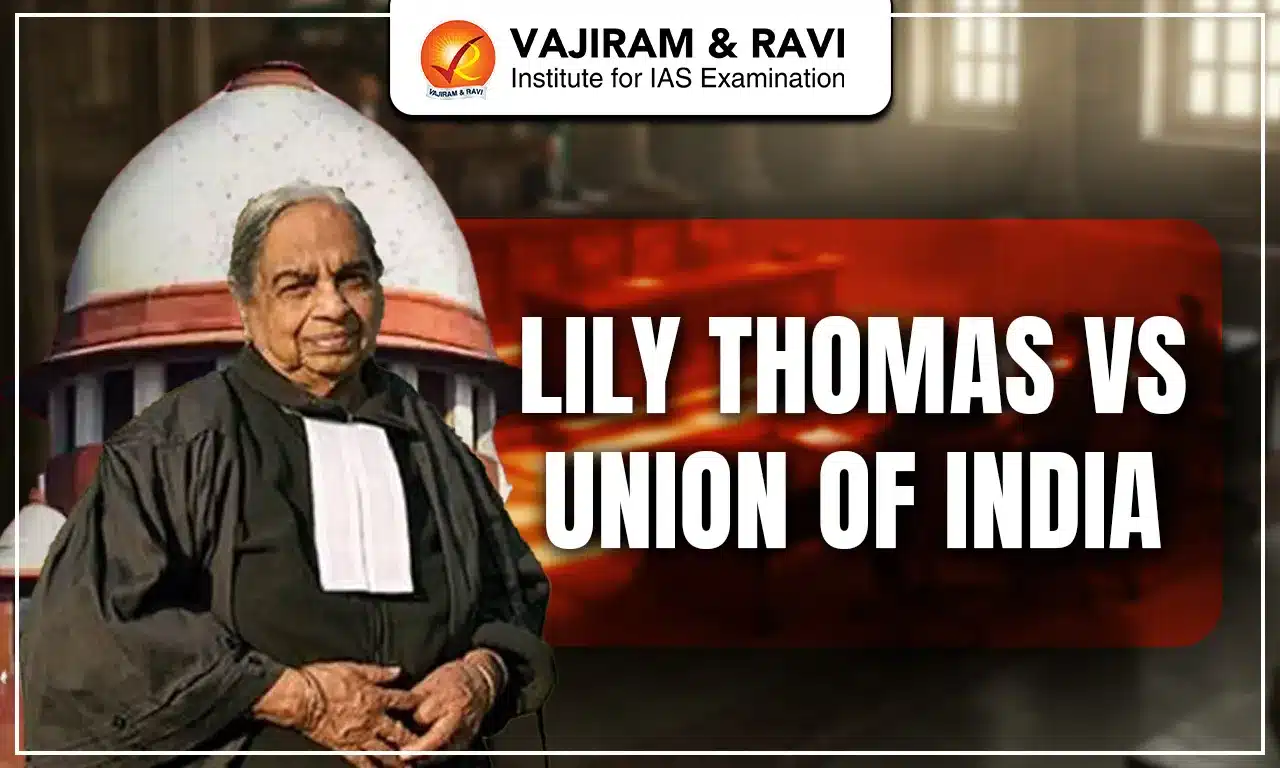
Lily Thomas vs Union of India (2013) is a landmark judgment that transformed the legal framework governing the disqualification of elected representatives in India. The case is widely discussed in the context of electoral reforms because it directly addressed whether convicted legislators should continue to hold office.
The Supreme Court’s ruling in this case strengthened democratic accountability and brought clarity to the provisions of the Representation of the People Act, 1951.
Lily Thomas vs Union of India Background
The case was filed by advocate Lily Thomas and NGO Lok Prahari challenging the constitutional validity of Section 8(4) of the Representation of the People Act (RPA), 1951. This provision allowed sitting MPs and MLAs to retain their seats even after being convicted of certain criminal offences, provided they filed an appeal within three months.
- Section 8 of the RPA outlines offences that lead to disqualification.
- Section 8(4) carved out an exception for sitting legislators, giving them immunity from immediate disqualification.
- Petitioners argued that this was discriminatory because ordinary citizens faced immediate consequences, while elected representatives enjoyed special protection.
- The case questioned whether Parliament had the authority to postpone the disqualification of convicted legislators.
- The matter raised concerns about electoral integrity and the criminalisation of politics.
Supreme Court Judgement on Lily Thomas vs Union of India
The Supreme Court delivered its judgment on 10 July 2013, striking down Section 8(4) of the RPA, 1951 as unconstitutional.
- The Court held that Parliament cannot defer the date of disqualification of a convicted representative through legislation.
- Once convicted for offences listed under Section 8(1), 8(2), or 8(3), the MP or MLA stands immediately disqualified.
- The Court clarified that Articles 101(3)(a) and 190(3)(a) of the Constitution provide for disqualification from the date of conviction.
- The exception created for sitting legislators under Section 8(4) was held to violate the principle of equality.
- The judgment emphasized the need for maintaining the purity of the legislative process.


Disqualification of MPs and MLAs under RPA, 1951
- Section 8(3) of the Representation of the People Act, 1951 mandates that any MP or MLA convicted of an offence and sentenced to two years or more of imprisonment is automatically disqualified.
- The disqualification under Section 8(3) continues for the entire duration of imprisonment and further extends for six additional years after the individual’s release.
- After such a conviction, the individual cannot contest elections, hold legislative office, or continue as a sitting representative.
- Even if the convicted individual is out on bail, the disqualification remains effective as long as the conviction stands.
- Candidates who have filed an appeal against their conviction and are on bail are still ineligible to contest elections unless a court specifically stays the conviction, not just the sentence.
- Before 2013, Section 8(4) created an exception for sitting MPs and MLAs, allowing them to continue in office if they filed an appeal against their conviction within three months.
- This provision provided a legal shield to elected representatives, preventing immediate disqualification and creating an unequal advantage over ordinary citizens.
Representation of the People Act, 1951
The Representation of the People Act, 1951 lays down the legal framework for conducting elections to Parliament and state legislatures in India. It defines the qualifications, disqualifications, and procedures governing elected representatives.
- Provides the rules and procedures for conducting elections to Lok Sabha and state assemblies.
- Defines qualifications and disqualifications for candidates and elected members.
- Regulates corrupt practices, electoral offences, and penalties.
- Lays down the framework for election petitions and resolution of electoral disputes.
- Empowers the Election Commission to ensure fair conduct of elections.
- Includes provisions relating to vacancies, by-elections, and conduct of polls.
- Contains mechanisms to address malpractices such as bribery, intimidation, and misuse of official machinery.
- Provides for maintenance of electoral rolls and registration of voters.

 Last updated on Oct, 2026
→ UPSC 2027 Notification will be released on 13 January 2027 at upsconline.nic.in.
→ Check Nobel Prize 2026 Winners List here.
→ Download PIB PRiSM Monthly Magazine 2026 here.
→ Check UPSC Monthly Current Affairs Magazine The Recitals here.
→ Check out the latest UPSC Syllabus here.
→ Download UPSC Model Answers for Mains 2026
→ UPSC Mains Question Paper 2026 is out now for Essay & GS Paper 1, 2, 3 & 4.
→ UPSC Calendar 2027 has been released.
→ Enroll in Vajiram & Ravi’s UPSC Mains Test Series 2027 for structured answer writing practice, expert evaluation, and exam-oriented feedback.
→ Join Vajiram & Ravi’s UPSC Mentorship Program 2027 for personalized guidance, strategy planning, and one-to-one support from experienced mentors.
→ Go through the UPSC Mains Previous Year Papers to enhance your preparation.
→ UPSC has released UPSC Toppers List 2025 with the Civil Services final result on its official website.
→ Also check Best UPSC Coaching in India
Lily Thomas vs Union of India FAQs
Q1. What is the Lily Thomas vs Union of India case about?+
Q2. What was Section 8(4) of the RPA, 1951?+
Q3. Why was Section 8(4) declared unconstitutional?+
Q4. What happens to MPs/MLAs convicted for 2 or more years?+
Q5. Does filing an appeal stop the disqualification?+
Tags: lily thomas vs union of india