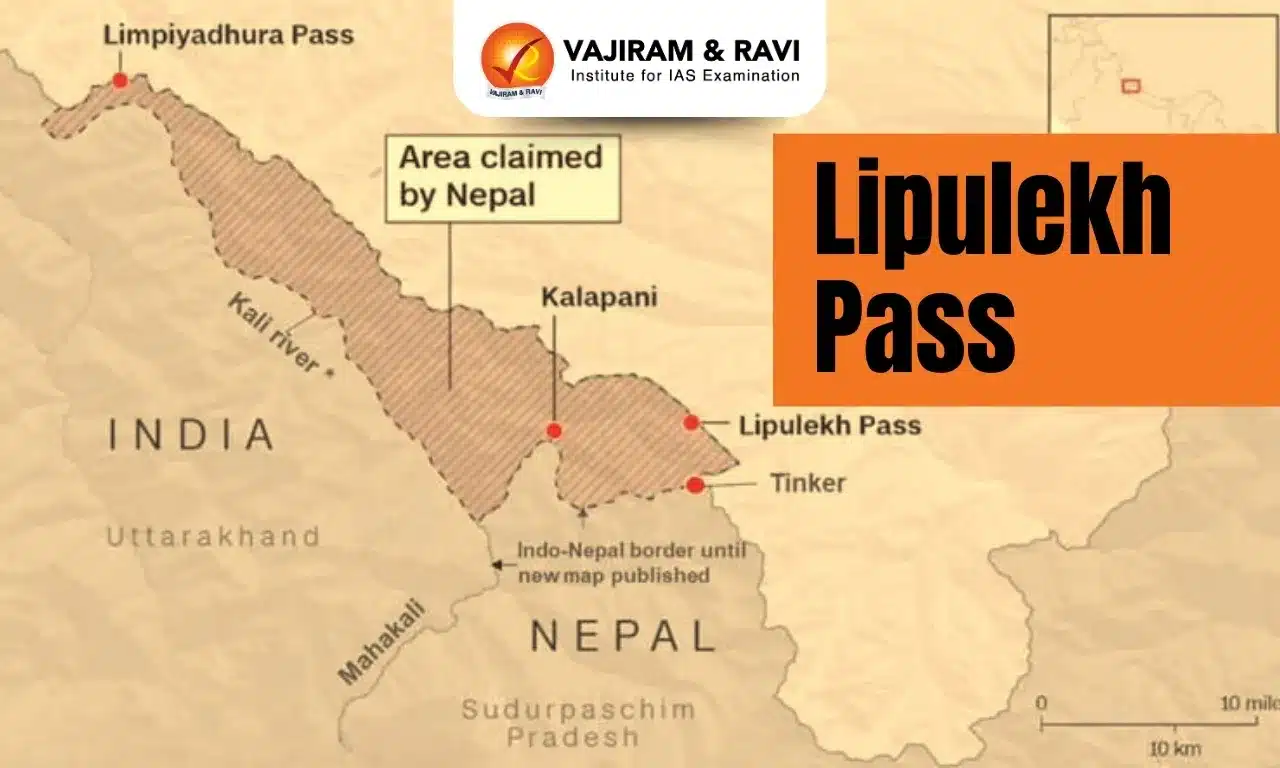
Lipulekh Pass Latest News
The centuries-old India-Tibet trade route through Lipulekh Pass has reopened recently, with a 17-member Indian delegation entering Taklakot in Tibet after China cleared cross-border trade.
About Lipulekh Pass
- It is a high-altitude mountain pass located in the Pithoragarh district of Uttarakhand, in India’s Kumaon region.
- It sits at the intersection of three international borders: India to the south and west, China (Tibet Autonomous Region) to the north and east, and Nepal to the west.
- It links the Indian state of Uttarakhand with the Tibet region of China.
- Altitude: It lies at an altitude of approximately 5,334 meters (17,500 feet).
- Its elevation and strategic location make it a gateway to the higher reaches of the Himalayas.
- It is the first Indian border post opened for trade with China in 1992.
- Other passes: This was followed by the opening of Shipki La Pass, Himachal Pradesh, in 1994 and Nathu La Pass, Sikkim, in 2006.
- Significance:
- Strategic Location: Lies at the tri-junction of India, Nepal, and China, making it geographically significant.
- Ancient Trade Route: Lipulekh Pass has been utilized for centuries as a trade route, connecting the Indian subcontinent with the Tibetan plateau.
- Religious Significance: It is a key corridor for the Kailash Mansarovar Yatra and plays an important role in connecting border communities, especially tribal groups such as the Bhotiyas who depend on cross-border trade.


What are the territorial disputes?
- The disagreement dates back to the 1816 Sugauli Treaty signed between British India and Nepal after the Anglo-Nepal War.
- Under the treaty, the Kali River was accepted as the boundary between the two sides.
- The problem is that India and Nepal disagree on where the Kali River actually begins.
- India maintains that the river originates near Kalapani, placing areas such as Kalapani, Lipulekh, and Limpiyadhura within Indian territory.
- Nepal, however, argues that the river begins farther west, which would place all three areas inside Nepal.
- Because both countries use different interpretations of the treaty, the border remains disputed even today.
- How does China come into the mix?
- What adds to the dispute is that Nepal argues that trade between India and China through this pass is often held without Nepali consent.
- In 2015, India and China agreed to use Lipulekh for bilateral trade and the Kailash Mansarovar pilgrimage, triggering widespread protests in Nepal.
News: NIE

 Last updated on Oct, 2026
→ UPSC 2027 Notification will be released on 13 January 2027 at upsconline.nic.in.
→ Check Nobel Prize 2026 Winners List here.
→ Download PIB PRiSM Monthly Magazine 2026 here.
→ Check UPSC Monthly Current Affairs Magazine The Recitals here.
→ Check out the latest UPSC Syllabus here.
→ Download UPSC Model Answers for Mains 2026
→ UPSC Mains Question Paper 2026 is out now for Essay & GS Paper 1, 2, 3 & 4.
→ UPSC Calendar 2027 has been released.
→ Enroll in Vajiram & Ravi’s UPSC Mains Test Series 2027 for structured answer writing practice, expert evaluation, and exam-oriented feedback.
→ Join Vajiram & Ravi’s UPSC Mentorship Program 2027 for personalized guidance, strategy planning, and one-to-one support from experienced mentors.
→ Go through the UPSC Mains Previous Year Papers to enhance your preparation.
→ UPSC has released UPSC Toppers List 2025 with the Civil Services final result on its official website.
→ Also check Best UPSC Coaching in India
Lipulekh Pass FAQs
Q1. What is Lipulekh Pass?+
Q2. Which three countries meet at the Lipulekh Pass tri-junction?+
Q3. Why is Lipulekh Pass strategically important?+
Q4. Which important pilgrimage route passes through Lipulekh Pass?+
Tags: lipulekh pass