


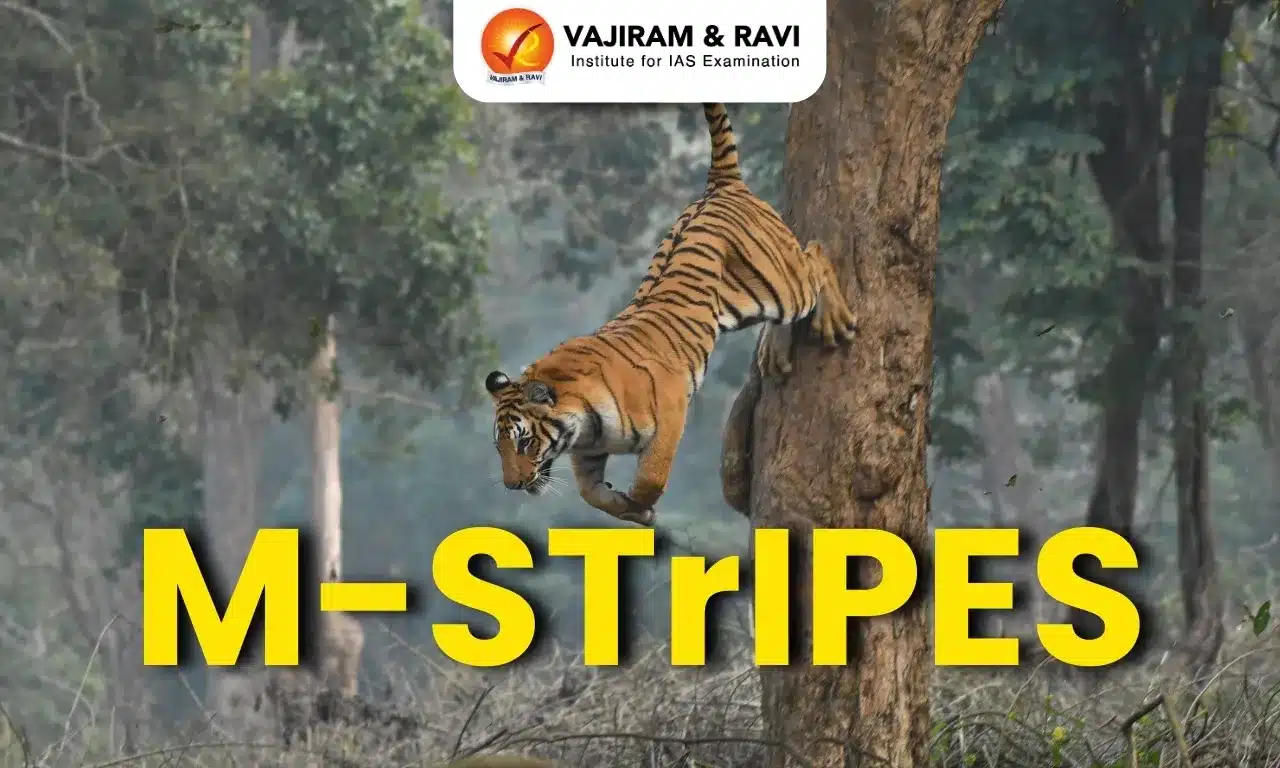
M-STrIPES Latest News
Forest staff who are to be involved in the census of tigers and other wild animals at Anamalai Tiger Reserve will be using the advanced Monitoring System for Tigers: Intensive Protection and Ecological Status (M-Stripes/MSTrIPES) app.
About M-STrIPES
- The MSTrIPES (Monitoring System for Tigers: Intensive Protection and Ecological Status) is a software-based monitoring system created to assist patrol and protect tiger habitats.
- It was launched by the National Tiger Conservation Authority (NTCA) along with the Wildlife Institute of India in 2010.
- It is designed to assist wildlife protection, monitoring, and management of Protected Areas.
- The programme consists of two parts: an analytical engine with a central desktop software and an online analysis tool, and an Android-based mobile application that records field observations and tracks using real-time GPS.
- It uses Global Positioning System (GPS), General Packet Radio Services (GPRS), and remote sensing,
- to collect information from the field
- create a database using modern Information Technology (IT)-based tools
- analyze the information using GIS and statistical tools
- to provide inferences that allow tiger reserve managers to better manage their wildlife resources.
- Under MSTrIPES protocols, forest guards are expected to patrol their beats and record their tracks using a GPS, in addition to recording observations in site-specific data sheets.
- Beat is the smallest unit of forest administration in India since British time and usually one forest guard is assigned for one beat.


Key Facts about Anamalai Tiger Reserve
- It is located at an altitude of 1400 m in the Anamalai Hills of Pollachi and Coimbatore District of Tamil Nadu.
- It lies south of the Palakkad gap in the Southern Western Ghats.
- It is surrounded by the Parambikulum Tiger Reserve on the east, Chinnar Wildlife Sanctuary, and Eravikulum National Park on the southwestern side.
- It is inhabited by six indigenous communities, viz., Kadar, Muduvar, Malasar, Malai malasar, Eravalar, and Pulayar.
- Vegetation:
- It supports diverse habitat types, viz. Wet evergreen forests, semi-evergreen forests, moist deciduous, dry deciduous, dry thorn, and shola forests.
- Other unique habitats like montane grasslands, savannah, and marshy grasslands are also present.
- Flora: The reserve is rich in wild relatives of cultivated species like mango, jackfruit, wild plantain, ginger (Zingiber officinale), turmeric, pepper (Piper longum), cardamom, etc.
- Fauna: The important wild animals of the reserve include: Tiger, Asiatic elephant, Sambar, Spotted deer, Barking deer, Jackal, Leopard, Jungle cat, etc.
Source: NIE

 Last updated on Oct, 2026
→ UPSC 2027 Notification will be released on 13 January 2027 at upsconline.nic.in.
→ Check Nobel Prize 2026 Winners List here.
→ Download PIB PRiSM Monthly Magazine 2026 here.
→ Check UPSC Monthly Current Affairs Magazine The Recitals here.
→ Check out the latest UPSC Syllabus here.
→ Download UPSC Model Answers for Mains 2026
→ UPSC Mains Question Paper 2026 is out now for Essay & GS Paper 1, 2, 3 & 4.
→ UPSC Calendar 2027 has been released.
→ Enroll in Vajiram & Ravi’s UPSC Mains Test Series 2027 for structured answer writing practice, expert evaluation, and exam-oriented feedback.
→ Join Vajiram & Ravi’s UPSC Mentorship Program 2027 for personalized guidance, strategy planning, and one-to-one support from experienced mentors.
→ Go through the UPSC Mains Previous Year Papers to enhance your preparation.
→ UPSC has released UPSC Toppers List 2025 with the Civil Services final result on its official website.
→ Also check Best UPSC Coaching in India
M-STrIPES FAQs
Q1. What does M-STrIPES stand for?+
Q2. What is M-STrIPES?+
Q3. Which organisations launched M-STrIPES?+
Q4. Which technologies are used by M-STrIPES to collect field data?+
Tags: m-stripes prelims pointers upsc current affairs upsc prelims current affairs








