Macroeconomic Stabilisation Latest News
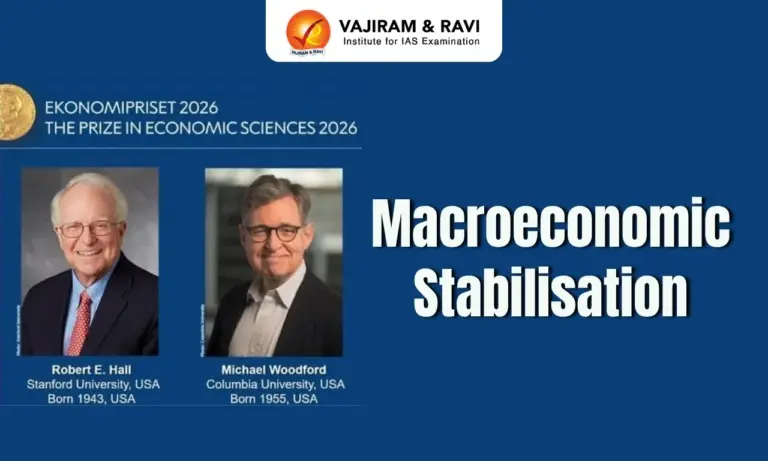
- The 2026 Sveriges Riksbank Prize in Economic Sciences in Memory of Alfred Nobel — commonly known as the Economics Nobel — has been jointly awarded to American economists Robert E. Hall (Stanford University) and Michael Woodford (Columbia University).
- The official citation honours them for establishing the “microeconomic foundations of macroeconomic stabilisation.”
About Nobel Prize in Economics
- The Economics Nobel (officially the Sveriges Riksbank Prize in Economic Sciences in Memory of Alfred Nobel) is not one of the original five Nobel Prizes.
- It was established by Sweden’s central bank in 1968 and first awarded in 1969.
- This prize is administered by the Royal Swedish Academy of Sciences, honouring outstanding contributions to economics.


What Is Macroeconomic Stabilisation?
- Stabilisation policy refers to the tools governments and central banks use to control wild swings in growth, inflation, unemployment, and business cycles.
- E.g., the RBI raising interest rates to contain inflation, or the Indian government cutting taxes to boost consumption during slowdowns like the COVID-19 pandemic.
- Without such interventions, economic recovery could take far longer, with business failures and job losses spiralling further.
The Historical Backdrop: From Keynes to Crisis
- The dominant pre-1929 view was that governments should not intervene, letting markets self-correct.
- The 1929 stock market crash triggered the Great Depression: US GDP fell 30%, unemployment soared to 25%, and thousands of banks/businesses collapsed.
- British economist John Maynard Keynes proposed a solution that reshaped 20th-century economics: governments should actively stabilise economies — cutting interest rates/taxes and increasing spending (even via deficits) during slowdowns, and tightening policy during overheating/inflation.
- This Keynesian framework worked for decades — until the 1970s, when economies faced high inflation and high unemployment simultaneously (a situation called stagflation), driven by repeated oil price shocks.
- Efforts to boost growth worsened inflation; efforts to curb inflation worsened unemployment. This crisis made many see Keynesian intervention itself as the problem.
Hall and Woodford’s Contribution: Rebuilding the Framework
- From the late 1970s onward, Hall and Woodford revitalised Keynesian economics by grounding it in real household and firm-level data, rather than Keynes’s assumed straight-line relationships between variables.
Robert Hall — The Demand Side
- Studied how households decide how much to consume and when to adjust spending.
- The old assumption: consumption moves mechanically with disposable income.
- Hall’s 1978/1982 research, using microdata from individual households, found that expectations about the future matter almost as much as current income.
- Crucially, he showed not everyone behaves the same way — households living hand-to-mouth do not adjust consumption based on future income expectations the way wealthier households do.
Michael Woodford — The Supply Side
- Focused on how firms set prices — showing prices are not adjusted continuously; firms fix prices for a period (e.g., ice-cream prices set at the start of summer, unchanged through the season).
- This introduced “forward-lookingness” into supply-side theory: firms must anticipate future conditions when fixing prices now.
- Woodford derived a formula linking aggregate inflation to expectations and current output, combining it with Hall’s demand-side insights.
- He laid out the complete framework in his 2003 monograph, Making Things Happen: A Theory of Causal Explanation — explaining business cycles and the critical role of policy transparency.
Why Transparency Matters: The Key Policy Insight
- Woodford’s central insight: stabilisation should not be viewed as policymakers “pulling levers” independent of public understanding.
- Because consumer and firm expectations about future policy directly shape economic outcomes, central banks must clearly communicate their intentions.
- As Woodford explained at the announcement: creating a framework to talk to people about why the things being done are being done was a key goal — not merely to use the framework on people, but to engage and inform them.
- Central bank communication (e.g., RBI policy statements, forward guidance) is now recognised as integral to policy effectiveness, not a mere add-on.
Significance Today
- In recent years, the global economy has faced extraordinary shocks — a pandemic, multiple wars spiking commodity prices, and policy missteps like tariffs.
- Yet, growth has largely avoided severe recession, partly because policymakers worldwide now design interventions informed by Hall and Woodford’s research — grounded in real behavioural data and backed by transparent communication.

 Last updated on Oct, 2026
→ UPSC 2027 Notification will be released on 13 January 2027 at upsconline.nic.in.
→ Check Nobel Prize 2026 Winners List here.
→ Download PIB PRiSM Monthly Magazine 2026 here.
→ Check UPSC Monthly Current Affairs Magazine The Recitals here.
→ Check out the latest UPSC Syllabus here.
→ Download UPSC Model Answers for Mains 2026
→ UPSC Mains Question Paper 2026 is out now for Essay & GS Paper 1, 2, 3 & 4.
→ UPSC Calendar 2027 has been released.
→ Enroll in Vajiram & Ravi’s UPSC Mains Test Series 2027 for structured answer writing practice, expert evaluation, and exam-oriented feedback.
→ Join Vajiram & Ravi’s UPSC Mentorship Program 2027 for personalized guidance, strategy planning, and one-to-one support from experienced mentors.
→ Go through the UPSC Mains Previous Year Papers to enhance your preparation.
→ UPSC has released UPSC Toppers List 2025 with the Civil Services final result on its official website.
→ Also check Best UPSC Coaching in India
Macroeconomic Stabilisation FAQs
Q1. What is macroeconomic stabilisation? +
Q2. Who received the 2026 Nobel Prize in Economics, according to the article? +
Q3. How did Keynesian economics change government responses to economic crises? +
Q4. What were Robert Hall’s contributions to macroeconomic stabilisation? +
Q5. Why is transparency important for macroeconomic stabilisation? +
Tags: Macroeconomic stabilisation mains articles upsc current affairs upsc mains current affairs