Bodh Gaya Temple Latest News
Buddhist monks under the All India Buddhist Forum (AIBF) have been protesting since February 2024, demanding the repeal of the Bodh Gaya Temple Act (BTA), 1949.
What is the Bodh Gaya Temple Act (BTA), 1949?
- The Act established an eight-member management committee to oversee the temple.
- Equal representation was given to Hindus and Buddhists, but the District Magistrate (DM) was made the ex-officio chairperson.
- Since the DM historically came from the Hindu community, this created a perceived Hindu majority in temple administration.
- Buddhist organizations have long demanded full control over the temple, calling it Bodh Gaya Mahavihara.
Historical Background of the Dispute
- Ancient Period: Emperor Ashoka built the original temple at Bodh Gaya in the 3rd century BCE. It remained a Buddhist religious center until the Pala dynasty.
- Medieval Period (13th Century):
- Bakhtiyar Khilji’s invasion led to the decline of Buddhism in India.
- 1590: A Hindu monk established the Bodh Gaya Mutt, leading to Hindu control over the temple.
- Colonial Period: British-era records refer to Bodh Gaya as a Hindu-controlled site.
- Post-Independence (1949): The Bihar Assembly passed the BTA to formalize temple management, transferring control to the new committee instead of a single Hindu authority.
Government Interventions
- The BTA, 1949, was passed to resolve ongoing disputes between Hindu and Buddhist religious heads.
- 2013 Amendment: The Bihar government amended the rule, allowing the ex-officio chairman (DM) to be from any faith.
- Early 1990s: Bihar CM Lalu Prasad Yadav drafted the Bodh Gaya Mahavihara Bill, aiming to transfer temple management to the Buddhist community.
- The Bill prohibited Hindu idol immersions near the temple and Hindu marriages inside the premises.
- However, it was never passed and remains in cold storage.


About the Mahabodhi Temple Complex
- The Bodh Gaya Temple is one of the four most sacred sites of Buddhism, marking the location where Buddha attained Enlightenment (Bodhi) along with:
- Lumbini (Buddha’s birthplace)
- Sarnath (Buddha’s first sermon)
- Kushinagar (Buddha’s parinirvana
- Location: Bodh Gaya, Bihar, on the banks of the Niranjana River.
- The temple is one of the oldest surviving brick structures in India.
- Originally built by Ashoka in the 3rd century BCE, the present structure dates to the 5th–6th centuries CE.
- UNESCO World Heritage Site since 2002.
Architectural Features
- Grand Temple: A 50-meter-high pyramidal shikhara (tower) with intricate engravings and arch motifs.
- Four smaller towers, each topped with an umbrella-like dome, surround the central temple.
- Sacred Bodhi Tree: Believed to be a direct descendant of the original tree under which Buddha attained Enlightenment.
- Vajrasana (Diamond Throne): A stone slab marking the exact spot where Buddha meditated.
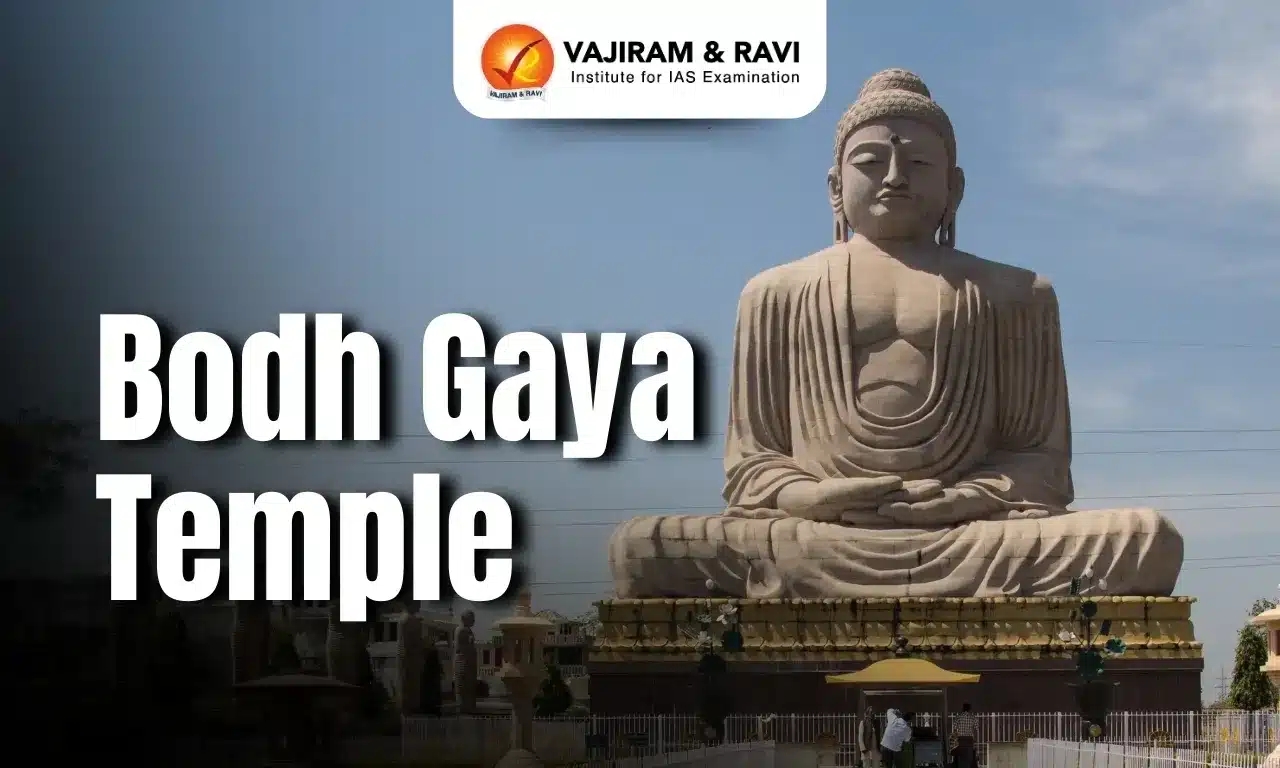
- Temple Shrine: Houses a yellow sandstone statue of Buddha, encased in glass.
- The 4.8-hectare complex includes ancient shrines and modern Buddhist structures built by devotees.
Bodh Gaya Temple FAQs
Q1. Why is the Bodh Gaya Temple important?
Ans. It is the site where Gautama Buddha attained enlightenment under the Bodhi tree, making it one of the holiest Buddhist pilgrimage sites.
Q2. What is the architectural style of the Mahabodhi Temple?
Ans. The temple is built in the Gupta architectural style with a pyramid-shaped spire and intricate carvings.
Q3. Is Bodh Gaya a UNESCO World Heritage Site?
Ans. Yes, the Mahabodhi Temple Complex was designated a UNESCO World Heritage Site in 2002.
Q4. What are the key attractions in Bodh Gaya?
Ans. The Bodhi Tree, Mahabodhi Temple, Vajrasana (Diamond Throne), and Animesh Lochana Chaitya.
Source: TH

 Last updated on Oct, 2026
→ UPSC 2027 Notification will be released on 13 January 2027 at upsconline.nic.in.
→ Check Nobel Prize 2026 Winners List here.
→ Download PIB PRiSM Monthly Magazine 2026 here.
→ Check UPSC Monthly Current Affairs Magazine The Recitals here.
→ Check out the latest UPSC Syllabus here.
→ Download UPSC Model Answers for Mains 2026
→ UPSC Mains Question Paper 2026 is out now for Essay & GS Paper 1, 2, 3 & 4.
→ UPSC Calendar 2027 has been released.
→ Enroll in Vajiram & Ravi’s UPSC Mains Test Series 2027 for structured answer writing practice, expert evaluation, and exam-oriented feedback.
→ Join Vajiram & Ravi’s UPSC Mentorship Program 2027 for personalized guidance, strategy planning, and one-to-one support from experienced mentors.
→ Go through the UPSC Mains Previous Year Papers to enhance your preparation.
→ UPSC has released UPSC Toppers List 2025 with the Civil Services final result on its official website.
→ Also check Best UPSC Coaching in India