Mahabodhi Temple Latest News
The Mahabodhi Temple received donations worth nearly Rs 2 crore in a six-day census of donation boxes, including Rs 1.5 crore from Indian and Rs 50 lakh from foreign countries.
About Mahabodhi Temple
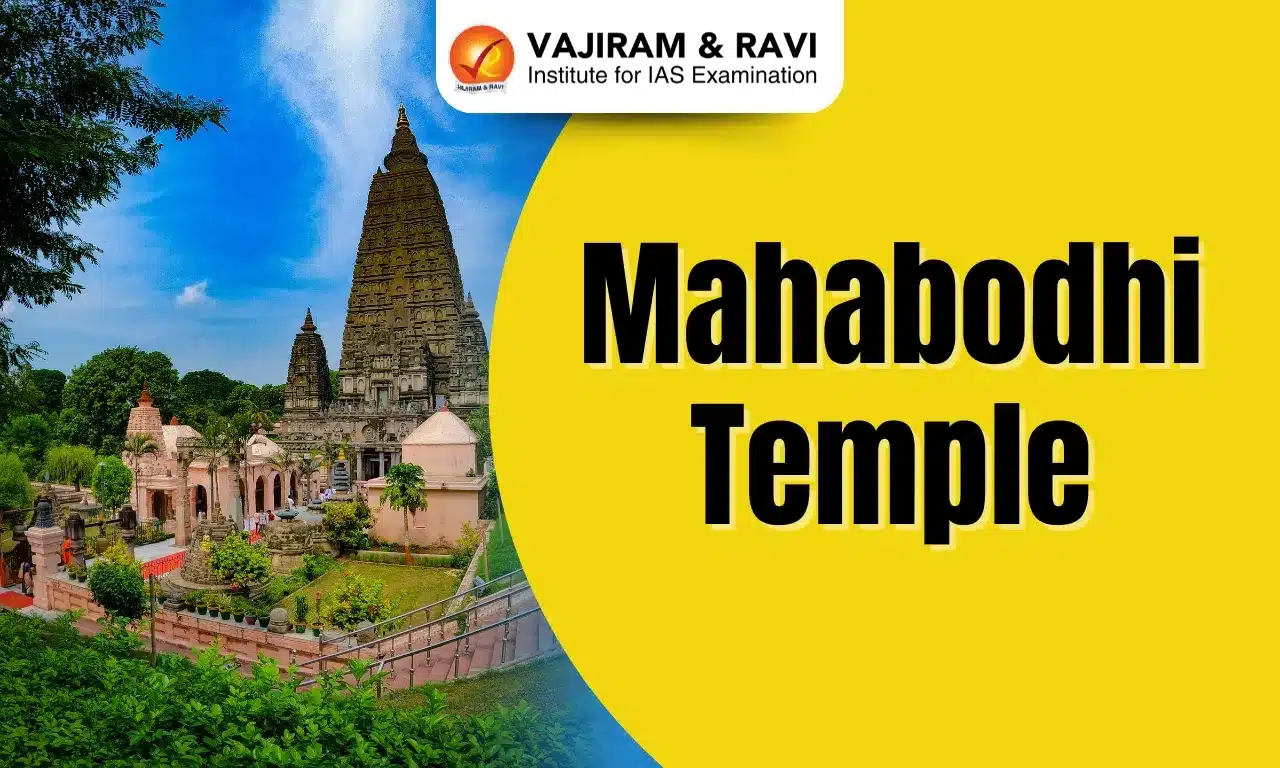
- It is an ancient Buddhist temple located in Bodh Gaya, Bihar, on the banks of the Niranjana River.
- It is one of the four most sacred sites of Buddhism, marking the location where Buddha attained Enlightenment (Bodhi), along with:
- Lumbini (Buddha’s birthplace)
- Sarnath (Buddha’s first sermon)
- Kushinagar (Buddha’s parinirvana)
- The original temple was constructed by the Mauryan emperor Ashoka in the 3rd century BC.
- The present structure is estimated to have been erected between 5th and 6th century AD during the Gupta Period.
- The temple was heavily restored in the 19th century by Myanmar (Burmese) Buddhists and then by the British archaeologist Sir Alexander Cunningham.
- It was recognized as a UNESCO World Heritage site in 2002.


Mahabodhi Temple Architecture
- It is constructed of brick and is one of the oldest brick structures to have survived in India.
- Built-in the classical style of Indian temple architecture, the temple complex spreads over 5 hectares.
- The temple structure is 180 feet (55 meters) in height.
- Its pyramidal shikhara (tower) comprises several layers of niches, arch motifs, and fine engravings.
- Four additional towers, each identical to the main tower but smaller in size, adorn the corners of the two-story structure.
- A shrine inside the temple holds a yellow sandstone statue of the Buddha encased in glass.
- In 2013, the upper portion of the temple was covered with gold, as a gift from the King and devotees of Thailand.
- A descendant of the Bodhi tree under which the Buddha is said to have sat until he attained enlightenment stands adjacent to the temple.
- Vajrasana (Diamond Throne): A stone slab marking the exact spot where Buddha meditated and attained enlightenment, originally installed by Emperor Asoka.
- Stone railings surround the temple as well as the Bodhi tree.
- One of the most famous of Ashoka’s many pillars (on which he had engraved his proclamations and his understanding of religious doctrine) stands at the southeast corner of the temple.
News: JAG

 Last updated on Oct, 2026
→ UPSC 2027 Notification will be released on 13 January 2027 at upsconline.nic.in.
→ Check Nobel Prize 2026 Winners List here.
→ Download PIB PRiSM Monthly Magazine 2026 here.
→ Check UPSC Monthly Current Affairs Magazine The Recitals here.
→ Check out the latest UPSC Syllabus here.
→ Download UPSC Model Answers for Mains 2026
→ UPSC Mains Question Paper 2026 is out now for Essay & GS Paper 1, 2, 3 & 4.
→ UPSC Calendar 2027 has been released.
→ Enroll in Vajiram & Ravi’s UPSC Mains Test Series 2027 for structured answer writing practice, expert evaluation, and exam-oriented feedback.
→ Join Vajiram & Ravi’s UPSC Mentorship Program 2027 for personalized guidance, strategy planning, and one-to-one support from experienced mentors.
→ Go through the UPSC Mains Previous Year Papers to enhance your preparation.
→ UPSC has released UPSC Toppers List 2025 with the Civil Services final result on its official website.
→ Also check Best UPSC Coaching in India
Mahabodhi Temple FAQs
Q1. Where is the Mahabodhi Temple located?+
Q2. Why is the Mahabodhi Temple considered sacred in Buddhism?+
Q3. Who originally built the Mahabodhi Temple?+
Q4. The present structure of the Mahabodhi Temple was mainly built during which period?+
Q5. What is the significance of the Bodhi Tree at the Mahabodhi Temple?+
Tags: mahabodhi temple prelims pointers upsc current affairs upsc prelims current affairs