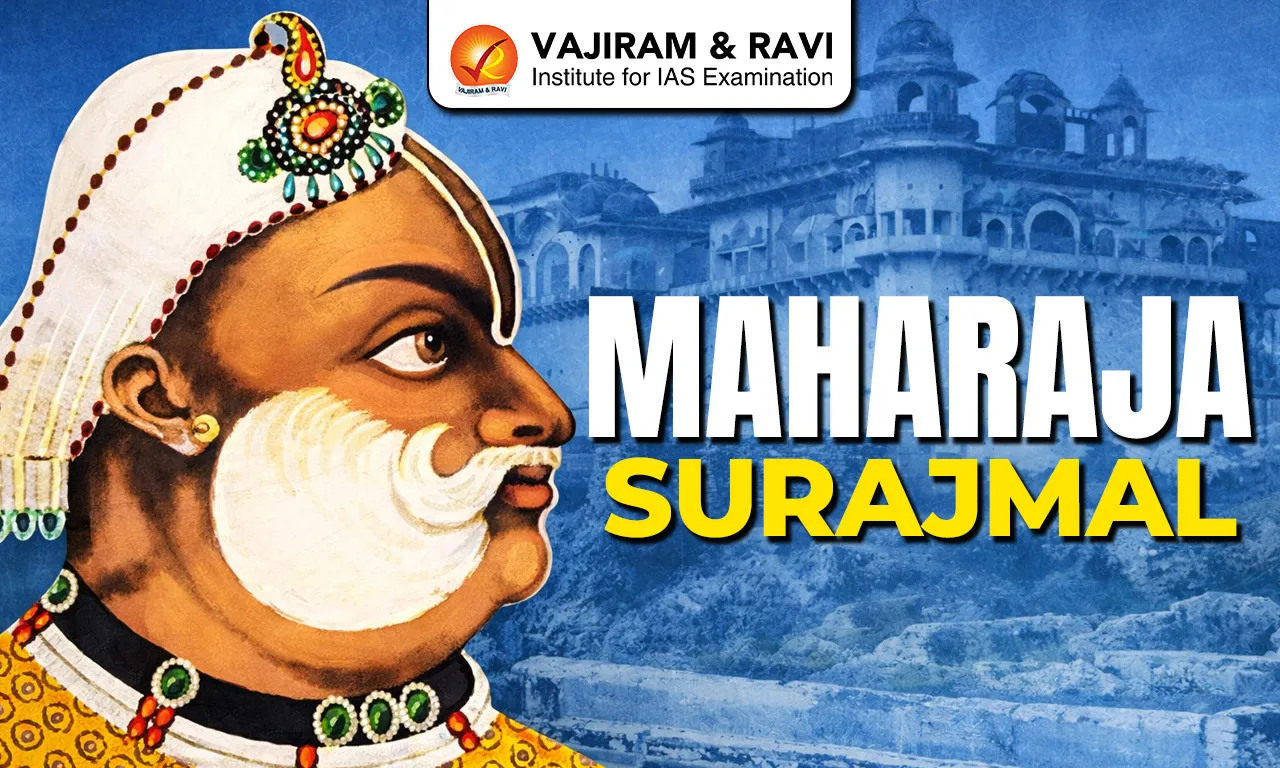
Maharaja Surajmal (1707-1763) was the most prominent ruler of the Bharatpur kingdom in Rajasthan during the 18th century. The Hindu Jat Kingdom reached its zenith under Maharaja Suraj Mal. He is known as the “Plato of the Jats” for his wisdom, diplomacy, and statesmanship.
Maharaja Surajmal Early Life
- Maharaja Surajmal was born in 1707 in the erstwhile kingdom of Bharatpur.
- He belonged to the Sinsinwar Jat dynasty.
- He was the son of Badan Singh, founder of Bharatpur State (Jat Kingdom of Rajasthan).
Maharaja Suraj Legacy
- Maharaja Surajmal expanded and strengthened Bharatpur into a powerful kingdom. Under his leadership, the kingdom extended over present-day Rajasthan, Haryana, western Uttar Pradesh, and parts of Delhi, making it a significant regional power.
- Maharaja Suraj Mal captured strategically important towns such as Agra, Mathura, and Aligarh. The strategic expansion of his kingdom made the Jat state a dominant force in North India during the 18th century, a period marked by the decline of the Mughal Empire and the rise of regional powers.
- Suraj Mal was widely respected for his strategic intelligence, earning him the title “Plato of the Jats”. He successfully repelled repeated attacks from the Mughals, Marathas, and Afghan invaders.
- Maharaja Surajmal rebuilt and fortified Lohagarh Fort (Iron Fort) at Bharatpur, enhancing its defensive features and making it a virtually impregnable stronghold of Bharatpur.
- He had a good relationship with Jai Singh of Jaipur.
- Surajmal was a secular ruler who believed in the unity of humanity above religion. He employed people based on merit, respected cultural monuments of other faiths, and envisioned a unified India.
- He implemented an efficient revenue system that ensured regular income for the state, while land reforms strengthened agricultural productivity and stability.
- His policies encouraged trade and commerce.
- Beyond administration and military conquests, Maharaja Suraj Mal was a patron of arts, architecture, and culture. He built palaces, forts, and public structures which enhanced the cultural identity of Bharatpur. The Lohagarh Fort is a prime example.
- Suraj Mal also encouraged artisans, craftsmen, and scholars.
- Maharaja Suraj Mal passed away in 1763.


 Last updated on Oct, 2026
→ UPSC 2027 Notification will be released on 13 January 2027 at upsconline.nic.in.
→ Check Nobel Prize 2026 Winners List here.
→ Download PIB PRiSM Monthly Magazine 2026 here.
→ Check UPSC Monthly Current Affairs Magazine The Recitals here.
→ Check out the latest UPSC Syllabus here.
→ Download UPSC Model Answers for Mains 2026
→ UPSC Mains Question Paper 2026 is out now for Essay & GS Paper 1, 2, 3 & 4.
→ UPSC Calendar 2027 has been released.
→ Enroll in Vajiram & Ravi’s UPSC Mains Test Series 2027 for structured answer writing practice, expert evaluation, and exam-oriented feedback.
→ Join Vajiram & Ravi’s UPSC Mentorship Program 2027 for personalized guidance, strategy planning, and one-to-one support from experienced mentors.
→ Go through the UPSC Mains Previous Year Papers to enhance your preparation.
→ UPSC has released UPSC Toppers List 2025 with the Civil Services final result on its official website.
→ Also check Best UPSC Coaching in India
Maharaja Surajmal FAQs
Q1. Who was Maharaja Surajmal?+
Q2. Who was the founder of Bharatpur state?+
Q3. Why is Maharaja Surajmal called the “Plato of the Jats”?+
Q4. What were Maharaja Surajmal’s major military achievements?+
Q5. What were his contributions as an administrator?+
Tags: maharaja surajmal