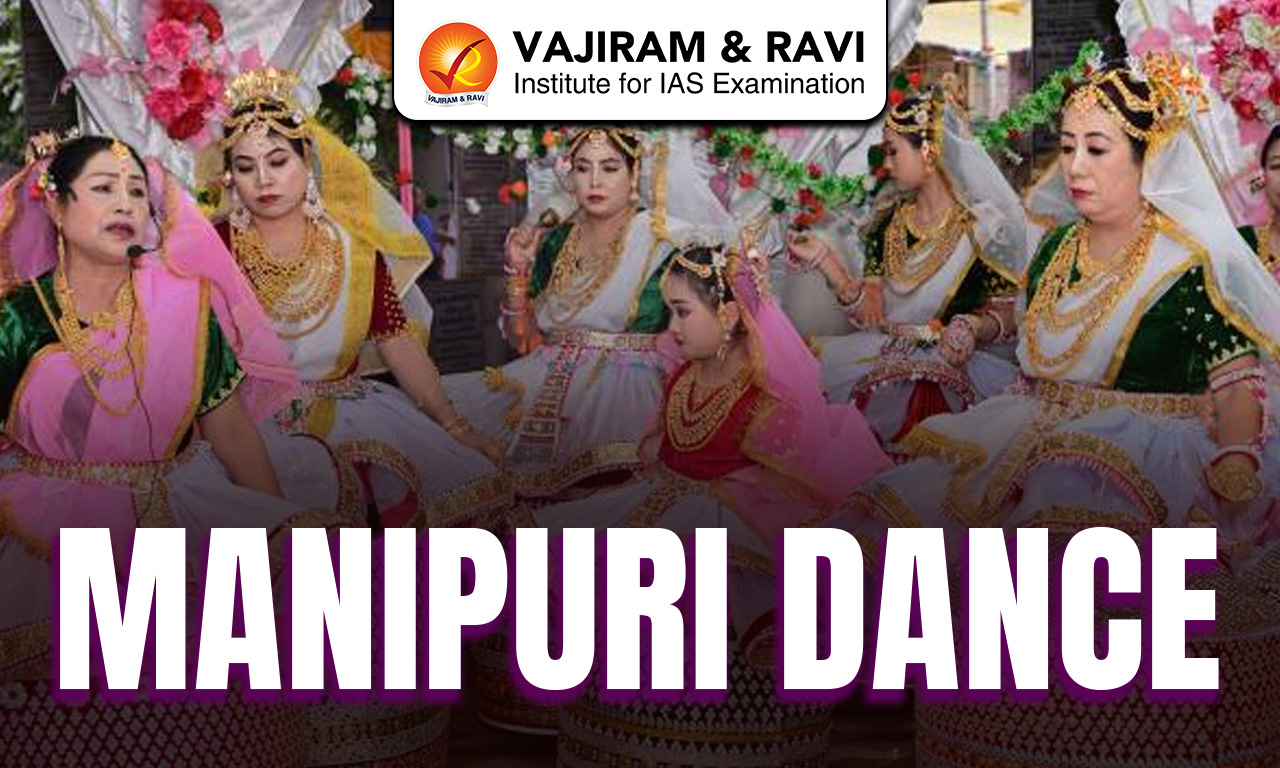
Manipuri Dance is one of the important classical dance forms of India that originated in the state of Manipur. It is known for its graceful movements and devotional themes. The dance form mainly reflects the culture, traditions, and religious beliefs of the region and often depicts stories related to Lord Krishna.
Manipuri Dance Evolution
- The origin of Manipuri Dance can be traced back to ancient times and is closely linked with the rituals and cultural traditions of the people of Manipur.
- One of its earliest influences is the festival Lai Haraoba, a pre-Vaishnavite ritual festival celebrated mainly by the Meitei community. In this festival, maibas and maibis (priests and priestesses) perform ritual dances depicting the creation of the world, which form the foundation of Manipuri dance.
- A major transformation occurred with the spread of Vaishnavism in the 15th century, which introduced devotional themes based on Radha and Krishna.
- During the reign of King Bhagyachandra, the famous Ras Leela dance tradition developed, and later rulers further enriched the dance with new compositions and rhythms.
- In modern times, Rabindranath Tagore helped popularize the dance by introducing it at Visva-Bharati University in Santiniketan, which brought wider recognition to Manipuri dance.
Also Read: Classical Dances of India
Manipuri Dance Salient Features
- The main theme of Manipuri Dance is the divine love stories of Radha and Krishna, especially the stories of Krishna and the Gopis.
- The dance form includes elements described in the Natya Shastra, such as Nritta (pure dance), Nritya (expressive dance), and Natya (dramatic representation) with the use of facial expressions, hand gestures, and body movements.
- The songs used in the performances are written in languages like Brajaboli, old Bengali, Maithili, Sanskrit, Braj, and now also in Manipuri, composed by devotional poets like Jayadeva, Vidyapati, and Chandidas.
- Manipuri dance has two main styles: Jagoi, which reflects the graceful Lasya aspect seen in Ras Leela, and Cholom, which represents the energetic Tandava aspect, often performed by male dancers.
- The dance is traditionally performed during autumn and spring festivals, often on full moon nights, and is presented in the form of dance-dramas that may include graceful as well as energetic movements.
- The costumes are unique, with female dancers wearing the cylindrical Potloi skirt similar to a Manipuri bridal dress, while male dancers portraying Krishna wear a yellow dhoti and peacock feather crown.
- The movements are soft, flowing, and graceful, often compared to bamboo trees swaying in the wind, and dancers usually do not wear ankle bells, so rhythm is expressed mainly through music.
- The dance combines masculine and feminine elements, and performances often include instruments such as the Pung, Pena, cymbals, flute, and harmonium.
- Famous Proponents: Jhaveri sisters- Nayana, Suverna, Ranjana and Darshana, Guru Bipin Singha, etc.


 Last updated on Oct, 2026
→ UPSC 2027 Notification will be released on 13 January 2027 at upsconline.nic.in.
→ Check Nobel Prize 2026 Winners List here.
→ Download PIB PRiSM Monthly Magazine 2026 here.
→ Check UPSC Monthly Current Affairs Magazine The Recitals here.
→ Check out the latest UPSC Syllabus here.
→ Download UPSC Model Answers for Mains 2026
→ UPSC Mains Question Paper 2026 is out now for Essay & GS Paper 1, 2, 3 & 4.
→ UPSC Calendar 2027 has been released.
→ Enroll in Vajiram & Ravi’s UPSC Mains Test Series 2027 for structured answer writing practice, expert evaluation, and exam-oriented feedback.
→ Join Vajiram & Ravi’s UPSC Mentorship Program 2027 for personalized guidance, strategy planning, and one-to-one support from experienced mentors.
→ Go through the UPSC Mains Previous Year Papers to enhance your preparation.
→ UPSC has released UPSC Toppers List 2025 with the Civil Services final result on its official website.
→ Also check Best UPSC Coaching in India
Manipuri Dance FAQs
Q1. What is Manipuri Dance?+
Q2. What is the origin of Manipuri Dance?+
Q3. How did Vaishnavism influence Manipuri Dance?+
Q4. Who developed the Ras Leela tradition in Manipuri Dance?+
Q5. What are the two main styles of Manipuri Dance?+
Tags: art and culture art and culture notes Manipuri Dance