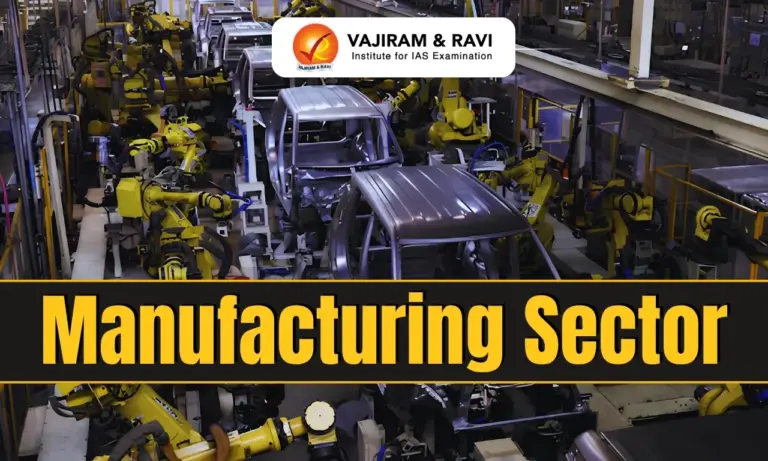
Manufacturing Sector Latest News
- NITI Aayog has released a report titled “Key Sectors to Position India as a Global Manufacturing Hub”, recommending cluster-based manufacturing, lower costs, and deeper domestic value addition across high-potential sectors.
Manufacturing Sector in India
- The manufacturing sector is a key component of India’s industrial base, encompassing activities that transform raw materials and intermediate goods into finished products.
- It includes sectors such as automobiles, pharmaceuticals, textiles, chemicals, electronics, machinery, food processing and metals.
- Contribution to the Economy
- According to the Economic Survey 2025-26, manufacturing’s share in India’s GVA has remained broadly stable at around 17-18% in real terms.
- The Survey notes that manufacturing’s share of real GDP has remained relatively steady despite fluctuations in its nominal share, while manufacturing’s gross value of output (GVO) has remained around 38%, highlighting its substantial role in overall economic activity.
- The latest national accounts also show that the broader secondary sector, comprising manufacturing, construction, electricity, gas, water supply and related utilities, accounted for 25.8% of India’s GVA in 2024-25 and grew by 8.0% in real terms during the year.
- Employment and Industrial Base
- Manufacturing is also an important source of non-farm employment.
- According to MoSPI’s Sustainable Development Goals indicator framework, manufacturing accounted for 11.44% of total employment in 2023-24, compared with 12.13% in 2017-18.


News Summary: NITI Aayog Report
- NITI Aayog has released the first volume of a study titled “Key Sectors to Position India as a Global Manufacturing Hub”.
- The report uses a structured, data-driven framework to identify sectors that can drive India’s ambition of becoming a global manufacturing powerhouse.
Scope of the Study
- The study shortlisted 12 sectors in which India can aspire to global leadership by 2047:
- Electronics, Telecommunications equipment, Solar photovoltaic, Pharmaceuticals, Chemicals, Automotive, Defence and drones, Steel, Capital goods, Textiles, Food processing, Leather and footwear
- This opening volume examines four of these in depth: chemicals, textiles, telecom and network equipment, and solar photovoltaic.
Methodology
- The study was structured into four phases:
- Phase 1: Shortlisting sectors based on market size and growth prospects in domestic and global markets.
- Phase 2: A three-pronged assessment of market potential, competitiveness, and strategic relevance.
- Phase 3: Benchmarking best practices from top-performing manufacturing countries.
- Phase 4: Developing sector-specific, actionable recommendations and a roadmap.
- The assessment considered factors such as market potential, infrastructure readiness, policy support, raw material availability, technology readiness, employment potential, and India’s current position in the value chain.
Sector-Wise Findings
- Chemicals
- The domestic chemicals industry is led by three consumption segments: petrochemicals and organic chemicals, specialty chemicals, and inorganic chemicals.
- Petrochemicals and organic chemicals form the largest segment.
- The report notes significant potential to enhance domestic value addition by expanding downstream production and improving feedstock utilisation. It identifies phenol, methanol, and acetic acid as priority products for import substitution.
- Reducing import reliance would help conserve foreign exchange, mitigate the impact of global price volatility, and ensure stable supply of essential chemicals.
- Textiles
- The textile and apparel sector is one of India’s most important manufacturing industries:
- Contributes approximately 2% to national GDP
- Accounts for 11% of manufacturing GVA
- Makes up 9% of merchandise exports
- Second-largest employer after agriculture, supporting more than 45 million people
- Exported textile products worth USD 37.7 billion in fiscal 2025
- Holds 4.1% of global textile and apparel exports, making India the sixth-largest exporter
- The report urges a strategic shift towards man-made fibre-led growth to reach $100 billion in exports by 2029-30.
- It flags that labour productivity in textiles remains significantly below the overall manufacturing average and calls for skilling through apprenticeships, industry-academia partnerships, safe and affordable accommodation for migrant workers near clusters, and voluntary certification for firms demonstrating ethical labour practices.
- The textile and apparel sector is one of India’s most important manufacturing industries:
- Telecom and Network Equipment
- India is the world’s second-largest telecommunications market with:
- More than 1.2 billion subscribers
- Approximately 85% telecom penetration
- Nearly 75% internet usage
- The National Telecom Policy 2025 targets doubling the sector’s contribution to GDP, doubling exports of telecom products and services, creating one million new jobs, and significantly increasing investment and R&D expenditure by 2030.
- Key priorities identified include deepening localisation, strengthening domestic component manufacturing, promoting joint ventures and technology transfer, developing integrated industrial clusters, and strengthening testing, certification, and skill development.
- India is the world’s second-largest telecommunications market with:
- Solar Photovoltaic
- India had installed 106 GW of solar capacity by March 2025 and needs to add about 174 GW to meet the 2030 target of 280 GW.
- The domestic PV market, estimated at Rs. 32,400 crore ($3.7 billion), is expected to grow at a 17-20% CAGR between fiscal 2023 and fiscal 2030, supported by utility-scale solar, rooftop solar, open-access projects, and green hydrogen-linked demand.
- A key concern flagged is export concentration; the US accounted for 97% of India’s solar module exports between 2019-20 and 2025-26, representing heavy dependence on a single geography.
- The report recommends moving upstream into polysilicon and wafers and broadening the export base.
Cross-Cutting Recommendations
- Across the sectors examined, the report recommends:
- Cluster-based manufacturing with integrated industrial parks offering shared utilities, infrastructure, and efficient approvals to build scale and lower costs
- Reducing import dependency through targeted incentives and viability gap funding
- Deepening domestic value addition across the chain
- Promoting joint ventures and technology transfer
- Raising labour productivity through skilling and technology adoption
- Diversifying export markets while negotiating balanced free trade agreements
Emphasis on Profitability and Private Investment
- NITI Aayog Vice-Chairman Ashok Lahiri made a notable observation on the approach India should adopt.
- He stated that India is not attempting to match Chinese scale directly, but that economies of scale and scope remain very important. He argued that most investment must come from the private sector, with the government’s role being to remove impediments.
- Crucially, he emphasised that investment will come only when there is profit. He added that the objective is not simply to increase manufacturing’s share of GDP, but to build productive capacity and expand India’s presence in global markets.
- This marks a shift in framing, from targeting a headline GDP share to focusing on commercial viability and competitiveness as the drivers of manufacturing growth.
Significance
- It provides a structured, evidence-based framework for prioritising manufacturing sectors rather than dispersing effort across all industries.
- It shifts emphasis from subsidy-led growth to profit-led investment, recognising that sustainable manufacturing requires commercial viability.
- It highlights cluster development as a practical route to scale, addressing India’s long-standing fragmentation problem.
- It flags export concentration risks, particularly in solar, where dependence on a single market creates vulnerability.
- It links manufacturing directly to employment generation for India’s young workforce.

 Last updated on Oct, 2026
→ UPSC 2027 Notification will be released on 13 January 2027 at upsconline.nic.in.
→ Check Nobel Prize 2026 Winners List here.
→ Download PIB PRiSM Monthly Magazine 2026 here.
→ Check UPSC Monthly Current Affairs Magazine The Recitals here.
→ Check out the latest UPSC Syllabus here.
→ Download UPSC Model Answers for Mains 2026
→ UPSC Mains Question Paper 2026 is out now for Essay & GS Paper 1, 2, 3 & 4.
→ UPSC Calendar 2027 has been released.
→ Enroll in Vajiram & Ravi’s UPSC Mains Test Series 2027 for structured answer writing practice, expert evaluation, and exam-oriented feedback.
→ Join Vajiram & Ravi’s UPSC Mentorship Program 2027 for personalized guidance, strategy planning, and one-to-one support from experienced mentors.
→ Go through the UPSC Mains Previous Year Papers to enhance your preparation.
→ UPSC has released UPSC Toppers List 2025 with the Civil Services final result on its official website.
→ Also check Best UPSC Coaching in India
Manufacturing Sector FAQs
Q1. What is the title of the NITI Aayog report on manufacturing?+
Q2. How many sectors has NITI Aayog shortlisted for global leadership by 2047?+
Q3. What is the contribution of the textile sector to India's economy?+
Q4. What is India's current solar capacity and 2030 target?+
Q5. What is the report's main structural recommendation for manufacturing?+
Tags: mains articles manufacturing sector upsc current affairs upsc mains current affairs