About Metal-air batteries:
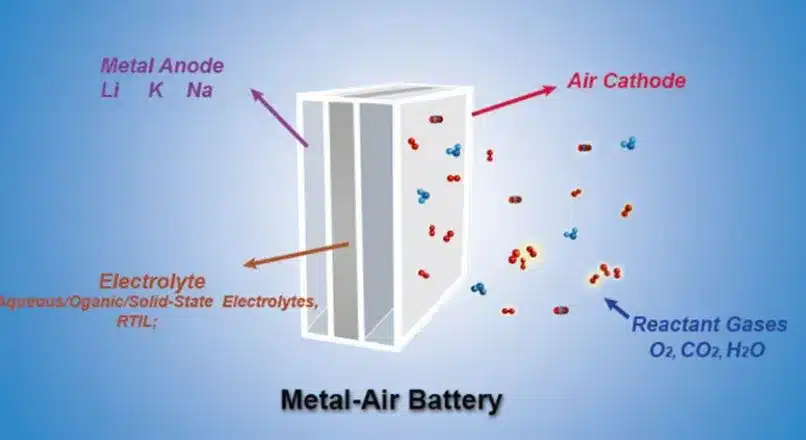
- It is an energy storage system based on electrochemical charge/discharge reactions that occur between a positive “Air Electrode” (cathode) and a negative “Metal Electrode” (anode).
- The negative electrode is typically made of metals such as Li, Zn, Al, Fe, or Na, while the positive usually contains some form of porous carbon material and a catalyst.
- Advantages :
- These batteries have higher energy density than a lithium-ion battery.
- Accessibility: Metal-air batteries use readily available metals in India, making them more accessible than lithium-ion batteries.
- Cost-Effective: Producing these batteries locally reduces imports.
- Environment-Friendly: Metal-air batteries are recyclable, offering a safer alternative to lithium-ion batteries that pose environmental hazards.
- Lightweight: Metals like aluminum are lightweight and can provide comparable or even higher energy density than lithium-ion batteries, making them an attractive choice.
- Applications: Due to their high scalability and energy density, M-Air batteries can be used in a large variety of applications:
- It is used in large-scale stationary energy storage applications
- Transportation
- Renewable generation
Q1: What is Lithium?
It is a chemical element with the symbol Li and atomic number 3. Classified as an alkali metal, lithium is a solid at room temperature. It is the lightest of the solid elements. It is soft, white, and lustrous. It reacts vigorously with water.
Source: Durable efficient battery for energy solutions in remote sub-zero conditions


 Last updated on Oct, 2026
→ UPSC 2027 Notification will be released on 13 January 2027 at upsconline.nic.in.
→ Asian Games 2026 are being held in Aichi-Nagoya, Japan, from 19 September to 4 October.
→ Check Nobel Prize 2026 Winners List here.
→ Download PIB PRiSM Monthly Magazine 2026 here.
→ Check UPSC Monthly Current Affairs Magazine The Recitals here.
→ Check out the latest UPSC Syllabus here.
→ Download UPSC Model Answers for Mains 2026
→ UPSC Mains Question Paper 2026 is out now for Essay & GS Paper 1, 2, 3 & 4.
→ UPSC Calendar 2027 has been released.
→ Enroll in Vajiram & Ravi’s UPSC Mains Test Series 2027 for structured answer writing practice, expert evaluation, and exam-oriented feedback.
→ Join Vajiram & Ravi’s UPSC Mentorship Program 2027 for personalized guidance, strategy planning, and one-to-one support from experienced mentors.
→ Go through the UPSC Mains Previous Year Papers to enhance your preparation.
→ UPSC has released UPSC Toppers List 2025 with the Civil Services final result on its official website.
→ Also check Best UPSC Coaching in India